In a link exchange, website owners agree to link to one another's sites. It can help SEO when the sites share a subject and the exchange stays small. It can hurt when links are swapped in bulk between sites that have nothing in common, because Google's spam policies list excessive link exchanges as an example of link spam.
This guide explains the kinds of link exchange, what Google's policy says, how to judge a swap before you agree to it, and how to run one by hand.
What Is a Link Exchange?
In a link exchange, two or more site owners agree to place links to one another. Neither owner pays the other. Each owner gives a link and gets a link.
People exchange links for two reasons. The first is readers: a link from a site on the same subject can send visitors who already care about your topic. The second is search: a link from another site is one of the signals search engines use to judge a page.
The second reason is where the trouble starts. A link that exists only to move rankings is what search engines try to discount.
Types of Link Exchange
Reciprocal link exchange
Two sites link to each other. This is the oldest form and the easiest to arrange. It is also the easiest to spot, because the two links point straight at each other.
Three-way (ABC) link exchange
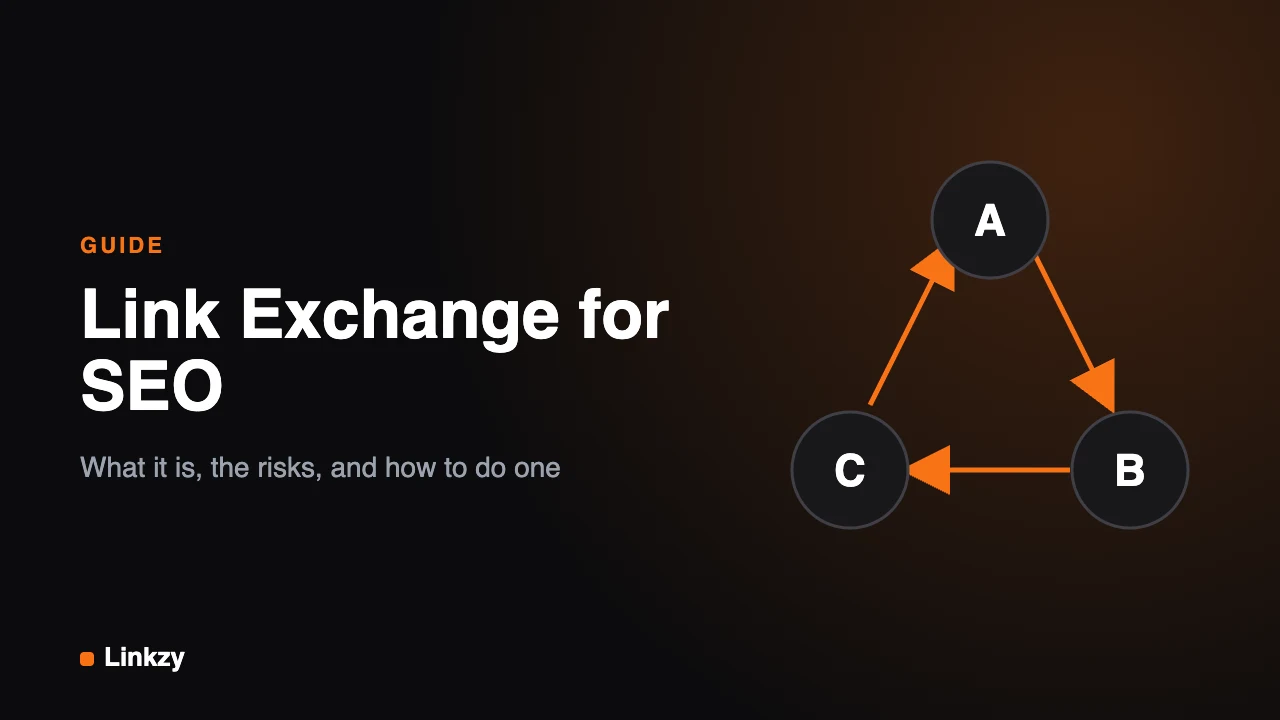
Three sites take part. Site A links to site B, site B links to site C, and site C links to site A. Every site gives one link and gets one, but no two sites link to each other. You will also see this called a 3-way link exchange or an ABC link exchange.
Guest post swaps
Two owners write an article for each other's site, and each article carries a link back to its author's site. The exchange is the same; the link arrives inside a new article instead of an existing one.
Link exchange groups and lists
Forums, chat groups and "link exchange sites" lists bring together owners who want to swap. They make finding partners fast. They also make it easy to swap with far too many sites, which is how an exchange becomes excessive.
What Google Says About Link Exchanges
Google's spam policies define the problem this way: "Link spam is the practice of creating links to or from a site primarily for the purpose of manipulating search rankings."
The policy then lists examples. Three matter for anyone thinking about an exchange:
- "Excessive link exchanges ('Link to me and I'll link to you') or partner pages exclusively for the sake of cross-linking"
- "Buying or selling links for ranking purposes", which includes exchanging money, goods or services for links
- "Using automated programs or services to create links to your site"
Two things follow. The example says "excessive" link exchanges. It does not say every exchanged link is spam, and it gives no number for where excessive begins. And the test is purpose. A link placed mainly to manipulate rankings is the target, whoever arranged it and however it was placed.
Nobody outside Google can tell you how a particular link will be treated. Any exchange carries some risk, and you are the one who decides whether to take it.
When a Link Exchange Makes Sense
Ask these questions before you agree to a swap.
- Would you link to this site anyway? If the page is useful to your readers, the link has a reason to exist beyond the swap.
- Do the two sites share a subject? A link between a bakery blog and a baking-supplies shop makes sense to a reader. A link between a bakery blog and a casino does not. See why niche relevance matters.
- Is the other site real? Look for original articles, a named owner and signs of an audience. A site that exists mainly to carry links is a poor partner.
- Where will the link sit? A link inside a relevant paragraph is better than one on a "partners" page or in a footer.
- How many swaps are you doing? A handful with sites in your field is one thing. Exchanges as your main source of links is another.
How to Do a Link Exchange by Hand
- List sites in your field. Start with sites you already read, suppliers, partners and writers who cover your subject. Leave direct competitors out; they have little reason to help you.
- Pick the page on each side. Choose an existing article on your site where a link to them would help the reader, and the page of yours that fits one of their articles.
- Write a short, plain request. Say who you are, which of their articles you would link from and to, and why it helps their readers. Our guide to pitching editors for backlinks covers the wording.
- Agree the details. Settle which pages, where in the text, and the words used for the link. Keep the wording natural; repeating one keyword-heavy phrase on every link looks unnatural. See how to choose anchor text.
- Place the link and check theirs. Add your link, then confirm theirs is live and points to the right page.
- Keep a record. Note the date, the two pages and the contact. Check the links again every few months, because pages get edited and links disappear.
For a three-way exchange the steps are the same, with a third owner and one more link to check.
Link Exchange Mistakes to Avoid
- Swapping with unrelated sites. A link that makes no sense to a reader is hard to explain as anything but a ranking link.
- Building a "partners" or "links" page. Google's policy names partner pages made only for cross-linking.
- Doing too many, too fast. A sudden run of swapped links looks nothing like links earned over time.
- Using the same keyword phrase for every link. Vary the wording and let some links use your brand name.
- Paying the other site for the link. Money, goods or services given to a site owner for a link fall under the policy's buying and selling example.
- Relying on exchanges alone. Useful content, mentions and links you did not ask for should make up most of your profile. Our list of link building mistakes covers the wider picture.
Link Exchanges and Other Ways to Build Links
An exchange is one method among several. Guest posts, digital PR, broken link building and content that earns links by being useful all sit beside it, and each has its own cost in time or money. The beginners guide to link building walks through them.
The fair way to think about an exchange is as a small part of the mix: a few links with sites you would be glad to send your readers to.
How Linkzy Fits In
Linkzy places relevant links between websites in the same or a closely related niche. You add your site, approve access once, and links are placed for you. It works with WordPress and with sites deployed from GitHub. Sites are grouped in rings of three, so your site hosts a link to a different member, never to the site that links to you. The Free plan gives up to 4 links a month, and Pro is $19 a month for up to 8. On every plan your site hosts one link for each link it receives.
That is a three-way link exchange, so everything in this guide applies to it too, including what Google's policy says. Linkzy cannot promise how any search engine will treat its links. The how it works page shows the ring and the limits in full.
FAQs
Is a link exchange bad for SEO?
Not by definition. Google's spam policies name "excessive" link exchanges as link spam. A few links between sites on the same subject, placed where they help readers, are a different thing from bulk swaps between unrelated sites. No one outside Google can promise how a given link will be treated.
What is an ABC link exchange?
It is a three-way exchange. Site A links to site B, site B links to site C, and site C links to site A. Each site gives one link and gets one, and no two sites link directly to each other.
What is the difference between a reciprocal and a three-way link exchange?
In a reciprocal exchange two sites link to each other. In a three-way exchange three sites link in a circle, so the site you link to is not the site that links to you.
Are free link exchange sites worth using?
They can help you find partners, but judge every partner on its own. Check that the site covers your subject, publishes original content and would be worth linking to even without the swap.
How many link exchanges are too many?
Google's policy gives no number. A sensible rule is to keep exchanges a small share of your links and to make each one with a site in your own field.