How to Pitch Content Editors for Backlinks
How to Pitch Content Editors for Backlinks
Backlinks are crucial for improving search rankings and driving traffic to your website. To secure them, you need to build strong relationships with content editors through highly personalized and strategic outreach. This guide covers the essentials:
- Why Backlinks Matter: They boost SEO by signaling expertise and authority to search engines like Google.
- Challenges in Outreach: Only 22% of cold emails are opened, and response rates can be as low as 1-3%.
- Key Steps for Success:
- Research target publications and editors using tools like Semrush or Hunter.
- Personalize your pitch by referencing the editor's work and aligning with their audience.
- Use concise, clear subject lines and avoid links in your initial email.
- Follow up strategically, as most responses come after multiple attempts.
- Building Long-Term Relationships: Thank editors, share their content, and offer ongoing value to maintain connections.
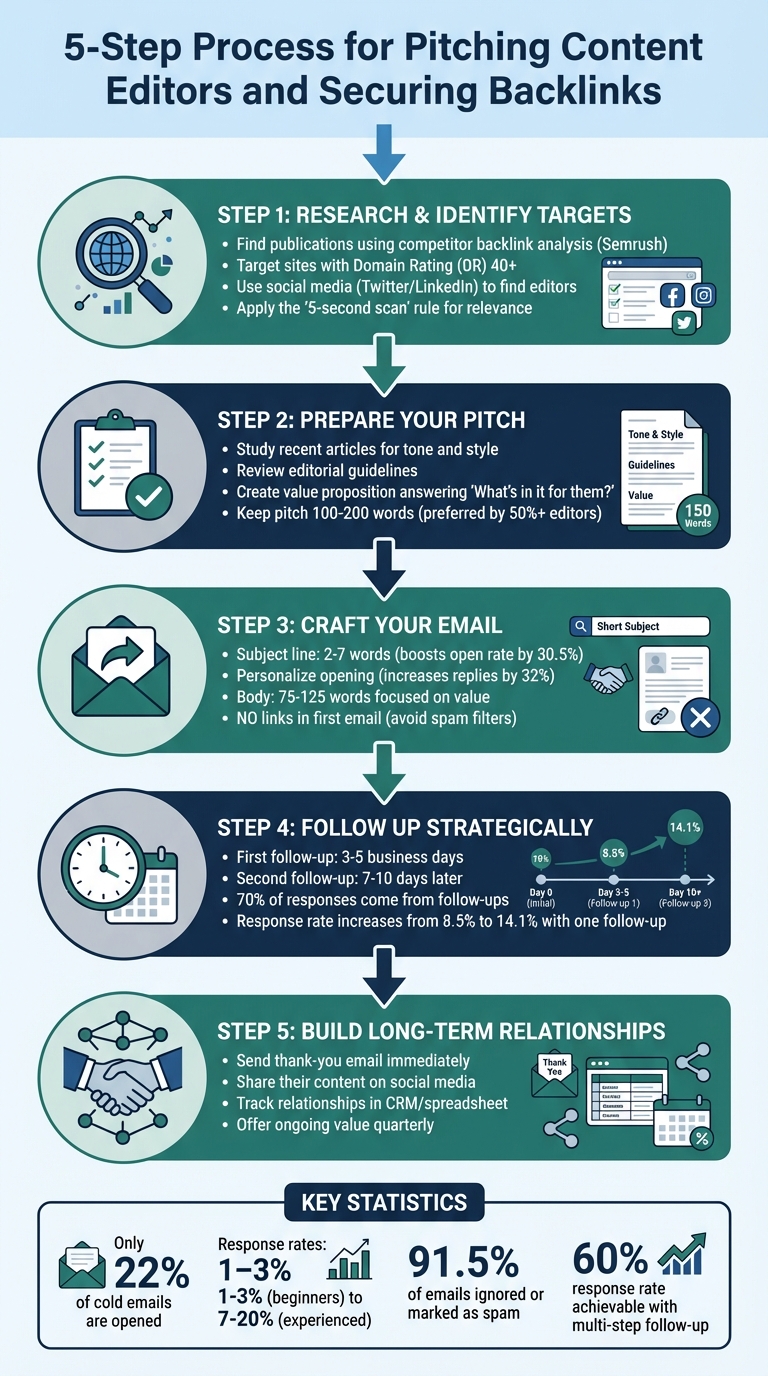
5-Step Process for Pitching Content Editors and Securing Backlinks
How To Pitch Publications For Backlink Opportunities?
sbb-itb-0f47b19
Research and Preparation Before Pitching
Before you hit "send" on that pitch email, take the time to do your homework. Editors are inundated with pitches - anywhere from 50 to 500 every week [4] - and irrelevant ones are quickly dismissed [6]. A well-researched pitch, on the other hand, grabs their attention and opens the door to meaningful conversations. To get there, you’ll need to identify the right contacts, study their content, and craft a clear value proposition.
Find Target Publications and Editors
Start by looking at where your competitors are getting backlinks. Tools like Semrush can help you analyze their backlink profiles [1][5]. These sites are already interested in similar content, making them great targets for your outreach. If SEO is your priority, focus on publications with a Domain Rating (DR) of 40 or higher to ensure the backlink carries enough authority [2].
Social media is another goldmine for finding editors and journalists. Use platforms like Twitter and LinkedIn to search for terms like “[your keyword] editor” or “[your keyword] journalist” [5]. Janet Murray, a PR and content expert, suggests creating a Twitter list of journalists from your target publications. Check in daily to see what they’re discussing [5]. Google News can also help - search for industry-related keywords to find blogs or news sites, then pinpoint the journalists covering those topics [5].
If you’re just starting out, free tools like Hunter (which offers 25 free searches per month) or trial services like Prowly and Respona can be incredibly helpful [4][5]. Apply the "5-second scan" rule when evaluating publications: if it’s not immediately clear how they align with your content, move on [2]. By focusing on relevant outlets, you’re setting the stage for authentic, long-term relationships with editors.
Review Editorial Guidelines and Content
Once you’ve identified potential publications, dig into their content. Check when a journalist last published to ensure they’re still active before reaching out [7]. Study recent articles to understand the publication’s tone, style, and the types of sources they use [7]. This insight is key to customizing your pitch.
"Just make sure the pitch is relevant to the writer and actually something the writer would consider doing."
"Show me what your pitch has to do with my beat. Show me why your pitch is helpful/interesting to my readers."
- Lauren Orsini, Tech Reporter [7]
These insights underline the importance of aligning your pitch with the publication’s audience. Your content should offer real value to their readers - not just serve as a promotional tool [4]. Keep in mind that over half of editors prefer pitches that are concise, ideally between 100 and 200 words [4].
Pay attention to how headlines are written as well. If you can match the journalist’s headline style in your subject line, you increase the chances of it being used as the final article title [7].
"It's imperative to do your research to make sure you are emailing the right person for what you're looking for."
- Natt Garun, Editor at The Next Web [7]
By thoroughly understanding a publication’s style and focus, you’ll be better equipped to craft a pitch that resonates.
Create a Clear Value Proposition
Your value proposition should answer a simple but critical question: What’s in it for them? [3]. Editors aren’t interested in your SEO goals - they care about delivering quality content to their readers.
"Journalists want quotes they can immediately copy and paste into their articles, no changes needed."
Make their job easier by providing ready-to-use quotes.
Strong value propositions often include offering something tangible, like a reciprocal link (through an A-B-C exchange), product samples for review, or even promoting the editor’s content to a broader audience [3]. Avoid weak incentives like basic social media shares or newsletter mentions; they don’t hold much weight with high-authority editors [3].
When crafting your pitch, start with a strong subject line. A good formula to follow is: [Your credentials] + [specific value] + [topic] [2]. Include a one-line credibility builder that highlights your title, company, or a noteworthy accolade to establish trust right away [2].
Laying this groundwork ensures your pitch is not only well-targeted but also genuinely valuable to the recipient.
How to Write an Effective Pitch Email
With only about 22% of cold emails getting opened [3], your pitch email needs to grab attention the moment it lands in an editor's inbox. The key? A strong subject line, a personalized opening, and a clear, concise structure.
Write a Clear Subject Line
Your subject line's job is simple: get the editor to open your email. Keep it short - 2 to 7 words - so it doesn’t get cut off in mobile inboxes [3]. Adding a personal touch, like the recipient's name or website, can boost open rates by up to 30.5% [3].
Here’s a formula to try: [credentials] + [specific value] + [topic]. For example, instead of writing "Guest Post Opportunity", go with something like "NYU Researcher: New Data on Remote Work Trends." A specific subject line shows your email isn’t part of a mass blast.
For a more personal feel, start your subject line with a lowercase letter. Avoid clickbait phrases like "I’ve got something for you", which can come across as spammy and are likely to get your email deleted [8].
Once your subject line does its job, the opening should prove you’ve done your homework.
Personalize Your Opening
Generic greetings can kill your credibility. Address the editor by name, and reference something specific they’ve worked on. Mention a recent article, a stat they shared, or a case study they highlighted [3]. This shows you’ve taken the time to research them, rather than using a generic template.
Emails with personalized details get about 32% more replies [4]. Keep your personalization professional - stick to their published work, industry achievements, or other relevant contributions.
Pay attention to details. Use the company’s proper name. For example, if they go by "SpyFu", don’t write "Spyfu.com" [8]. Also, make sure formatting is consistent when pasting personalized info into your email. Mismatched fonts or sizes scream "form letter" [8].
Organize Your Pitch Properly
After a personalized opening, structure your pitch to make it easy to read and impactful. Editors prefer pitches that are 75–125 words long and get straight to the point [3][4].
Here’s a simple structure:
- Start with a one-line intro that establishes your credibility.
- Follow with 2-3 sentences outlining your content idea and why it benefits their readers (not your SEO goals).
- End with a direct, low-pressure call to action. Instead of asking for a meeting - which can feel pushy [3] - ask something like, “Would this fit your editorial calendar?”
Skip links in your first email; they often trigger spam filters [3]. If you need to reference a URL, just type the domain name without the "https://", or wait until they show interest. And never criticize their current content - like pointing out broken links. Instead, highlight how your pitch adds a fresh perspective or unique angle [8].
| Email Element | Best Practice | Why It Matters |
|---|---|---|
| Subject Line | 2-7 words, personalized | Boosts open rates by 30.5% [3] |
| Opening | Reference specific work | Shows you’ve done your research |
| Body | 75-125 words, focused on value | Respects their time, improves response rates |
| Links | Avoid in the first email | Reduces the chance of hitting spam filters [3] |
"A good pitch is clear, concise, and to the point; you want the reader to know exactly what you're pitching and why they want to keep reading."
- Farzad Rashidi, Respona [4]
Keep your tone conversational and approachable, as if you were emailing a colleague. Too much formal, corporate language can make your pitch feel impersonal and templated.
Following Up and Building Editor Relationships
Did you know that only 30% of link-building responses come from your initial pitch? The real magic happens in the follow-ups, which account for the majority of backlinks secured [9]. Without these follow-ups, you risk leaving most of your opportunities on the table. Beyond just pitching, building strong relationships with editors is essential for long-term success.
When and How Often to Follow Up
Timing is everything when it comes to follow-ups. After sending your initial pitch, wait 3–5 business days before following up to give editors enough time to review your content [3]. If your content is time-sensitive, such as tied to a trending topic, shorten this window to 2 days [9].
Still no response? Send a second follow-up 7–10 days later [3][9]. Make this your final check-in and include a soft deadline, such as “Submission deadline: tomorrow” [3]. If you’re still met with silence, try reaching out to someone else in the organization, like a content manager or marketing director [9].
Here’s a real-world example: In 2024, Sujan Patel, Founder of Mailshake, ran an outreach campaign for a Pandadoc article titled "top sales blogs." By using a multi-step follow-up process and contacting secondary editors when the primary ones didn’t respond, his campaign achieved a 60% response rate. This approach earned over 20 high-quality backlinks and helped the article rank in the top 4 for the keyword “sales blogs” [9].
| Follow-up Type | Suggested Timing | Purpose |
|---|---|---|
| First Follow-up | 3–5 Business Days | Gentle reminder [3] |
| Second Follow-up | 7–10 Days | Final check-in with urgency [3][9] |
| Post-Win Follow-up | Immediate | Thank-you note; share the live link [1] |
| Relationship Nurture | Quarterly | Offer new data or ideas without asking for a link [2] |
Provide Ongoing Value
Once you’ve secured a backlink, don’t let the relationship end there. Transform it into a long-term connection. Start by sending a thank-you email and sharing their article on your social media channels right away [1]. You can also offer to update their content in the future or introduce them to other trusted experts in your network [2].
To keep things organized, track your relationships with editors in a spreadsheet or CRM. Record details like contact dates, their areas of expertise, and past collaborations [2][10]. This system helps you tailor future pitches, making them more relevant and increasing your chances of landing even bigger opportunities.
Sujan Patel highlights that maintaining relationships with editors and content creators is one of the best ways to secure lasting value [9]. By offering ongoing support and staying top of mind, you’ll build a network that continues to pay off in the long run.
Tools That Simplify Backlink Building
Relying on manual outreach for backlinks can feel like a losing battle. With response rates hovering below 1%, it’s a time-consuming process that’s tough to scale - especially for marketers juggling multiple tasks[15].
How Linkzy Can Help
Enter Linkzy, a platform designed to take the hassle out of backlink building. From finding prospects to following up, Linkzy automates the entire process. All you need to do is choose your niche, add a tracking snippet, and let the AI handle the rest. The result? High-quality, contextual backlinks placed on real user websites, all while maintaining a natural, search-friendly growth pattern.
Whether you’re using WordPress, Shopify, or another platform, Linkzy has you covered. It offers three pricing tiers to fit different needs:
- Free Plan: Includes 3 credits, no credit card required.
- Starter Plan: $19/month for 5 credits.
- Pro Plan: $29/month for 15 credits and priority support.
Each credit secures a niche-specific backlink, ensuring relevance and topical authority for your site. Unlike generic high-authority links, this targeted approach aligns with the challenges of scaling backlinks effectively[13].
Why Automation Works for Backlink Building
Automation doesn’t just save time - it’s a game-changer for efficiency. For example, with 91.5% of emails either ignored or flagged as spam[11], automation tools help ensure your outreach efforts actually reach editors.
"Automation enables sales teams to focus more on high-value activities and less on repetitive tasks." – Serena Miller, Editor, Sales Best Practices at Outreach[15]
Modern tools come equipped with features like email warmup and mailbox rotation, which improve deliverability and keep your messages out of spam folders[14]. This is crucial because high bounce rates (anything over 2.8%) can harm your sender reputation[15].
In addition to improving email success rates, automation keeps your backlink-building efforts consistent. By maintaining a steady flow of placements on an optimized schedule, these tools create the natural growth patterns that Google favors. This eliminates the unpredictable spikes and dips that often plague manual campaigns.
Conclusion
Successful backlink pitching hinges on thorough preparation, genuine personalization, and building meaningful connections. By combining detailed research, customized messaging, and consistent follow-ups, you create a winning strategy. For instance, emails with personalized body text see 32% more replies [4], while personalized subject lines can increase open rates by about 30.5% [3]. These small but impactful adjustments can determine whether your pitch lands in an editor's inbox or ends up in the spam folder.
Final Tips for Better Pitches
To elevate your outreach game, keep these additional tips in mind. Track your outreach efforts - monitor editor responses, topics, and follow-up dates to transform initial cold pitches into long-term relationships [2]. Stay persistent but respectful; sending a single follow-up email 3–5 days after your first pitch can boost response rates from 8.5% to 14.1% [4]. However, if you don’t hear back after two follow-ups, it's best to move on to protect your sender reputation.
As you refine your strategy, keep in mind that outreach is a learning process. If you're just starting, response rates might hover around 1–3% [2]. With experience and improved targeting, seasoned professionals often achieve rates between 7% and 20% [2]. As Vince Nero, Director of Content Marketing at BuzzStream, wisely shares:
"Developing relationships with bloggers, journalists, and site owners increases the likelihood that they might feature my content again!" [12]
Next Steps for Growing Your Backlink Strategy
With a solid foundation in place, it’s time to take your backlink outreach to the next level. Focus on high-authority websites (DR 40+) and craft concise, value-packed pitches that are no more than 100–200 words [2][4]. Leverage the C.H.A.M.P. method, ensuring your emails are Concise, Human, Authoritative, Value-Driven, and Personalized [12].
If manual outreach feels too time-consuming or you’re looking to scale faster, tools like Linkzy can help automate the process. The goal is to strike the right balance - use personal outreach to build strong, strategic relationships while relying on automation for consistent, scalable growth.
FAQs
How can I personalize my pitch to content editors effectively?
To make your pitch truly resonate, take the time to customize your message for the specific editor you're reaching out to. Address them by name, mention recent articles they've written, or point out a topic they've covered. This demonstrates that you've done your homework and understand their audience and writing style.
Steer clear of generic, cookie-cutter messages. Instead, craft a pitch that offers clear value and aligns with their interests. Even something as simple as a personalized subject line can boost the chances of your email getting noticed. The ultimate aim? Establish a genuine connection and show that your proposal is thoughtful and relevant.
What’s the best way to follow up after pitching a content editor?
The art of a successful follow-up lies in finding the sweet spot between persistence and respect. After sending your initial pitch, wait about 5–7 days before reaching out again with a friendly and professional follow-up email. This timing keeps you on their radar without making you seem overly insistent.
When crafting your message, aim to keep it short and focused. Gently remind them of your earlier pitch, highlight the value you’re offering, and acknowledge that their schedule is likely packed. To make your email stand out, consider adding a personal touch - mentioning their recent work or referencing something specific to their interests can go a long way in grabbing their attention.
The combination of consistency and personalization is key. A well-thought-out follow-up can often transform silence into a chance for meaningful collaboration.
Why is it important to build lasting relationships with content editors?
Building strong connections with content editors is key to creating trust and reliability. When editors trust you, they’re far more likely to engage with your pitches and work with you regularly. These relationships can make your content stand out as relevant and valuable, boosting your chances of securing backlinks and consistent media coverage.
By taking the time to understand each editor’s preferences and guidelines, you can tailor your outreach to be more effective and personal. These relationships also play a vital role in maintaining a steady link-building strategy, which helps improve your site’s authority and search engine rankings over time. Putting effort into these connections builds a network of reliable partners who are open to future collaborations and content-sharing opportunities.