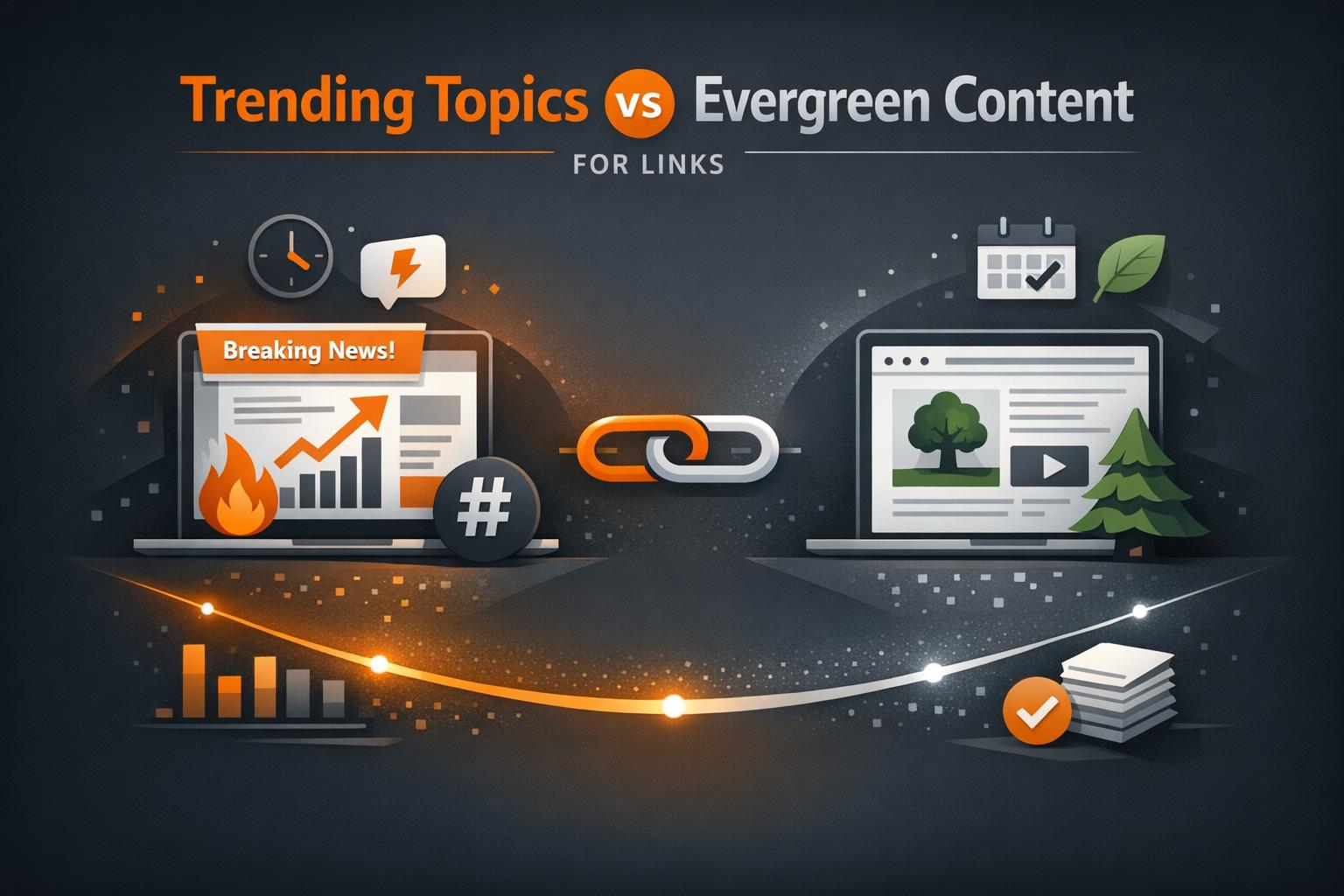
Trending Topics vs Evergreen Content for Links
Trending Topics vs Evergreen Content for Links
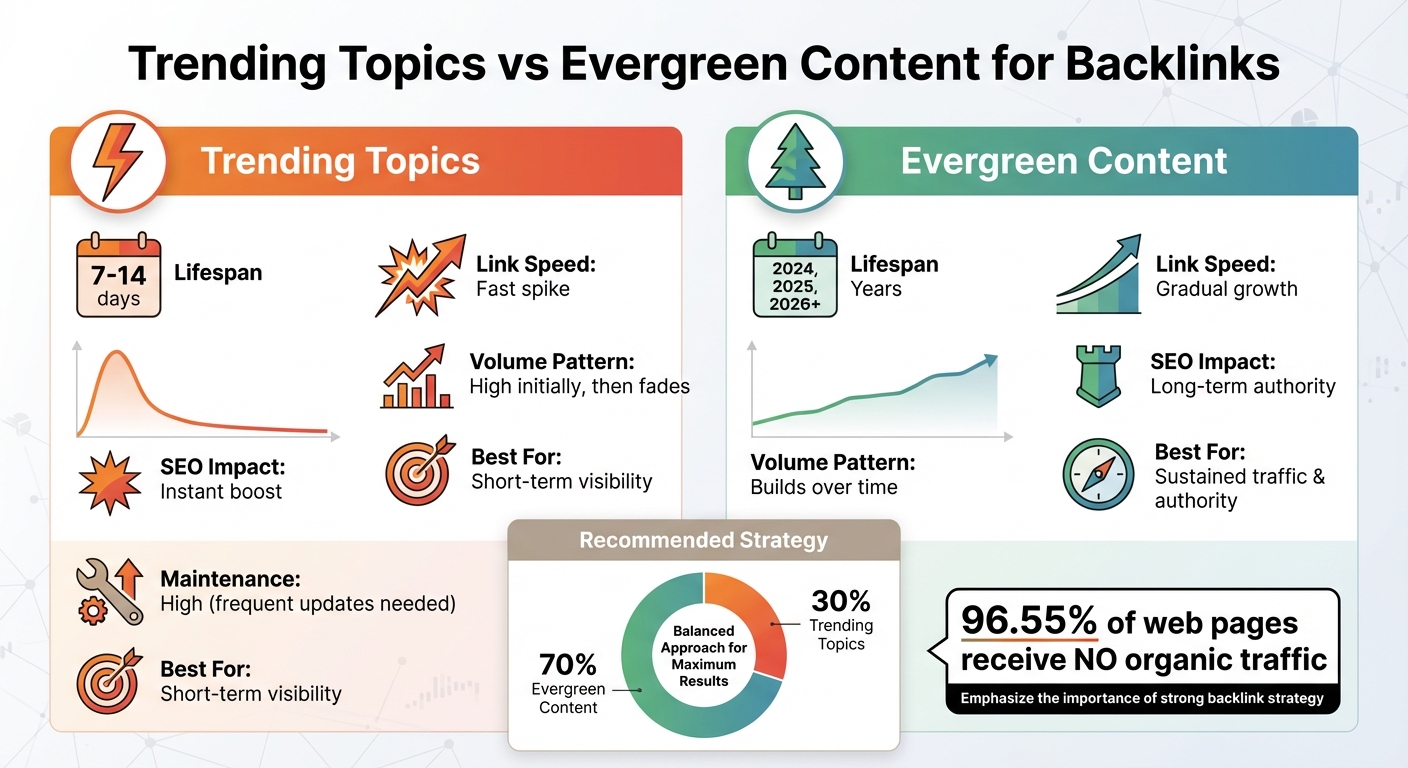
When deciding between trending topics and evergreen content for building backlinks, the choice depends on your goals. Here's a quick breakdown:
- Trending Topics: Focused on current events or viral trends, they generate a quick surge in backlinks but lose relevance fast - usually within 7–14 days. Ideal for short-term visibility.
- Evergreen Content: Timeless resources like how-to guides or industry statistics steadily attract backlinks over months or even years. Great for long-term authority and consistent traffic.
Key Points:
- Trending topics offer immediate results but require speed and relevance to succeed.
- Evergreen content grows backlinks slowly but remains valuable over time.
- A balanced strategy (e.g., 70% evergreen, 30% trending) can maximize both short-term gains and long-term benefits.
Quick Comparison:
| Metric | Trending Topics | Evergreen Content |
|---|---|---|
| Lifespan | Days to weeks | Years |
| Link Acquisition Speed | Fast | Gradual |
| Total Backlink Volume | High initially, fades | Builds over time |
| SEO Impact | Instant boost | Long-term authority |
| Maintenance | High (frequent updates) | Low (occasional updates) |
Trending Topics vs Evergreen Content: Backlink Strategy Comparison
Backlink Potential of Trending Topics
Fast Backlink Spikes
Trending topics thrive on newsjacking - crafting content that aligns with current events, industry news, or viral conversations to grab quick attention [4][5]. Getting in early on a trending topic can attract backlinks from journalists, bloggers, and industry websites eager to report on the latest developments. For example, moments like algorithm updates, new tool launches, or major industry announcements often spark a flurry of activity [4][8].
Timing is everything. Even a slight delay can mean missing out on the opportunity to ride the wave [5][8]. Take Google’s algorithm updates, for instance. The first detailed analyses published after such announcements usually secure the majority of early backlinks [4]. This creates a rapid surge in backlinks, temporarily boosting a site's authority and visibility. That said, these spikes are often short-lived.
Short Lifespan of Relevance
The same factors that drive the initial surge in backlinks also contribute to their quick decline. Trending topics are tied to news cycles and current events, meaning their relevance fades fast [5]. Search engines, which prioritize fresh content using "Temporal Signals", tend to reduce visibility once the buzz dies down [9].
For example, articles with current-year titles like "Top AI Tools in 2025" tend to perform well initially but have limited staying power, with a median evergreen value of just 33 [3]. Similarly, podcast episodes are 4.28 times less likely to maintain relevance over time compared to list-style posts. Content that thrives on platforms like Twitter - focused on real-time updates - rarely supports long-term backlink growth [3].
Examples of Trending Topics
Trending topics include events like Google’s algorithm updates, which trigger SEO sites to publish quick analyses. For instance, when Google rolled out a major update in March 2025, early detailed articles gained a rapid influx of backlinks. However, as the news cycle moved on, this momentum quickly faded [4][1].
Social media trends also create temporary backlink opportunities. When a viral TikTok or Instagram trend emerges, blogs and news outlets rush to cover it, generating a wave of backlinks [8]. Similarly, seasonal topics like "holiday marketing strategies for 2025" or "tax tips for 2025" see a spike in backlinks during their peak relevance but lose traction once the season ends [4][1][8].
In short, while trending content can deliver quick wins in visibility and backlinks, its benefits are often fleeting and tied to the moment.
Evergreen Content's Long-Term Backlink Strategy
Consistent Backlink Growth
Evergreen content stands out for its ability to generate backlinks steadily over time, unlike trending topics that often lead to short-lived spikes. Instead of experiencing a sharp rise and a quick drop-off, evergreen pieces gradually build backlinks as bloggers, journalists, and researchers continue to discover and reference them [6][10]. This creates a snowball effect, where traffic and backlinks grow consistently over time [7].
Take the example of Brainlabs' "Content Strategy Guide." First published in 2014 and updated in 2019, this guide had amassed over 63,000 page views by August 2020. In contrast, a time-sensitive article on platform updates garnered 16,500 views in its first month but saw its traffic drop off quickly. The evergreen guide, however, continued to bring in traffic and backlinks for six years and counting [7]. This illustrates how evergreen content remains a valuable resource long after its initial publication.
"Evergreen content is awesome Link Bait. An evergreen article can get backlinks years after it first goes live." - Brian Dean, Founder, Backlinko [6]
In addition to backlink growth, evergreen content consistently serves its audience over time.
Timeless Value for Readers
Evergreen content isn’t just about steady backlink growth - it’s also about staying relevant to readers. Its timeless nature ensures it remains a go-to resource, making it a natural candidate for backlinks [6][10]. Websites often link to evergreen pieces because they serve as reliable, long-term references, unlike fleeting news articles [11].
By targeting keywords with stable or growing search volumes, evergreen content continues to attract new visitors, many of whom may link to it as a resource [6][10]. These pieces often act as "pillar pages", offering foundational information that supports internal linking and attracts external citations as authoritative guides [11]. Research shows that articles with titles featuring words like "data", "reports", "study", "science", or "research" tend to score higher on evergreen metrics [3].
"Quality evergreen content naturally attracts backlinks as other sites reference your comprehensive resources. These links continue accumulating over time, strengthening your domain authority." - Entail Staff, Entail AI [11]
Examples of Evergreen Content
Some content formats are particularly effective for evergreen strategies:
- How-to guides and list posts: These formats are highly shareable and often remain relevant for years. For instance, Backlinko's "SEO Copywriting" list post continued to attract significant traffic and backlinks three years after its publication. Research shows that list posts are 15 times more likely to achieve evergreen status than other formats like presentations [6][3].
- Industry statistics and research: Data-driven content performs exceptionally well because it provides specific, actionable insights that others can cite. A study of 3.6 billion articles revealed that "best of" lists, guides, and research-based content are among the most likely to achieve evergreen status [3]. Including original data or unique findings makes these pieces especially link-worthy [10].
- Comprehensive guides: These pieces maintain their value with regular updates. For example, HubSpot's "How to Start a Blog", first published in 2013, remains one of their top-performing evergreen assets. By periodically updating technical details while keeping the core advice intact, the guide has stayed relevant for over a decade. Regular updates - every 6 to 12 months - are essential to keeping evergreen content fresh and maintaining a steady flow of backlinks [6][11].
Trending Topics vs Evergreen Content: Direct Comparison
Comparison Table: Backlink Metrics
When it comes to SEO, trending topics and evergreen content serve very different purposes. The table below breaks down key backlink metrics for both, helping you understand their unique strengths.
| Metric | Trending Topics | Evergreen Content |
|---|---|---|
| Lifespan | Days to weeks (fleeting) [2] | Years (timeless) [1] |
| Link Acquisition Speed | Rapid spike [2] | Steady, cumulative growth [4] |
| Total Backlink Volume | High volume in a short burst, then plateaus [14] | Highest cumulative volume over time [4] |
| SEO Impact | Instant boost [14] | Builds foundational authority [4] |
| Link Quality | News-based, social-heavy mentions [5] | Authoritative, reference-based links [4] |
| Domain Diversity | Concentrated in news/social domains [5] | Broad diversity from various authoritative niches [14] |
| Maintenance | High (requires timely updates) [13] | Low (occasional refreshes every 6–12 months) [12] |
This comparison paints a clear picture of the trade-offs between the two types of content. Trending topics deliver quick wins, with visibility spikes often lasting just 7 to 14 days before their relevance fades [2]. On the other hand, evergreen content builds momentum over time, with significant link growth typically starting around six months after publication [4].
"A post written today might not do much in its first month, but six months later it starts picking up links, impressions and clicks without you touching it." - Bubble SEO [4]
One of the biggest advantages of evergreen content is its ability to attract links from a wide variety of authoritative sites across different niches. These links are often reference-based, making the content a long-term resource [14]. In contrast, trending content tends to generate a high volume of links quickly but mainly from news-focused or social-media-heavy outlets [5].
Here's a sobering fact: 96.55% of web pages receive no organic traffic from Google, often because they fail to meet search demand or attract backlinks [2]. This highlights the importance of balancing your strategy. While trending topics can give you a temporary boost, evergreen content helps ensure your site remains relevant and visible in the long run.
sbb-itb-0f47b19
When to Create Evergreen vs. Trending Content (with Devin Reed)
How to Balance Trending Topics and Evergreen Content
Striking the right balance between trending topics and evergreen content can amplify your content strategy. A solid approach is to aim for an 80/20 split - 80% evergreen content to establish lasting authority and 20% trending topics to seize timely opportunities [15][2].
Using Trending Topics for Short-Term Gains
Trending topics are ideal for gaining short-term visibility but shouldn't dominate your strategy. When big news hits your industry or a market shift occurs, quickly publishing a response can grab immediate attention. These pieces often generate traffic spikes that last anywhere from 7 to 14 days before their relevance diminishes [2]. Timing is everything - delays can mean missing the moment [2]. Use trending posts to demonstrate your brand's awareness and to encourage social shares, while keeping an eye on their performance metrics [15][2].
Prioritizing Evergreen Content
Evergreen content should be the cornerstone of your backlink strategy. Unlike trending posts, which fade quickly, evergreen pieces like guides or tutorials continue to attract backlinks and organic traffic for 12 months or more after publication [15]. A well-rounded content calendar can help you stay organized. Consider using a three-tier approach:
- Monthly evergreen pillars: Foundational content that remains relevant over time.
- Quarterly seasonal guides: Timely updates tied to predictable, recurring trends.
- Occasional trending updates: Quick responses to current events or newsworthy topics.
This structure ensures your content strategy remains consistent and effective. After all, 96.55% of web pages lack the search demand and backlinks needed to attract organic traffic [15][2].
"High-quality content marketing requires this balanced approach. While evergreen content builds your foundation of search visibility, trending pieces keep your brand in current conversations." – Allied Insight [15]
To keep your backlink strategy running smoothly across both content types, automation can be a game-changer.
Automating Backlink Building with Linkzy
Automation tools like Linkzy can simplify the process of maintaining a steady flow of backlinks. Linkzy specializes in automating technical backlink placement, ensuring your content - whether trending or evergreen - gets the link signals it needs to rank. It distributes high-quality, niche-relevant links across websites on a consistent schedule, maintaining a natural link velocity. Search engines expect this steady stream of links from authoritative sites, and Linkzy delivers it seamlessly.
The platform uses AI to place contextual backlinks that enhance both short-term visibility and long-term authority. This means you can focus on creating content while Linkzy handles the heavy lifting of building your backlink profile automatically. Whether you're chasing a traffic spike with a trending post or crafting an evergreen guide, Linkzy ensures your efforts are supported with the right links.
Conclusion: Choosing the Right Approach
Key Takeaways
Evergreen content works like a long-term investment - it builds authority over time and continues to attract backlinks even a year or more after being published. On the flip side, trending topics give you a quick boost in visibility but tend to lose their appeal within a week or two [15]. Here's a staggering stat: 96.55% of pages get no organic traffic, mostly because they lack strong backlink profiles [15]. While trending content may offer quick wins, evergreen content compounds its value over time, becoming a reliable resource for readers and search engines alike [15] [4].
"Evergreen content builds stability. Trending content creates momentum. Sites that rely only on trends burn out quickly." – Bubble SEO [4]
These insights set the stage for clear, actionable strategies.
Final Recommendations
The data makes one thing clear: a well-rounded strategy is your best bet. Aiming for a 70/30 split - where 70% of your efforts focus on evergreen content and 30% on trending topics - can help you balance short-term visibility with long-term authority [5]. However, this ratio isn't set in stone. In fast-changing industries like technology, it makes sense to lean more heavily on trending topics (around 70%). Meanwhile, in more stable fields, you can shift the focus to evergreen content, allocating up to 85% of your efforts there [15] [2].
Automation tools like Linkzy can make this process easier. It handles the heavy lifting by distributing niche-specific links on a regular schedule. Whether you're promoting a new trending post or refreshing an evergreen guide, Linkzy ensures your content gets the link signals search engines look for - without the hassle of manual outreach. That means you can concentrate on creating high-quality content while your backlink profile grows steadily. By combining these tactics, you can maintain both consistent visibility and growing authority.
FAQs
How can I balance trending topics and evergreen content for better backlinks?
Finding the perfect mix of evergreen content and trending topics is essential for a solid SEO strategy. Evergreen content addresses timeless questions, offering consistent value and steady traffic over time. It’s a great way to build authority and naturally earn backlinks that keep working for you.
On the flip side, trending content focuses on current events or viral topics. While its relevance may be short-lived, it can deliver quick bursts of visibility, helping you engage new audiences and boost brand awareness in the moment.
The smartest strategy? Blend the two. Use evergreen content as your long-term anchor, while weaving in trending topics to take advantage of timely opportunities. The right balance will depend on your goals, audience, and the niche you’re working in.
How can I keep evergreen content relevant over time?
Keeping evergreen content relevant means revisiting it regularly to ensure it stays accurate, useful, and in step with current trends or industry standards. This could involve updating outdated statistics, including fresh insights, or fine-tuning explanations to keep the material engaging and valuable for readers.
Regular updates not only boost the content's long-term performance but can also improve its search engine rankings and attract ongoing natural backlinks. By doing this, you ensure your content remains a trusted and authoritative go-to resource for your audience.
How can tools like Linkzy simplify and improve my backlink strategy?
Automation tools such as Linkzy simplify managing your backlink strategy by creating high-quality, niche-specific links on genuine websites. With its easy setup and AI-powered placement, Linkzy ensures a natural link-building pace that aligns with SEO guidelines.
This tool works seamlessly with any website platform, consistently providing contextual backlinks on a well-timed schedule. By automating this process, Linkzy enhances your site's authority, improves search rankings, and helps attract consistent organic traffic - giving you more time to focus on producing meaningful content.