How To Analyze Competitor Anchor Text Profiles
How To Analyze Competitor Anchor Text Profiles
Analyzing competitor anchor text profiles is a key step in improving your SEO strategy. Anchor text - the clickable words in a hyperlink - tells search engines what your page is about and influences rankings. By studying competitors, you can:
- Identify keyword strategies and gaps.
- Avoid penalties from over-optimization.
- Discover high-authority link sources and outreach opportunities.
- Benchmark against industry leaders for better backlink diversity.
Key Takeaways:
- Use tools like Ahrefs, Semrush, or Moz to gather anchor text data.
- Categorize anchor text into types like branded, generic, exact match, partial match, and long-tail.
- Aim for a balanced profile: ~45% branded, ~25% generic, ~7% exact match, and others.
- Focus on high-authority backlinks (DA/DR 50+).
- Regularly audit your profile to maintain diversity and relevance.
This approach helps refine your link-building strategy, ensuring a natural, effective backlink profile that supports long-term SEO success.
Anchor Text SEO - How To Find The Perfect Anchor Text Distribution
sbb-itb-0f47b19
Why Analyze Competitor Anchor Text Profiles?
Digging into competitor anchor text profiles can give you a window into their keyword strategy, helping you spot areas where your site might be falling short.
It’s also a smart way to avoid over-optimization. Relying too heavily on exact-match anchors can lead to penalties, so studying competitors can guide you toward a healthier balance of branded, generic, and partial-match anchors.
"If you're looking to build more backlinks to your website, checking how your competitors built and earned their backlinks is a good starting point." - Joshua Hardwick, Head of Content at Ahrefs [2]
This approach doesn’t just refine your strategy - it can also unearth link opportunities you may have missed.
Analyzing competitor anchor text goes beyond just keywords. It can help you identify link prospects by spotting domains that link to several of your competitors but not to you. These publishers are already engaged in your niche, making them prime candidates for outreach. Plus, by observing which types of content - like guides, infographics, or research - are earning the most backlinks, you can shape your own content strategy to attract similar attention.
Another key insight? Link velocity. Tracking how quickly competitors gain backlinks can reveal whether they’re building links steadily (a sign of a natural, organic approach) or experiencing sudden spikes (which could indicate risky tactics). Understanding the quality and context of competitor anchor text is essential for crafting a sustainable and effective long-term strategy.
Step 1: Select Competitors and Gather Data
Identify Relevant Competitors
Start by pinpointing two types of competitors: domain-level competitors and page-level competitors. Domain-level competitors help you understand broader industry trends and branding strategies. On the other hand, page-level competitors provide a closer look at anchor text patterns tied to specific rankings. Examining both types gives you a mix of strategic insights and actionable tactics [1].
Once you've identified your competitors, the next step is to dig into their anchor text data using specialized tools.
Use Tools to Collect Anchor Text Data
To gather anchor text data, tools like Ahrefs, Semrush, and Moz are your go-to options. Each platform offers its own way to organize and present anchor text insights:
- Ahrefs: Check out the "Anchors" report in Site Explorer.
- Semrush: Use the "Backlinks Anchors" feature.
- Moz: Access "Anchor Text" through Link Explorer.
These tools allow you to sort the data by metrics like the number of backlinks, linking domains, dofollow/nofollow status, domain authority, and even the context in which the anchor text appears. Collecting this information will give you a clear picture of your competitors' backlink strategies.
Step 2: Categorize and Organize Anchor Text Data
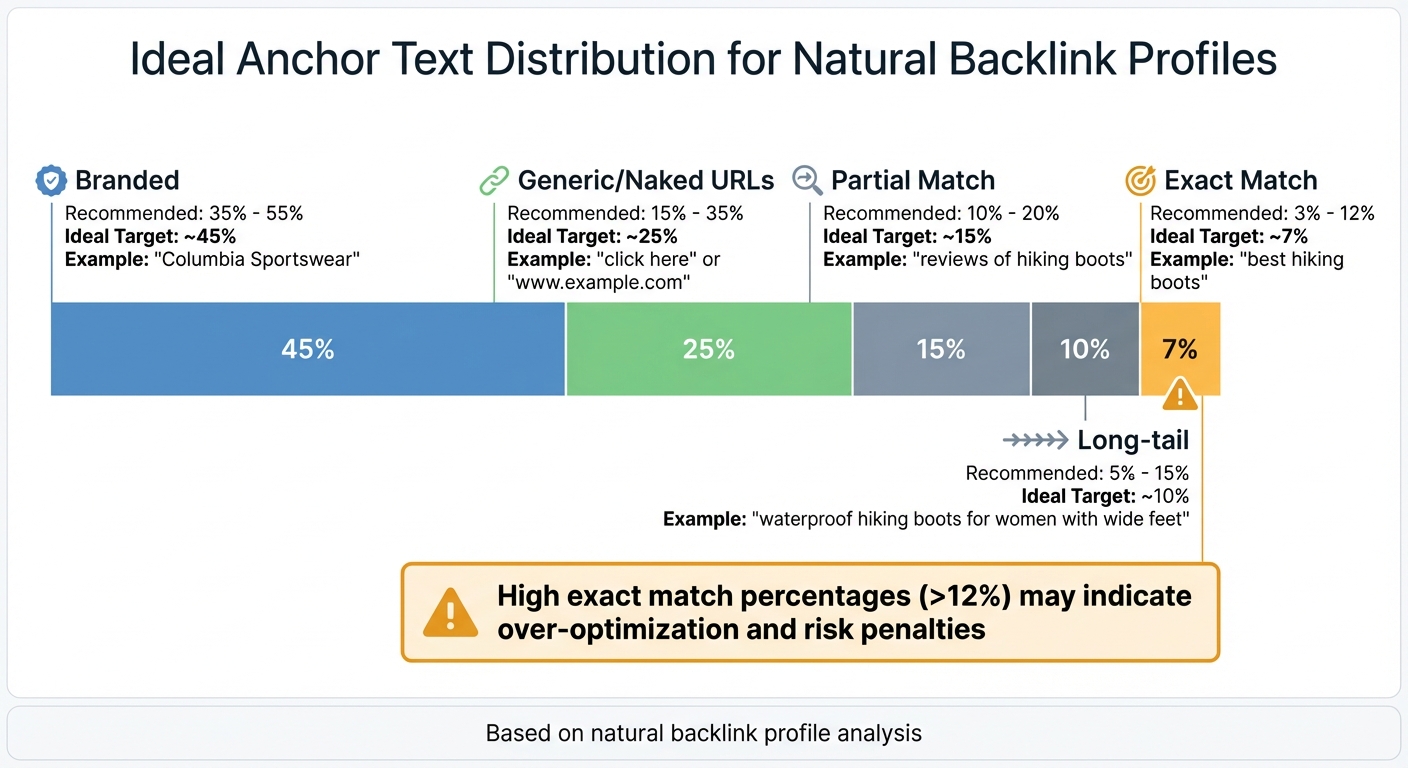
Ideal Anchor Text Distribution for SEO: Recommended Percentages by Category
Once you've gathered your anchor text data, the next step is to sort and structure it for easier pattern recognition.
Anchor Text Categories
Start by classifying anchor texts into distinct categories. This helps you identify linking patterns and better understand the focus of your competitors' keyword strategies. Common anchor text categories include:
- Exact Match: Anchors that perfectly match the target keyword, like "best hiking boots."
- Partial Match: Variations that include the keyword, such as "reviews of hiking boots."
- Branded: Anchors featuring company or product names, like "Columbia Sportswear."
- Generic/Naked: Phrases like "click here" or raw URLs like "www.example.com."
- Long-tail: Longer, more specific phrases, such as "waterproof hiking boots for women with wide feet" [3].
Analyzing these categories can reveal which keywords your competitors prioritize and their overall strategy [1]. A natural anchor text profile generally includes about 45% branded, 25% generic/naked URLs, and around 7% exact match anchors [3]. For a well-balanced profile, aim for these ranges: Branded (35%–55%), Generic/Naked URLs (15%–35%), Exact Match (3%–12%), Partial Match (10%–20%), and Long-tail (5%–15%) [3].
Using Spreadsheets or Tool Filters
To make sense of your data, use spreadsheets or filtering tools. In Excel or Google Sheets, set up columns for key details like Source URL, Anchor Text, Category, Link Type (dofollow vs. nofollow), and Domain Authority. This setup allows you to track the value of each link. Use the "Remove Duplicates" feature on the Domain and Anchor Text columns to focus on unique pairs.
Standardizing URLs, capitalization, and special characters is crucial to avoid filtering errors when analyzing your data [3]. SEO tools with preset filters can quickly highlight specific patterns, such as dofollow links or exact keyword matches. Export this refined data to a spreadsheet for deeper analysis. Pivot tables are particularly helpful for summarizing large datasets and calculating percentage distributions across different anchor text categories.
Step 3: Analyze Anchor Text Distribution Patterns
Now that your data is organized, it's time to dig into the patterns to uncover your competitors' backlink strategies.
Distribution Percentages Across Categories
Start by calculating the percentage of each anchor text category. To do this, divide the number of links in a specific category by the total number of backlinks, then multiply by 100. For instance, if a competitor has 200 branded anchors out of 1,000 total backlinks, that would mean 20% of their anchor texts are branded.
Compare these percentages against what’s considered a natural backlink profile. A high percentage of exact match anchors might suggest over-optimization, which could lead to penalties. On the other hand, a very low percentage could mean missed opportunities for targeting relevant keywords. By analyzing multiple competitors, you can identify a balanced range of anchor text distributions that align with strong rankings. This insight will help you assess whether your own link profile is well-balanced.
Dofollow vs. Nofollow Links
Once you’ve analyzed anchor text categories, shift your focus to the types of links - specifically dofollow and nofollow. Dofollow links pass authority and contribute to rankings, while nofollow links help create a natural backlink profile and can drive referral traffic.
Use SEO tools to filter and isolate dofollow links, then calculate their percentage of the total backlinks. A solid backlink profile typically has a mix of both types. For example, if a competitor’s exact match anchors are mostly dofollow links, it could indicate an aggressive keyword-targeting strategy. Dig deeper into the distribution of anchor text categories within these dofollow links to better understand how authority is being transferred.
Identify High-Authority Links
Pay special attention to backlinks from high-authority domains - those with a Domain Authority (DA) or Domain Rating (DR) of 50 or higher. These links are powerful ranking signals, as top-ranking pages tend to have significantly more of them.
"If you're looking to build more backlinks to your website, checking how your competitors built and earned their backlinks is a good starting point." - Joshua Hardwick, Head of Content, Ahrefs [2]
Filter for these high-authority domains and examine their anchor texts. Look for repeated target phrases in anchors from sites with a DR of 50 or above - these often highlight key priorities for your competitors. Additionally, identify high-authority domains that link to multiple competitors. These domains are prime candidates for your own outreach efforts. Remember, while link quantity matters, 84.6% of SEO experts emphasize content relevance over sheer volume [2]. A link that is relevant and contextual can often provide more value than one placed in a less meaningful spot.
Step 4: Find Opportunities and Optimize Your Anchor Text Strategy
Now that you've gathered insights from the earlier steps, it's time to fine-tune your approach. By analyzing your competitors, you can uncover gaps and refine how you use anchor text to strengthen your SEO efforts.
Identify Keyword Gaps
Take a close look at how your anchor text profile stacks up against your competitors'. Are there key phrases or long-tail keywords they’re using that you’ve overlooked? For example, if competitors frequently use terms like "enterprise CRM solutions" or "affordable project management software", while your profile sticks to more generic phrases, you’ve pinpointed an area to improve. Cross-check these gaps with your keyword research to prioritize terms that align with your content and match search intent. Then, update your anchor text to naturally include these targeted keywords.
Diversify Anchor Text Usage
A well-rounded anchor text profile is essential to avoid over-optimization penalties. Studies suggest keeping exact match anchors to around 5% of your external backlinks. Phrase match anchors can make up about 20%, while branded and URL anchors should dominate at roughly 60%. Partial match anchors can fill in the remaining 30%, striking a balance that feels natural and effective.
"Anchor text diversity is the practice of using a mix of anchor text types in your link profile. Instead of using the same keyword repeatedly, you vary the types of anchor text to create a natural and balanced profile."
To maintain this balance, regularly audit your backlink profile using tools like Ahrefs or SEMrush. These tools help you spot any overused keywords and adjust accordingly. For ongoing monitoring, automated platforms like Linkzy can simplify the process, ensuring your anchor text remains diverse and aligned with best practices.
Conclusion
Digging into competitor anchor text profiles can uncover valuable keyword opportunities and highlight high-authority domains to target. By studying how competitors shape their link profiles, you can uncover strategies for effective anchor text usage and identify domains that are worth pursuing for backlinks.
This process builds on earlier steps - choosing competitors, organizing the data, and spotting patterns - laying out a clear path for refining your backlink strategy. A balanced approach to backlinks is essential for long-term SEO success.
"Backlinks are the backbone of any effective SEO strategy. They act as endorsements from other websites, signaling that your content is valuable and worth noticing." - Hansjan Kamerling, Co-Founder, Adaptify [2]
Managing a diverse anchor text profile manually can be a daunting task, but automation can make it manageable. Tools like Linkzy can streamline the process by automating contextual backlink placement, ensuring balanced anchor text distribution and a natural link-building pace.
Take these insights and put them to work today. Start by exporting competitor anchor text data, sorting it into meaningful categories, and identifying actionable steps to strengthen your SEO efforts.
FAQs
How do I find the most valuable keywords in competitor anchor text profiles?
To find useful keywords from your competitors' anchor text profiles, start by using an SEO tool to compile a detailed list of all anchor texts pointing to their website. Export this data into a spreadsheet, then sort it by frequency to spot the most commonly used anchor texts.
From there, narrow your focus to exact-match keywords - phrases like "best coffee maker" that directly relate to your niche. Filter out generic or unrelated terms, then use a keyword research tool to assess each one's search volume, competition level, and potential impact. Focus on keywords that are frequently used, relevant to your target audience, and could address gaps in your current content strategy.
Lastly, take a closer look at how these high-value anchor texts are spread across multiple competitors. This can help you identify a natural distribution pattern for your industry. With this insight, you can craft contextual, niche-specific backlinks. A service like Linkzy can help you integrate these keywords strategically, giving your rankings a solid boost.
What are the risks of over-optimizing anchor text, and how can I prevent them?
Overloading anchor text with too many exact-match or keyword-focused links can raise red flags with search engines. This kind of practice might be seen as manipulative, which could lead to penalties or a drop in your rankings and website traffic.
To steer clear of this issue, focus on creating a balanced and varied mix of anchor text. This includes using branded terms, generic phrases, partial-match keywords, and even plain URL-based anchors. Keep exact-match anchors to a minimal percentage - ideally staying below 5–10%. Regularly reviewing your backlink profile is also essential to spot and remove any links that seem unnatural or spammy. The goal is to strike a balance between consistency and variety to keep your anchor text profile in good standing.
How can I find the right balance of anchor text types for better SEO results?
To strike the right balance with your anchor text types, start by examining your current backlinks. Tools like Google Search Console or SEO platforms can help you gather and analyze this data. Break down your anchor texts into categories like branded, exact-match, partial-match, generic, and naked URLs, and calculate the percentage each type represents in your backlink profile.
A well-rounded anchor text profile often looks something like this: about 50% branded anchors, 25% partial-match, 15% generic or naked URLs, and 10% keyword-rich variations. If exact-match anchors dominate your profile, it could signal over-optimization - something that might harm your rankings. Instead, aim for a natural mix, emphasizing branded and generic links.
After identifying any imbalances, adjust your link-building efforts to create a healthier profile. Tools like Linkzy can simplify this process by helping you secure niche-relevant backlinks that naturally diversify your anchor text. Keep an eye on your progress and tweak your strategy regularly to ensure your profile remains balanced and effective for both search engines and users.