Niche Backlinks for Domain Authority Growth
Niche Backlinks for Domain Authority Growth
Niche backlinks are the key to improving your website's Domain Authority (DA) and search rankings. Unlike generic links, these links come from websites within your industry, signaling relevance and expertise to search engines like Google.
- Why they matter: Search engines prioritize context and relevance. A link from a related site carries more weight than one from an unrelated domain.
- Impact: Niche backlinks help rank for competitive keywords, improve traffic quality, and build long-term SEO resilience.
- How to get them: Create link-worthy content, collaborate on guest posts, use broken link building, and engage niche communities.
Focusing on niche backlinks ensures your site is seen as a trusted authority in its field, driving targeted traffic and boosting rankings over time. Let’s dive into the strategies that make this happen.
Guest Post Backlinks: How I Find Powerful Backlinks That Boost DA Instantly (Step-By-Step)
How Niche Backlinks Improve Domain Authority
Niche vs Generic Backlinks: SEO Impact Comparison
The Role of Relevance and Authority in Backlinks
Backlinks act as powerful signals of context. For instance, when a trusted plumbing supplier links to your plumbing business, search engines interpret this as a strong endorsement within your field. This process, known as entity resolution, uses semantic distance - calculated through vector embeddings - to determine your site's relevance within a specific topic area [7]. These targeted signals are essential for enhancing your domain authority.
"A backlink is no longer just a vote. It is a context signal that helps Google decide which entities belong together." - Stellar SEO [7]
This relevance greatly influences how link equity flows to your site. Links from credible, related sources not only build trust but also grow in value over time, especially for niche-specific visibility. In fact, 88% of SEO professionals agree that topical authority plays a crucial role in search engine optimization [6]. Search algorithms prioritize these contextual links because they naturally fit into industry-specific content, reducing the chance of being flagged by spam filters like SpamBrain [7][1]. Local endorsements further strengthen topical authority without triggering unnecessary algorithmic scrutiny [7]. These factors explain why niche backlinks often outperform generic ones, which we’ll dive into next.
Niche vs. Generic Backlinks: Which is Better?
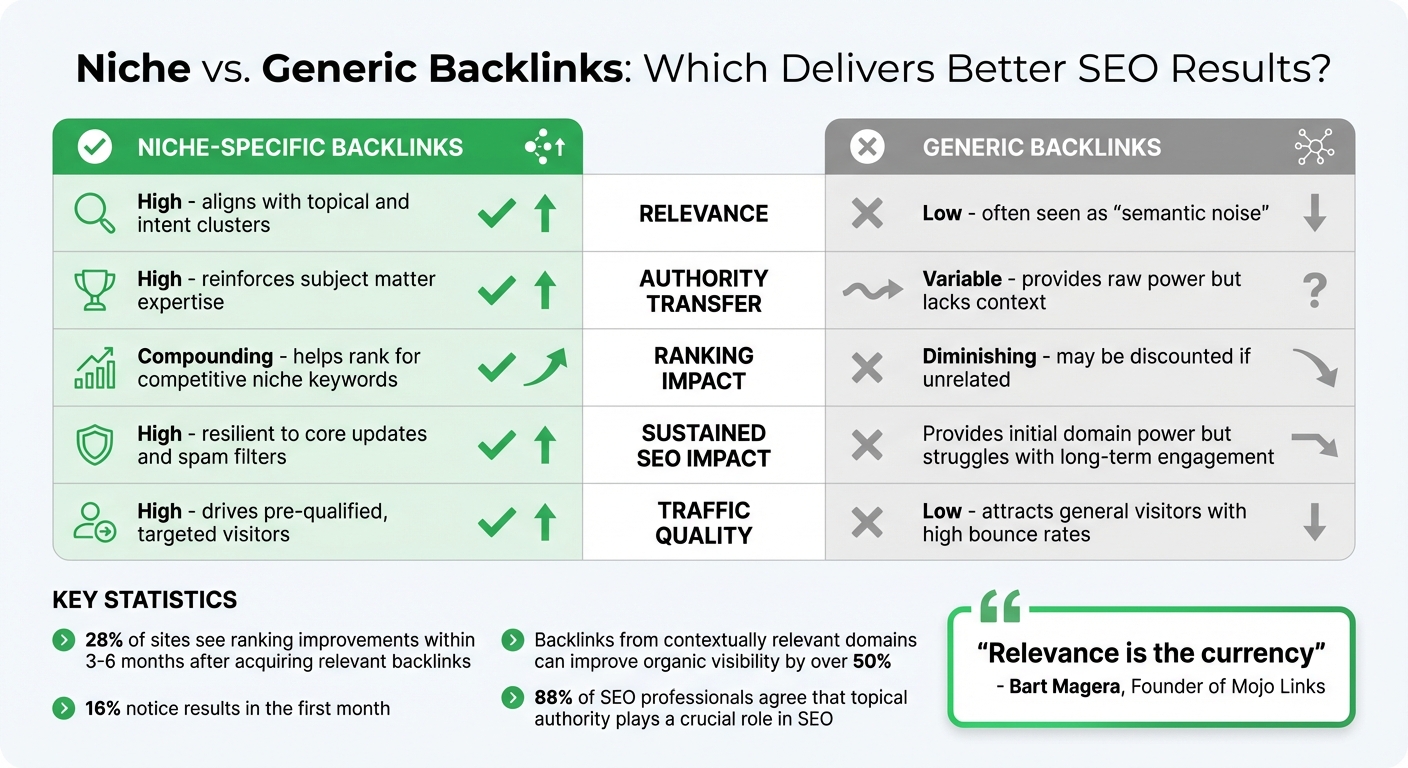
When comparing niche and generic backlinks, it becomes clear that niche links offer a more lasting impact. While a high-authority but unrelated link might provide a temporary boost, it lacks the contextual relevance needed for effective SEO today [9]. Research even shows that backlinks from contextually relevant domains can improve organic visibility by over 50% [9].
| Factor | Niche-Specific Backlinks | Generic Backlinks |
|---|---|---|
| Relevance | High; aligns with topical and intent clusters | Low; often seen as "semantic noise" |
| Authority Transfer | High; reinforces subject matter expertise | Variable; provides raw power but lacks context |
| Ranking Impact | Compounding; helps rank for competitive niche keywords | Diminishing; may be discounted if unrelated |
| Sustained SEO Impact | High; resilient to core updates and spam filters | Provides initial domain power but struggles with long-term engagement [8][3] |
| Traffic Quality | High; drives pre-qualified, targeted visitors | Low; attracts general visitors with high bounce rates |
The numbers back this up. Around 28% of sites see ranking improvements within three to six months after acquiring relevant backlinks, with 16% noticing results as soon as the first month [2]. On the flip side, generic links from unrelated industries can appear manipulative to search engines, risking devaluation [8][3].
"Relevance is the currency" - Bart Magera, Founder of Mojo Links [9]
These findings set the stage for the next section, where we’ll explore actionable strategies to harness the power of niche backlinks for sustained domain authority growth.
Strategies to Build Niche-Relevant Backlinks
Creating Linkable Assets for Your Niche
One of the most effective ways to earn backlinks is by creating content that others find indispensable - what's often called "linkable assets." These are resources that solve real problems, provide fresh insights, or offer tools that others naturally want to reference. Think original research, comprehensive guides, or free tools that address specific needs.
"A linkable asset isn't just another blog post. It's the definitive resource that solves a problem, offers up fresh data, or provides a perspective no one else has."
Interestingly, only about 6% of content creators succeed in earning backlinks. Original research tends to rank highest in its ability to attract links, scoring a perfect 10, while ultimate guides follow closely with a 9 out of 10 rating [10][11][12].
Here’s an example: In April 2025, Atlassian created an infographic titled "15 Ways to Master Trello for Slack", which simplified a complex integration process. This visual guide quickly gained traction, earning backlinks from productivity and project management blogs [5]. Another strategy to boost citability is branding your methodology - like the well-known "Skyscraper Technique" - to make it more memorable and shareable [13].
Next, let’s look at how guest posting can expand your backlink portfolio.
Guest Posting and Content Collaboration
Guest posting remains a reliable method for building backlinks while also establishing relationships with industry leaders. It allows you to control anchor text and backlink placement, but it’s not without its challenges - most outreach campaigns see success rates below 5% [17].
To find opportunities, use search operators like intitle:"write for us" + [niche keyword] or [niche] + "become a contributor" [5][14]. Once you identify potential sites, evaluate their Domain Authority, niche relevance, and organic traffic trends. Be cautious of sites with an 80–90% drop in traffic, as this could indicate penalties from Google [4].
A great example of success comes from April 2025, when Maria Harutyunyan, co-founder of Loopex Digital, published a guest post on Mangools' blog about category page optimization. This aligned her expertise with Mangools' audience and secured a high-value backlink [5]. The key to acceptance is pitching topics that solve real problems for the target audience, rather than overtly promoting your brand. Personalize outreach emails by referencing specific articles from the recipient’s site and explaining how your content adds value [4][15]. Even with personalization, live link rates typically range between 10% and 16% [17].
For instance, UnderFit partnered with Black Lapel in a content collaboration that not only secured backlinks but also drove 150 direct sales and improved search visibility over a year [13].
Now, let’s shift to how broken link building can deliver quick wins.
Broken Link Building and Resource Outreach
Broken link building is a powerful tactic that offers immediate value to webmasters by helping them fix gaps in their content. This approach often achieves higher success rates because it provides a clear benefit to the site owner [1].
Here’s how it works: Identify broken links on niche-relevant websites, create a better replacement, and reach out to the webmaster with your ready-to-go solution [1][5]. A similar strategy, the "Moving Man Method", focuses on businesses that have rebranded, changed URLs, or shut down. Use backlink tools to find sites still linking to outdated pages, then suggest your updated resource as a replacement [13][14].
Another opportunity is unlinked mention reclamation. Set up Google Alerts for your brand name, and when you find mentions without a link, contact the author to thank them and request a link for better user navigation [1][5].
Participating in Niche Communities and Directories
Getting backlinks from niche communities and directories can be highly effective, provided the links are contextually relevant. In fact, links from smaller, niche-specific sites often deliver more targeted SEO benefits than those from unrelated industries [1].
One way to expand your reach is by targeting "shoulder" niches - industries related to, but not directly competing with, your own. For example, a gardening blog might collaborate with landscape architecture sites [4]. Use search queries like [niche] useful resources or intitle:roundup [niche] to find resource pages or link roundups [5][14][15].
Another tactic is niche edits, where you ask site owners to insert your link into an existing high-performing article. This works particularly well for evergreen content and offers a faster turnaround since no new content needs to be created [4][1][5].
A recent example comes from a beauty startup that leveraged the "Barbie Botox" TikTok trend in 2025. By providing data and expert commentary on the trend, the brand earned backlinks from high-authority outlets like Business Insider (DR 83) and Forbes [5]. Engaging with trending topics in your niche can be a smart way to earn authoritative links.
Pros and Cons of Common Backlink Strategies
Each link-building method has its own strengths and challenges, as well as varying impacts on domain authority.
| Method | Advantages | Challenges | Expected DA Impact |
|---|---|---|---|
| Original Research | Attracts journalists; positions you as an authority [10] | Requires significant time and data analysis [10] | Very High |
| Guest Posting | Offers control over anchor text; fosters relationships [5] | Low response rates; time-intensive outreach [5] | Moderate to High |
| Broken Link Building | Provides immediate value; high success rate [1] | Requires SEO tools to find opportunities [5] | Moderate |
| Free Tools/Calculators | Useful for recurring traffic and passive links [10][11] | Needs technical development and ongoing maintenance [10] | High |
The cost of acquiring a high-quality backlink can exceed $1,000 when you factor in labor, content creation, and tools [11]. About 36% of businesses outsource link building, with costs per link ranging from $50 to over $1,000, averaging around $83 [17].
"High-quality content is at the core of any effective link-building strategy, but it's also one of the hardest parts to execute well."
- Jason Davis, Founder at Makarios Marketing [17]
To maintain a natural backlink profile, aim for a mix of do-follow and no-follow links. A healthy ratio is approximately 60% do-follow to 40% no-follow [16]. It’s worth noting that 52.2% of SEO experts consider link building to be the toughest part of search engine optimization [17].
sbb-itb-0f47b19
Automating Backlink Building with Linkzy
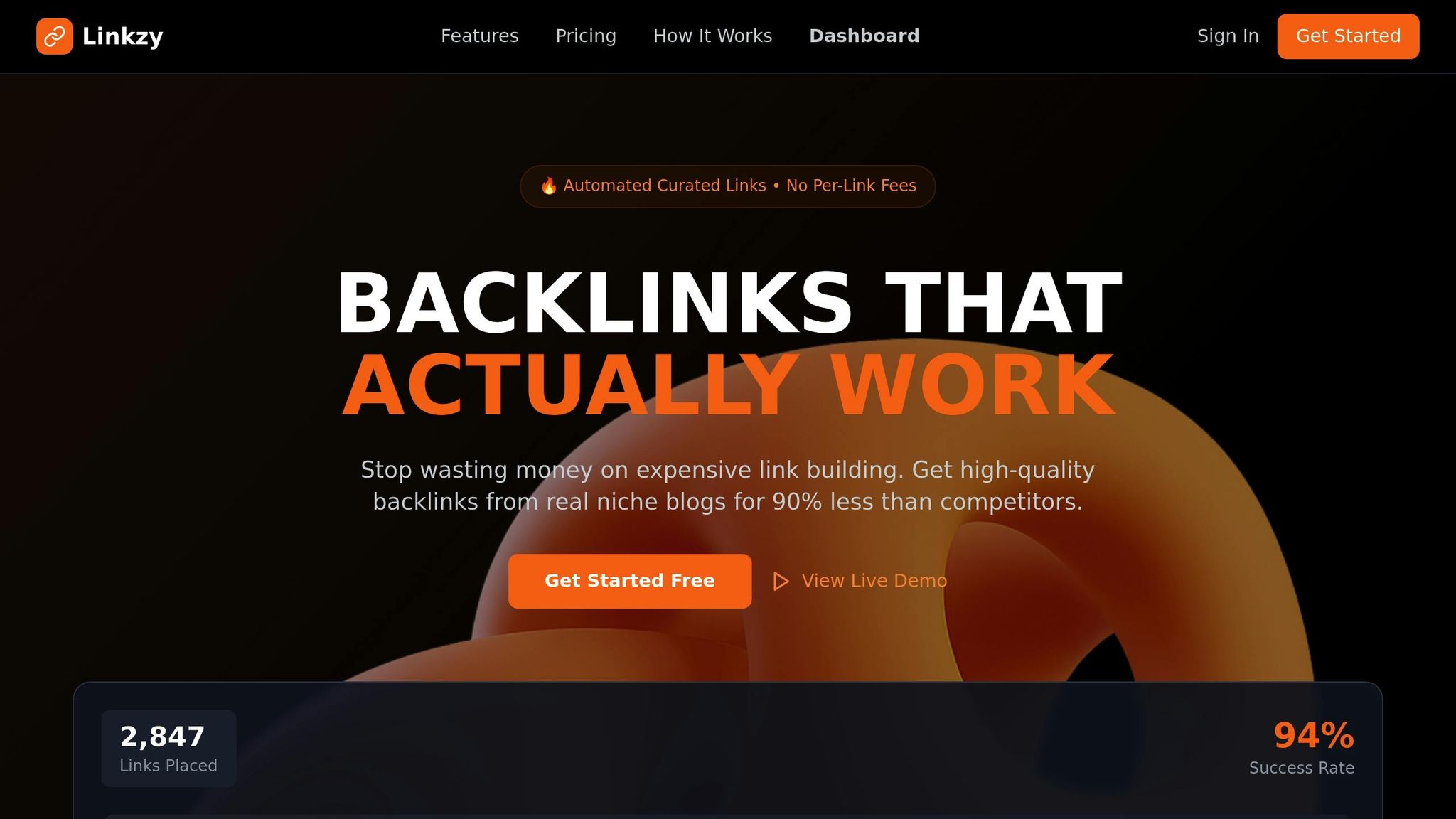
Link building is one of the toughest parts of SEO, and securing a single high-quality backlink can often cost over $1,000 [11]. Manual outreach, with its endless prospecting, vetting, and follow-ups, eats up hours of time and often yields disappointing results. That’s where automation steps in to simplify the process - and this is exactly what Linkzy aims to deliver.
How Linkzy Simplifies Niche Backlink Building
Linkzy streamlines the backlink-building process by automating the placement of contextual links across a network of active websites in your niche. Instead of spending weeks hunting for prospects and sending personalized outreach emails, you simply select your niche, install a tracking snippet, and let the platform’s AI take over. It identifies relevant link placement opportunities, generates contextual anchor text, and schedules links in a way that mimics organic growth.
What’s more, Linkzy ensures natural link patterns to avoid triggering search engine algorithms. It filters potential link sources based on authority metrics and organic traffic, so you’re getting links from websites with active readership - not outdated domains or link farms [3][4]. By keeping every link contextually relevant to your niche, Linkzy helps steadily grow your domain authority.
Why Linkzy Stands Out
Linkzy doesn’t just automate - it adds value with features designed to make backlink building smarter and easier. The platform works with any website, no matter the platform you’re on. Setup is quick, and you can track performance through real-time analytics that show referral traffic and the status of your links. For businesses focused on ROI, UTM parameters can be added to inbound links, allowing you to track conversions directly in Google Analytics 4 [3].
The pricing is straightforward and accessible. The Starter Plan costs $19/month and provides 5 credits, making it a great option to test the impact on your domain authority. The Pro Plan costs $29/month, offering 15 credits and priority support for those ready to scale. There’s even a free plan that gives you 3 credits to try the service - no credit card required.
"High-quality niche links amplify the value of your best content. They don't replace good content – they validate it." - TheLinksGuy [3]
It’s important to note that backlinks take time to make an impact. SEO gains from backlinks typically show up within 3 to 12 months [11]. With Linkzy, you can maintain steady progress, avoiding the manual workload that often slows down traditional link-building strategies.
Tracking and Measuring the Impact of Niche Backlinks
Keeping tabs on the impact of niche backlinks on your domain authority is crucial. The right metrics can reveal whether your link-building efforts are on track or if adjustments are needed.
Key Metrics to Monitor
Once you've established a baseline, pay close attention to these metrics:
Domain Authority (DA), Domain Rating (DR), and Authority Score (AS) are essential indicators of your site's overall strength. These scores, provided by Moz, Ahrefs, and Semrush respectively, assess your site's credibility. DA, for example, operates on a logarithmic scale from 0–100, meaning progress becomes more challenging as you climb higher - going from 60 to 70 is much harder than moving from 10 to 20 [19]. Check these scores monthly to identify trends over time.
Referring domain diversity is more impactful than sheer link volume. It's far better to gain backlinks from 10 different quality domains than to get 10 links from the same domain. Research shows that the top Google result typically has 3.8x more backlinks than results ranked 2 through 10 [18]. Additionally, top-ranking pages often see a monthly increase of 5% to 14.5% in dofollow backlinks [18]. Keep an eye on your unique referring domains to ensure a diverse and healthy link profile.
Anchor text distribution should appear natural and varied. A diverse anchor text profile can boost rankings by 22%, while relevant anchor text increases the likelihood of higher rankings by 5% [18]. Aim for a mix of branded, generic, partial-match, and exact-match anchors to avoid penalties for over-optimization.
Dofollow ratio is another critical factor, as only dofollow links pass link equity and directly enhance authority metrics [22][23]. While high-quality nofollow links from trusted niche sources can still drive traffic and build trust, your backlink profile should primarily consist of dofollow links for maximum impact. Use Google Search Console to confirm that the pages hosting your backlinks are indexed by Google; links on non-indexed pages won’t contribute to your SEO efforts [23].
Link velocity refers to the rate at which you acquire backlinks. A steady, natural growth curve is key, as sudden spikes in backlinks may raise red flags with search engine algorithms. Focus on consistent monthly growth instead of irregular bursts. Links that bring actual visitors who engage with your site are especially valuable - use referral traffic as a signal of relevance and quality.
Here’s a quick summary of these metrics, their purposes, and the trends to aim for:
| Metric | Purpose | Ideal Trend |
|---|---|---|
| Domain Authority (DA/DR) | Measures overall site strength | Steady upward growth |
| Referring Domains | Measures unique site "votes" | Consistent monthly increase |
| Organic Traffic | Measures visibility and reach | Growth following link acquisition |
| Keyword Rankings | Measures specific page performance | Movement toward Top 3 or Page 1 |
| Dofollow Ratio | Measures equity-passing links | Majority should be dofollow/natural |
| Toxicity Score | Measures profile health | Maintain at "Low" or near zero |
Before-and-After Comparisons for Link Performance
Before launching a niche backlink campaign, establish a baseline. Record your current DA, DR, or AS scores, along with organic traffic and keyword rankings for a set of target keywords. A "good" authority score is relative - compare it to your competitors within the same niche to gauge where you stand [21].
Revisit these metrics at 30-day, 90-day, and 6-month intervals after your backlinks go live. SEO improvements from backlinks often take 3 to 12 months to materialize, so patience is key. Pay close attention to keyword ranking changes on pages that received new backlinks to directly link improvements to your efforts. For a more granular view, monitor Page Authority (PA) or URL Rating (UR) to assess the localized authority growth of specific pages.
Conduct a backlink profile audit every 3–6 months and disavow any toxic links to safeguard your rankings [20]. Keeping your toxicity score low is vital for maintaining a healthy link profile. Remember, the first backlink from a new domain usually delivers the biggest authority boost, while subsequent links from the same domain may have diminishing returns.
Conclusion
Building domain authority isn’t about amassing a mountain of random backlinks; it’s about securing a handful of strategic, niche-specific links that establish trust and improve rankings. As SEO analyst Brittney Fred explains:
"You need links from your own neighborhood in order to be considered a trusted authority in your topical space" [4].
Take, for example, the impressive results achieved by Backlinkers. They boosted a job board’s organic traffic from 4.8 million to 12 million monthly visitors in just ten months by focusing solely on niche-relevant backlinks [2]. Similarly, CookUnity increased its Authority Score from 44 to 48 within a year by publishing targeted content that earned 658 backlinks from food and lifestyle sites [24]. These successes highlight the importance of aligning your backlinks with your area of expertise, reinforcing your credibility and the value of your content.
While manual outreach can be time-intensive, tools like Linkzy simplify the process. Linkzy automates the acquisition of niche-relevant backlinks, ensuring your efforts align with effective strategies for increasing domain authority. By identifying websites in your niche, securing contextual backlinks on real user sites, and maintaining a natural link-building pace, Linkzy takes the heavy lifting out of the equation. With plans starting at $19 per month for 5 credits - and a free trial offering 3 credits upfront - you can test the waters risk-free while setting the stage for sustainable growth.
Once you’ve automated the groundwork, it’s crucial to track your progress. Monitor key metrics to measure results, keeping in mind that meaningful improvements typically take three to six months [2]. Focus on quality over quantity, diversify your anchor texts, and allow your backlink profile to grow naturally within your niche.
The journey to higher domain authority begins with a single, well-placed link that signals trust and positions your site as the go-to resource in your field. That one link could be the first step toward transforming your rankings and reputation.
FAQs
How do niche-specific backlinks help improve my site's Domain Authority?
Niche-specific backlinks play a crucial role in improving your site's Domain Authority by serving as highly relevant endorsements. When well-regarded websites within your industry link to your content, it sends a clear message to search engines: your site is a trusted and credible source in its field. This added relevance not only strengthens your backlink profile but also helps your site climb higher in search rankings.
In addition to credibility, these links pass valuable "link equity" to your site - a critical factor in boosting Domain Authority. Tools like Linkzy can make this process easier by delivering a steady stream of high-quality, niche-relevant backlinks. With consistent contextual links, your site can build authority and maintain better visibility in search results over time.
How can I effectively build niche-specific backlinks to boost my domain authority?
To effectively build backlinks tailored to your niche, start by focusing on producing high-quality, useful content that naturally attracts links from relevant websites in your industry. Think about creating in-depth guides, original research, or case studies that address real challenges your audience faces. When your content becomes a trusted resource, it’s more likely to earn those valuable links.
When it comes to outreach, you’ll need to identify the right websites. Use Google search operators like "write for us" + [your keyword] to find opportunities or dive into competitor backlink analysis with tools such as Ahrefs or SEMrush. These tools help you spot sites already linking to content similar to yours. Once you’ve identified potential websites, craft personalized outreach messages that explain how your content can add value, fill a gap, or even replace outdated or broken links on their pages.
For scaling your efforts, tools like Linkzy can be a game-changer. It’s an automated service that places niche-specific backlinks on real websites while maintaining a natural link-building pace. This allows you to focus more on creating content while your backlink profile strengthens steadily. By combining manual outreach with automation, you can ensure consistent growth in your domain authority without compromising quality.
How do I track the impact of niche backlinks on my website's SEO?
To understand how niche backlinks impact your SEO efforts, start by setting a benchmark for key metrics like Domain Authority (DA), keyword rankings, and organic traffic. Tools such as Google Search Console or other SEO platforms can help you gather and document these numbers before you begin link-building.
As you acquire backlinks from niche-relevant sources, keep an eye on changes in your metrics. Watch for growth in DA, improved keyword rankings, and increased referral traffic from the linking domains. The relevance of these backlinks is crucial - links from websites in your industry or niche tend to have a greater effect.
To simplify the tracking process, consider using tools like Linkzy. These tools can automatically log details about new backlinks, including their placement dates and referring domains. Regularly reviewing this data allows you to measure success and adjust your backlink strategy to drive better SEO results.