What Are Niche-Relevant Backlinks and Why They Matter
What Are Niche-Relevant Backlinks and Why They Matter
I spent months doing manual backlink outreach for my websites. Sending emails, finding prospects, following up, and getting ghosted 80% of the time. The few links I did land were often from sites that had nothing to do with my niche, and they moved the needle almost zero.
That frustration is exactly why I built Linkzy. I wanted a system that didn't just find any backlink, but found the RIGHT backlink. One from a site in the same niche, with similar domain authority, with content that actually relates to mine. Because after going through that painful manual process, I became convinced that relevance isn't just important, it's everything.
Here's what I've learned about niche-relevant backlinks, and why we built an entire matching algorithm around them.
Why they matter:
- Boost Rankings: Links from related sites help search engines understand your expertise, improving your position in search results.
- Better Traffic Quality: Visitors from niche-relevant links are more likely to engage with your content and convert.
- Improved E-E-A-T: These links enhance your site's perceived expertise, authoritativeness, and trustworthiness.
Key takeaway: Focus on earning links from industry-specific sites rather than generic, high-authority ones. Relevance is more important than sheer link volume in today's SEO landscape.
7 Best Practices to Build Niche-Relevant Backlinks [2024]
What Are Niche-Relevant Backlinks?
A niche-relevant backlink is a link from a website that operates in the same or a closely related industry or market as your own. These links come from sources that align with your site's focus and are respected within your field.
Three main qualities define niche-relevant backlinks:
- Topical focus: The linking site covers similar themes or topics as your own.
- Industry connection: The source is well-regarded within your industry.
- Contextual relevance: The link is embedded within content directly related to your subject matter.
For instance, imagine a fitness equipment retailer receiving a link from a health and wellness blog. This type of link signals to both readers and search engines that your content is recognized by credible sources within your niche.
In fact, 88% of SEOs believe that topical authority plays a key role in search rankings [1]. Niche-relevant backlinks are a cornerstone in building that authority.
Now, let’s break down how niche-relevant backlinks differ from generic ones.
How Niche-Relevant Backlinks Differ from Generic Backlinks
The difference between niche-relevant and generic backlinks lies in their context and alignment with your industry. Niche-relevant backlinks come from websites that share your topical focus and are naturally embedded into related content. Meanwhile, generic backlinks can come from any website, regardless of its subject matter.
For example, a gardening website benefits more from a link by a gardening blogger or horticultural society than from an automotive trade journal - even if the latter has a high domain authority [3]. While both links might boost your overall link profile, only the gardening-related link provides the topical relevance that search engines prioritize. Similarly, a link from The New York Times is valuable, but it only becomes niche-relevant if the content directly ties to your industry [8].
Having too many generic or unrelated links can dilute your backlink profile's effectiveness. Search engines may interpret an unnatural mix of links as manipulative, potentially leading to ranking penalties [2]. This is why modern SEO emphasizes the quality and relevance of backlinks over sheer quantity.
Why Relevance Matters for SEO
The value of niche-relevant backlinks goes beyond their definition - they deliver measurable SEO benefits.
Google increasingly prioritizes contextual relevance and authority rather than focusing solely on the volume of links [1]. When authoritative sites in your niche link to your content, it signals to search engines that your site is trustworthy and valuable, which can improve your rankings and visibility.
Here’s a telling stat: 28% of websites see ranking improvements within 3–6 months of acquiring new backlinks, and 16% notice results within the first month [4]. Sites with niche-relevant backlinks often rank higher because these links align closely with their topics [9].
Niche-relevant backlinks also bolster your site’s E-E-A-T - Experience, Expertise, Authoritativeness, and Trustworthiness - further reinforcing your credibility in the eyes of both users and search engines.
Moreover, research from Ahrefs highlights that 76% of AI Overview citations link to pages ranking in Google’s top 10 [9]. There’s even a moderate positive correlation (about 0.295) between the number of referring domains and brand visibility in AI Overview. And with Google’s March 2024 update, which warns against hosting low-quality third-party content, the focus on quality backlinks has become more critical than ever [4].
Next, we’ll dive into how niche-relevant backlinks measure up against high-authority generic links.
Key Benefits of Niche-Relevant Backlinks for SEO
Niche-relevant backlinks bring three major advantages that can directly improve your search engine performance: they enhance your topical authority, build your site's credibility, and attract highly engaged visitors.
Improved Topical Authority
Topical authority is how search engines measure your expertise in a specific subject area. When respected websites within your industry link to your content, they’re essentially endorsing your credibility in that niche [4][13]. Google interprets these links as a sign of your subject matter expertise [12]. For instance, a financial planning website that earns backlinks from trusted investment blogs, banking institutions, or financial news platforms demonstrates stronger topical authority than if it received links from unrelated sources. This level of relevance helps Google rank your content higher for niche-specific keywords because the platform values authoritative links that align with your subject [11][3]. This kind of targeted authority also strengthens your site's E-E-A-T signals.
Strengthened E-E-A-T Signals
Niche-relevant backlinks play a key role in boosting your site’s E-E-A-T - Experience, Expertise, Authoritativeness, and Trustworthiness. Links from respected industry sources act as endorsements of your trustworthiness [4][13]. These endorsements carry far more weight than links from general or unrelated sites. For example, a health article linked by a reputable medical research site significantly enhances E-E-A-T compared to a link from a general lifestyle blog. Beyond credibility, these links also bring in a more relevant and engaged audience.
Higher Engagement and Better Conversions
Niche-relevant backlinks don’t just build authority - they also drive traffic that’s more likely to convert. Links from related websites attract visitors who already have a specific interest in your content, leading to lower bounce rates and higher engagement [1]. When users arrive via a link from a relevant site, they often come with clear intent, making them more likely to explore your content further. These backlinks also help search engines better understand your website's focus, improving indexing and rankings while ensuring you reach the right audience.
sbb-itb-0f47b19
Niche-Relevant Backlinks vs. High-Authority Generic Backlinks
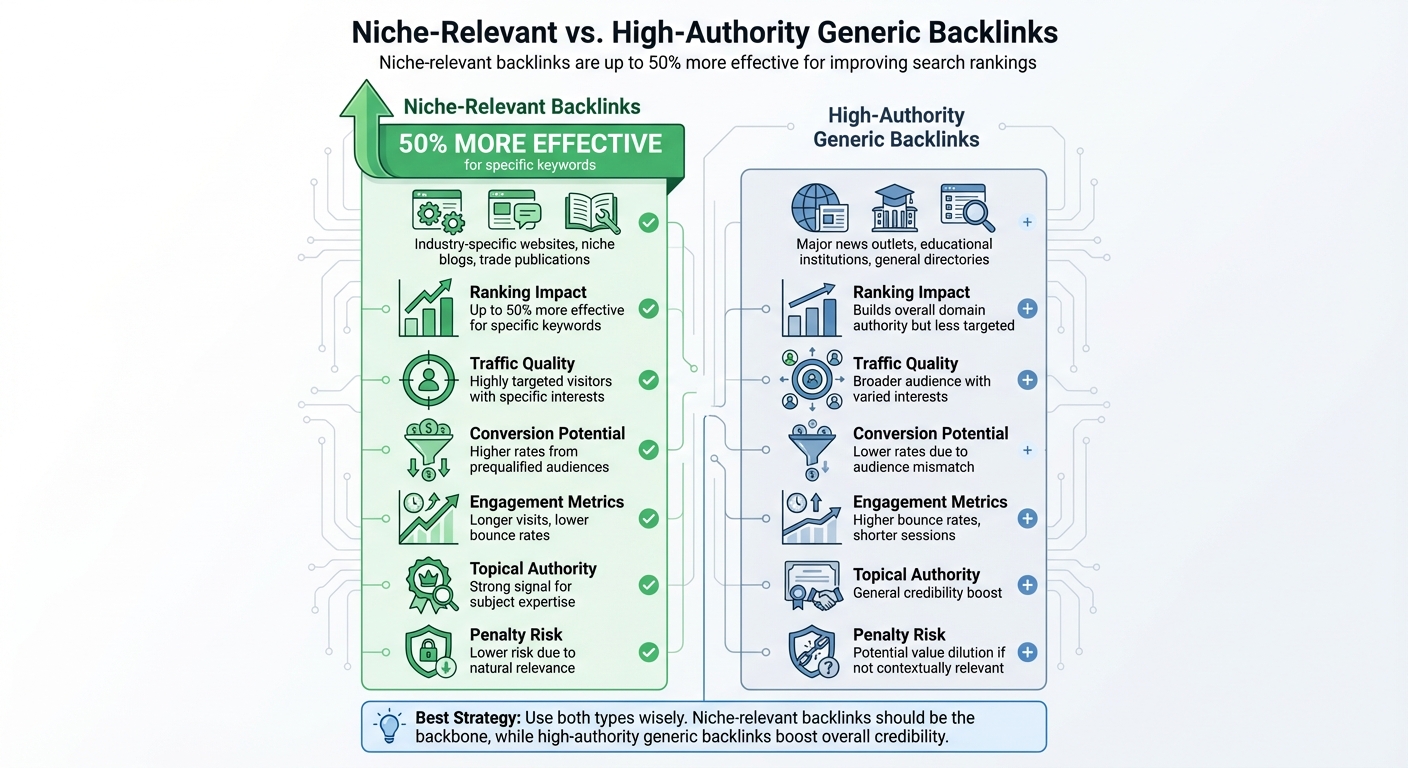
Niche-Relevant vs High-Authority Generic Backlinks: SEO Impact Comparison
Did you know that niche-relevant backlinks can be up to 50% more effective for improving search rankings compared to high-authority generic links? [14] While getting a backlink from The New York Times or Harvard might sound impressive, Google has shifted its focus. These days, relevance and context carry more weight than just domain authority alone [14][7][3]. Links from industry-specific blogs or websites send a stronger signal about your expertise in a particular field.
This difference becomes even clearer when you look at traffic quality and conversions. Sure, high-authority generic backlinks can give you broad visibility, but they often attract a less targeted audience [14][10][16]. On the other hand, niche-relevant backlinks bring in visitors who are already interested in what you offer. That means better conversion rates and a more engaged audience [14][10][16][7].
"Not all backlinks are created equal. A single link from a reputable media outlet can be more valuable than hundreds of random directory links. Quality and context are everything."
– Mia, Senior SEO Specialist, OWDT [15]
Comparison of Key Metrics
| Metric | Niche-Relevant Backlinks | High-Authority Generic Backlinks |
|---|---|---|
| Source Type | Industry-specific websites, niche blogs, trade publications [14][10] | Major news outlets, educational institutions, general directories [14][10] |
| Ranking Impact | Up to 50% more effective for specific keywords [14] | Builds overall domain authority but less targeted [10][16] |
| Traffic Quality | Highly targeted visitors with specific interests [14][7] | Broader audience with varied interests [14][10] |
| Conversion Potential | Higher rates from prequalified audiences [14][10][16] | Lower rates due to audience mismatch [14][16] |
| Engagement Metrics | Longer visits, lower bounce rates [14][10][16][7] | Higher bounce rates, shorter sessions [14][10][16] |
| Topical Authority | Strong signal for subject expertise [10][16] | General credibility boost [10][16] |
| Penalty Risk | Lower risk due to natural relevance [7] | Potential value dilution if not contextually relevant [14][10] |
The best strategy? Use both types of backlinks wisely. Niche-relevant backlinks should be the backbone of your link-building strategy, as they align closely with Google’s emphasis on relevance. That said, high-authority generic backlinks still play a role in boosting your overall credibility and can serve as a buffer against algorithm updates [14][10][16]. The key takeaway: relevance outweighs raw authority when it comes to backlink value in today’s SEO landscape [14][7][3].
Up next, let’s dive into how you can identify and secure those all-important niche-specific backlinks.
How to Identify and Acquire Niche-Relevant Backlinks
To secure niche-relevant backlinks, begin by thoroughly understanding your industry landscape. This means identifying key players, competitors, and core topics that define your niche [3]. Once you have a clear picture, you can turn these insights into actionable link-building strategies that improve your SEO performance.
Methods to Find Relevant Websites in Your Niche
Start by analyzing where your competitors are earning their backlinks. Tools like Ahrefs, Semrush, and Moz can help you identify these backlink sources [3]. Pay attention to recurring sources, such as trade publications, niche blogs, and respected directories.
You can also use Google search operators to uncover hidden opportunities. For example, typing inurl:resources + [your niche] into Google can lead you to resource pages in your industry [1]. If you're in the specialty coffee business, searches like "best coffee roasters" or "coffee industry resources" might reveal websites that frequently feature businesses like yours. Coffee Bros, for instance, secured a backlink for Onyx Coffee Lab by being included in an article that listed the "51 best specialty coffee roasters and brands in the United States" [1].
Don’t overlook niche-specific directories with strong authority. Examples include Healthgrades for healthcare or G2 for tech companies. If you’re focusing on local SEO, local business directories can also be valuable. Just make sure these directories maintain quality by enforcing strict verification processes and regular updates [4].
How to Evaluate the Quality of Potential Backlinks
Not all backlinks are created equal, so it’s crucial to evaluate their quality before reaching out. Start by checking for contextual relevance [3]. Google places higher value on links from websites that are closely related to your niche. In fact, a few highly relevant backlinks can outperform a large number of generic ones [3].
Look at a website’s Domain Rating (DR). Aim for sites with a DR above 50 and organic traffic of at least 500 to 1,000 monthly visitors [1]. Review the site’s content and engagement levels - active comments or social shares are good indicators of an engaged audience.
Avoid sites with excessive ads, poor-quality content, or spammy profiles. Google’s March 2024 update specifically cautioned against hosting low-quality third-party content, as it can harm a site’s reputation [4]. Also, prioritize securing do-follow backlinks, as these directly pass link equity to your site [6].
Outreach Strategies to Secure Backlinks
Guest posting remains a proven method for earning backlinks. Personalize your outreach by addressing editors by name and referencing specific articles they’ve published [1]. Over 64% of link builders use this approach [1]. When pitching, focus on ideas that genuinely benefit their audience rather than appearing overly promotional. This not only strengthens your backlink profile but also reinforces your site’s relevance.
"Google uses links as an important factor in determining the relevancy of web pages" and "any links that are intended to manipulate rankings in Google Search results may be considered link spam."
– Google Search Central [3]
Another effective strategy is broken link building. Use SEO tools or Google search operators to find broken links on relevant, authoritative sites in your niche [1]. Once you’ve identified a broken link, notify the site owner and suggest your content as a replacement. With 66% of all links being broken, this tactic offers plenty of opportunities [1]. Following up after one week can improve your success rate by up to 40% [1].
Creating linkable assets is another powerful approach. Hootsuite, for example, produced a data-driven report that earned 233 backlinks [1]. Focus on producing content that performs well in your niche, such as original research, expert quotes, interactive tools, or comprehensive industry guides. Promote these assets through email outreach, social media, and digital PR [1].
HARO (Help a Reporter Out) is a great way to connect with journalists seeking expert commentary. Respond to queries relevant to your niche, and target publications that align with your industry. A complete profile showcasing your expertise can help you stand out [17].
Author Thomas Cavanagh gained niche-relevant backlinks by writing a guest post for "Mystery of Writing", a blog that features novels similar to his [1].
Webinars and podcasts also offer backlink opportunities. Pitch yourself as a guest speaker by emphasizing your expertise and the value you bring to their audience [1]. Request a backlink in the episode description or on the event’s landing page. Many webinar pages include links to guest speakers, especially when their expertise ties directly to the topic.
Finally, building long-term relationships is key. Engage with potential link sources on social media, comment on their posts, or participate in online communities where they’re active. While over 52% of digital marketers say link building is one of the toughest parts of SEO [1], the rewards are worth it. Many websites see ranking improvements within one to three months of acquiring new backlinks, while 28% report results within three to six months [4]. Brands that collaborate with niche websites for promotions have reported a 44% boost in engagement [17].
How Linkzy Automates Niche-Relevant Backlink Matching
Everything we've covered in this post is exactly what we built Linkzy to solve automatically. When you install the Linkzy tracking snippet on your site, our system analyzes your content and extracts your real topical keywords not just meta tags, but the actual phrases and topics your pages cover. Then our ecosystem matcher finds other sites in the network that cover similar topics, in the same niche, with a comparable domain authority to yours. Every potential match gets scored across five factors: keyword overlap (30%), niche proximity (25%), domain authority similarity (20%), geographic relevance (15%), and partner quality (10%). Only matches that score above a 70% threshold get automatically approved and placed, because we'd rather place zero backlinks than place irrelevant ones. The result is contextual backlinks placed automatically inside real content on real sites in your niche, exactly the kind of links Google rewards. No outreach. No ghosting. No links from random unrelated sites. If you're tired of the manual process, you can try Linkzy free and see your first matches within minutes of installing the snippet.
Conclusion
Niche-relevant backlinks aren't just another SEO strategy - they're the backbone of sustainable SEO efforts. When it comes to backlinks, relevance trumps quantity every time. Google values contextual authority, and it's worth noting that 84.6% of SEO professionals assess backlink quality based on relevance [2].
These links do more than just boost rankings. They strengthen topical authority, enhance E-E-A-T signals, and attract targeted traffic. The result? Higher engagement rates, improved conversion metrics, and a steady stream of sustainable traffic. With 88% of SEOs highlighting the importance of topical authority [1], building links within your niche isn’t just a good idea - it’s a necessity.
Tactics like guest posting, broken link building, and creating linkable assets all thrive on authentic connections within your industry. Prioritizing relevance not only aligns with Google’s preferences but also ensures long-term strength for your SEO strategy. Considering that 92% of marketers believe backlinks will remain a key ranking factor over the next five years [5], investing in quality, niche-specific links today is an investment in your future success.
Here’s the key takeaway: quality always beats quantity. A few highly relevant backlinks from trusted sources in your niche will always outperform a large number of generic links from unrelated sites. Focus on creating content that’s worth linking to, and build genuine relationships within your industry. While 52% of digital marketers admit that link building can be challenging [1], those who stay committed often see results - many reporting ranking improvements within just one to three months [4].
Make relevance your guiding principle. By doing so, your backlink strategy will not only support your SEO goals but also contribute to the broader success of your business.
FAQs
How do I find websites that are relevant to my niche for building backlinks?
To discover websites in your niche for backlinking, start by pinpointing well-established sites in your field. These could be blogs, forums, or businesses that naturally align with your content or services. A smart way to find these is by using advanced search tricks - pair your niche keywords with phrases like "write for us" or "guest post opportunities". This approach can reveal potential sites open to collaboration.
Another effective strategy is to dig into your competitors’ backlinks. By analyzing which websites link to them, you can uncover valuable, niche-specific opportunities. Tools designed for backlink analysis make this process easier, helping you identify sites that might also be interested in linking to your content. Prioritize building relationships with websites that cater to your target audience for the most impactful results.
How can I effectively get niche-relevant backlinks for my website?
Acquiring backlinks that are relevant to your niche means focusing on strategies tailored to your industry or audience. One of the best ways to do this is by creating content that stands out and delivers real value - the kind of content others in your niche will naturally want to link to. Another proven approach is guest blogging on trusted websites within your field. It not only helps with backlinks but also builds credibility. Participating in forums or communities specific to your industry can also help you form connections and earn links over time.
You can take it a step further by studying your competitors' backlinks. Tools and analytics can reveal where they’re getting links, giving you insights into potential opportunities. Additionally, reaching out to niche directories or using Google search operators to find relevant sites can help you uncover more backlink sources. The golden rule here? Make sure every link you build serves your audience and stays true to your website’s purpose.
Why are niche-relevant backlinks better than generic high-authority links?
Niche-relevant backlinks pack a punch because they align closely with your website's content and audience. While generic high-authority links might look impressive, these targeted backlinks send a clear message to search engines: your site is a trusted authority in its specific industry or niche.
The focus on relevance does more than just boost your rankings. These links attract targeted traffic - visitors who are already interested in what you offer. The result? Higher engagement, improved conversion rates, and a more solid foothold in your industry.