Low Traffic Despite Good Content? Here's the Fix
Low Traffic Despite Good Content? Here's the Fix
If your website has great content but struggles with low traffic, the problem likely lies beyond just your writing. Search engines prioritize authority, backlinks, and technical optimization when ranking pages. Without these, even high-quality articles may remain invisible.
Here's the solution:
- Build Authority with Backlinks: Backlinks are like votes of confidence for your site. Tools like Linkzy automate acquiring high-quality, niche-relevant links, saving time and improving rankings.
- Fix On-Page SEO: Improve internal linking, optimize metadata, and structure your content for better search engine visibility.
- Address Technical Issues: Ensure your site is mobile-friendly, fast, and easy for search engines to crawl.
Why it matters:
- Pages with strong backlinks are 3.8x more likely to rank in top spots.
- Internal linking helps search engines understand your content hierarchy.
- Proper metadata and content structure improve click-through rates and user experience.
Key takeaway: Combine backlink authority and on-page SEO fixes to boost visibility and drive traffic. Start with automated tools to simplify the process, and refine your site’s structure for long-term growth.
Why Content Alone Doesn't Drive Traffic
Search Rankings Require More Than Content
Here's the thing: Google relies on over 200 ranking factors to decide which pages deserve those coveted top spots [3]. While high-quality content is crucial, it's just one part of a much bigger equation. Your well-researched articles are competing against countless others in an incredibly crowded digital space.
Search engines don't just look at your content - they assess a mix of signals. Backlinks from reputable websites act like endorsements, signaling to Google that your content is worth trusting [4]. Then there are technical aspects like site speed, mobile-friendliness, and proper site architecture. These factors determine how well search engines can crawl and index your pages, which directly affects whether your content even gets seen [4]. And let’s not forget user experience - Google pays attention to how visitors interact with your site.
It's also important to note that Google doesn't evaluate pages in isolation. Instead, it looks at your entire site to determine if you're an authority on specific topics [6]. Without the right blend of technical optimization, quality backlinks, and solid domain authority, even your best content can remain hidden in the depths of search results. These elements leave measurable clues that reflect your site's overall performance.
Signs Your Website Has Low Traffic
If your site struggles to rank and has only a handful of referring domains, it’s a clear sign that you lack the authority needed to compete - even if your content is top-notch.
What's Holding Your Website Back
When you dig into these issues, common roadblocks in your SEO strategy often come to light. A major challenge is the lack of high-quality backlinks. It’s a frustrating cycle: you need backlinks to rank, but without ranking, it’s hard to earn those links - especially for competitive keywords [5]. The solution lies in securing targeted, niche-relevant links from trusted sources. These links carry far more weight than a large number of unrelated ones and can help you establish the topical authority needed to break free from this cycle [6].
Other issues might also be at play. Poor internal linking can confuse search engines about your site's structure, while the absence of niche-relevant links can limit your ability to build authority in your field. Fixing these foundational problems is essential if you want your high-quality content to finally get the visibility it deserves.
Link Building: How to Get 1,347 Backlinks Every Month
Step 1: Build Authority With Automated Backlinks
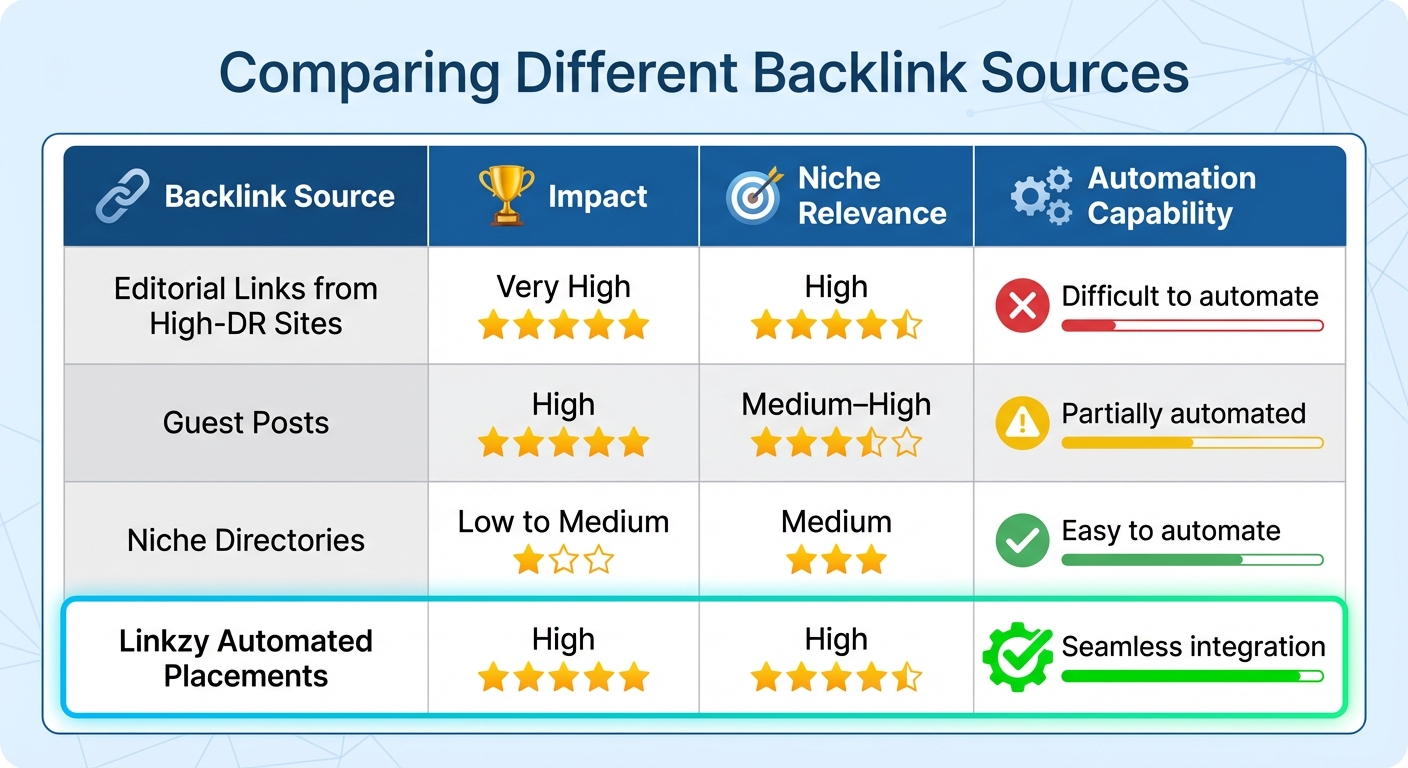
Backlink Source Comparison: Authority, Relevance, and Automation
Why Backlink Authority Matters
Backlinks are still one of Google's top three ranking factors in 2025, acting as trust signals for your site. Pages that rank at the top often boast 3.8 times more backlinks than those in positions #2–#10. Moreover, links from domains with a Domain Rating (DR) above 50 make pages 3.2 times more likely to secure a spot in the top five. SEMrush's 2024 ranking factors study highlights that the quality of backlinks now outweighs their quantity [9].
"One link from a relevant, trusted site in your niche is worth more than 100 random directory links."
This insight, as noted by Rank Math SEO [6], underscores why prioritizing high-quality, niche-specific backlinks is essential for achieving better results.
How Linkzy Automates Backlink Building
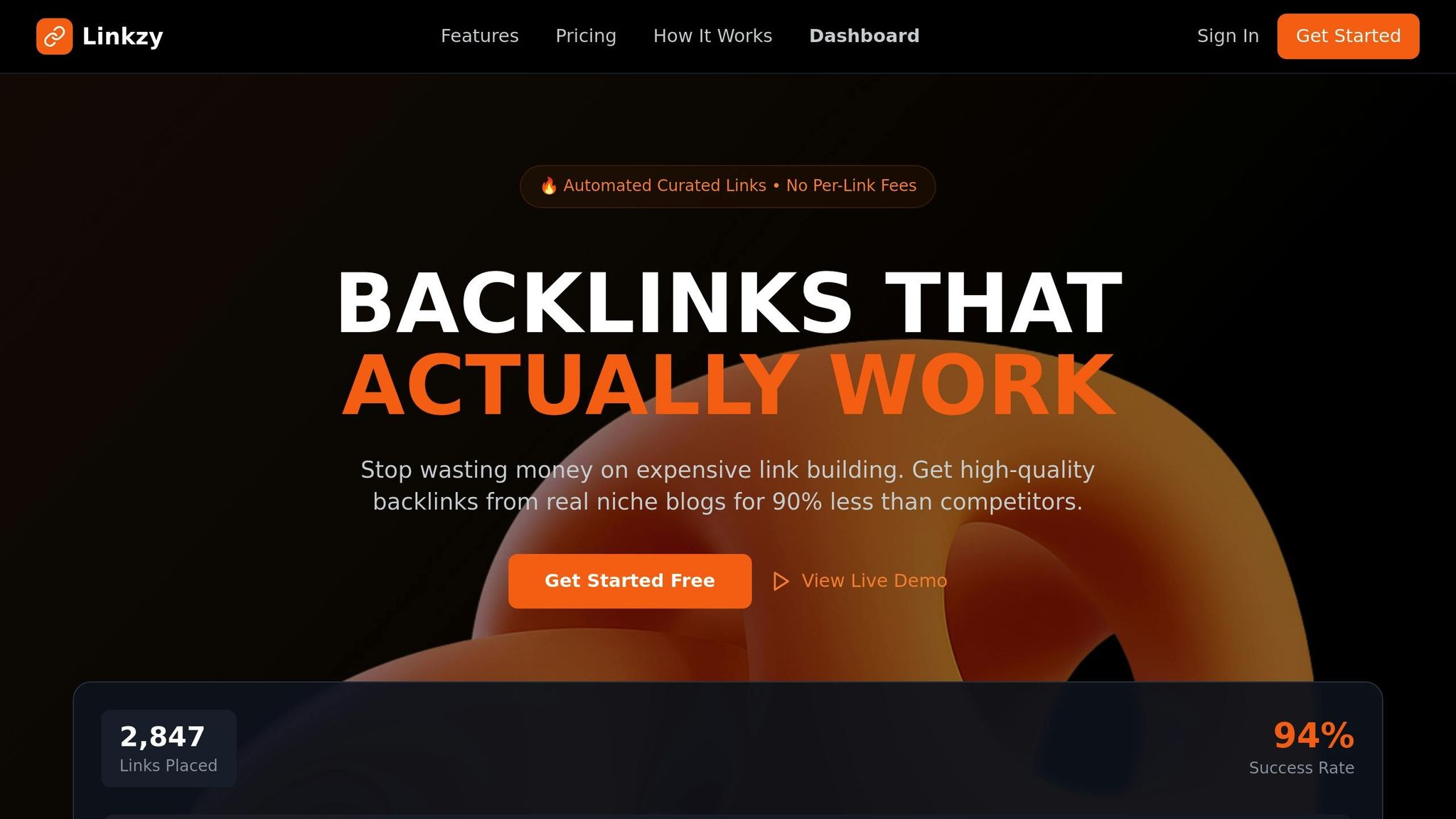
Given the importance of quality backlinks, automation can make the process much more efficient. Manually building backlinks involves finding prospects, sending outreach emails, and following up - a process that can eat up hours of your time. This is where Linkzy steps in. Using AI, Linkzy automates every step for you.
Here’s how it works: after you set your niche and add a tracking snippet, Linkzy's AI identifies and evaluates high-quality, contextually relevant websites. Backlinks are then placed gradually on authentic sites, creating an organic profile. Plus, you can monitor performance in real time. Pricing starts at $19 per month for 5 credits, and there’s even a free plan with 3 credits so you can try it out without entering your credit card details.
Comparing Different Backlink Sources
Not all backlinks are created equal. To make the most of your efforts, it’s important to understand how different sources compare in authority, relevance, and ease of automation. Here’s a breakdown:
| Backlink Source | Impact | Niche Relevance | Automation Capability |
|---|---|---|---|
| Editorial Links from High-DR Sites | Very High | High | Difficult to automate |
| Guest Posts | High | Medium–High | Partially automated |
| Niche Directories | Low to Medium | Medium | Easy to automate |
| Linkzy Automated Placements | High | High | Seamless integration |
While securing editorial links or guest posts manually can be time-intensive and often inconsistent, Linkzy simplifies this process. With just a one-time setup, it delivers ongoing, niche-relevant backlinks. This not only strengthens your website’s authority but also allows you to focus on other SEO strategies without getting bogged down in the details of link building.
sbb-itb-0f47b19
Step 2: Fix On-Page SEO and Internal Structure
Improve Internal Linking
Internal linking is one of those SEO techniques that can make a big difference but often gets overlooked[10]. By linking high-authority pages on your site to pages that aren't performing as well, you can share credibility while helping search engines understand the relationships between your content. This approach not only boosts topical relevance but also makes it easier for Google to crawl and index your site efficiently.
Think of it this way: when you connect your best-performing pages to weaker ones, you’re not just improving visibility - you’re also creating a better experience for your users. This interconnected structure becomes the backbone for future on-page SEO improvements.
Optimize Metadata and Content Structure
Once your internal links are in place, it’s time to fine-tune your metadata and how your content is organized. Title tags and meta descriptions are like your content’s first impression - they need to be clear and engaging to draw in clicks. A well-crafted title can set your content apart in search results.
Beyond metadata, focus on how your content is structured. Use clear headings, short paragraphs, and group related topics into clusters to make your pages easier to read and navigate. And since most users are browsing on their phones these days, adopting a mobile-first design ensures that both visitors and search engines can interact with your site seamlessly.
Merge and Redirect Overlapping Content
Google tends to favor the most comprehensive resource on a given topic[1]. If you have multiple pages competing for the same keywords, you’re essentially splitting your site’s authority - a problem known as keyword cannibalization. This can hurt your rankings and confuse search engines.
Here’s an example of how consolidation can work wonders: A blog post that had been underperforming was updated by expanding its thinner sections with more detailed content. Within a month, organic traffic shot up by 1,135%, and the post climbed to the top of the first page for its target keyword[1]. To achieve similar results, combine thin or duplicate pages using 301 redirects, set a canonical URL, or rewrite content to eliminate overlap and strengthen your site’s authority.
Conclusion
Key Takeaways
Even the best content can fall short if search engines don’t recognize your site as a trusted authority. The solution lies in combining two critical elements: building backlink authority and refining your on-page SEO structure. Backlinks act as a key signal for search engines, helping establish your page’s credibility and relevance. This not only improves rankings but also speeds up indexing [11][8]. On the other hand, optimizing internal links, metadata, and content organization addresses the structural issues that can hinder your website’s performance.
When you pair automated backlink acquisition with a well-optimized site structure, you create a strategy for long-term SEO growth. This ensures steady link building while making your content clear and valuable to search engines, leading to better rankings and greater visibility [12][13][14][7].
Next Steps
Put these insights into action to elevate your SEO strategy. Start by evaluating your current backlink profile and on-page SEO to identify areas for improvement - such as weak internal links, duplicate content, or poorly optimized metadata.
For backlinks, tools like Linkzy can simplify the process, helping you acquire niche-specific links consistently. With plans starting at just $19/month, even small businesses can build authority without the hassle of manual outreach. Meanwhile, focus on on-page fixes like thorough keyword research, improved title tags, and well-structured headings. Connect high-performing pages to underperforming ones with a solid internal linking strategy [2].
The secret is addressing both areas simultaneously. Backlink authority and structural optimization aren’t separate tactics - they work together to show search engines that your content is worth showcasing. If tackling both at once feels overwhelming, start with one, but don’t neglect the other. Your content needs a strong foundation to reach its full potential. By combining these strategies, you’ll turn high-quality content into real, measurable traffic growth.
FAQs
Why are backlinks important for boosting my site's authority?
Backlinks act as endorsements from other websites, signaling to search engines that your content is trustworthy and worth referencing. When respected, niche-specific sites link to your pages, it sends a message of credibility and authority. This can boost your domain authority and improve your search engine rankings.
The secret lies in prioritizing high-quality backlinks from well-regarded sources within your industry. These links not only elevate your site's visibility but also attract organic traffic by connecting you with the right audience.
Why isn’t my website getting traffic despite having great content?
Even if your content is top-notch, technical SEO problems can hold your website back from reaching its full potential. Some frequent culprits include slow-loading pages, often due to oversized images or messy code, broken internal links, and misconfigured robots.txt files that accidentally block essential resources. You might also encounter issues like duplicate or missing meta tags, redirect chains or loops, or 404 errors, all of which can drag down your site’s performance.
Other trouble spots include orphan pages (pages with no internal links), outdated sitemaps, and poor mobile usability. To tackle these challenges, focus on improving your site’s loading speed, maintaining a strong internal linking structure, and ensuring your site is mobile-friendly. Conducting regular audits is key to spotting and fixing these problems, which can significantly improve your site’s visibility and traffic.
How does internal linking help improve my website's SEO?
Internal linking is a crucial part of improving your website's SEO. It helps search engines make sense of your site's structure by guiding crawlers to find, index, and rank your most important pages. This increases their chances of appearing prominently in search results.
Beyond search engine benefits, internal links also spread authority and relevance across your site, which can help boost rankings for specific pages. On top of that, they enhance user navigation by making it easier for visitors to explore your content. This keeps users on your site longer, sending a positive signal to search engines about the value and relevance of your content. By thoughtfully linking related pages, you create a better experience for users while improving your site's SEO performance.