7 Link Building Mistakes That Hurt Your SEO Rankings
7 Link Building Mistakes That Hurt Your SEO Rankings
Link building is one of Google's top ranking factors, but it’s easy to make mistakes that can harm your SEO. Here are seven common pitfalls and how to avoid them:
- Over-Optimizing Anchor Text: Using the same keyword repeatedly in anchor text can trigger penalties. Keep exact-match anchors between 1%-15% of your backlinks and diversify with branded, generic, or partial-match anchors.
- Ignoring Link Relevancy: Backlinks from unrelated sites confuse search engines and hurt rankings. Focus on links from sites that align with your niche or topic.
- Using Low-Quality Backlinks: Links from spammy or irrelevant sites can lead to penalties. Prioritize reputable sites with real traffic and strong editorial standards.
- Building Backlinks Too Fast: Rapid link growth looks unnatural to search engines. Build links gradually to avoid raising red flags.
- Choosing Quantity Over Quality: A few high-quality links are far more effective than a large number of low-quality ones. Focus on earning links from authoritative, relevant sites.
- Overusing Reciprocal Links: Excessive link exchanges can appear manipulative. Limit reciprocal links to less than 10% of your profile.
- Using Automated Link Generators: These tools often create spammy links that violate Google’s guidelines. Stick to manual, relationship-driven link-building strategies.
Quick Comparison
| Mistake | Impact | Solution |
|---|---|---|
| Over-Optimizing Anchor Text | Penalties for unnatural patterns | Diversify anchor text and avoid overuse of exact-match keywords |
| Ignoring Link Relevancy | Confuses search engines and lowers rankings | Focus on backlinks from related niches |
| Low-Quality Backlinks | Can lead to penalties and devaluation | Prioritize links from reputable, high-traffic sites |
| Building Links Too Fast | Triggers search engine suspicion | Build links gradually over time |
| Quantity Over Quality | Low-quality links harm credibility and rankings | Focus on a few high-quality, niche-relevant links |
| Overusing Reciprocal Links | Appears manipulative, risking penalties | Limit reciprocal links and focus on editorial, one-way links |
| Automated Link Generators | Creates spammy links, leading to penalties | Use manual outreach and avoid automated tools |
Avoiding these mistakes can help you create a strong, natural backlink profile that supports long-term SEO success.
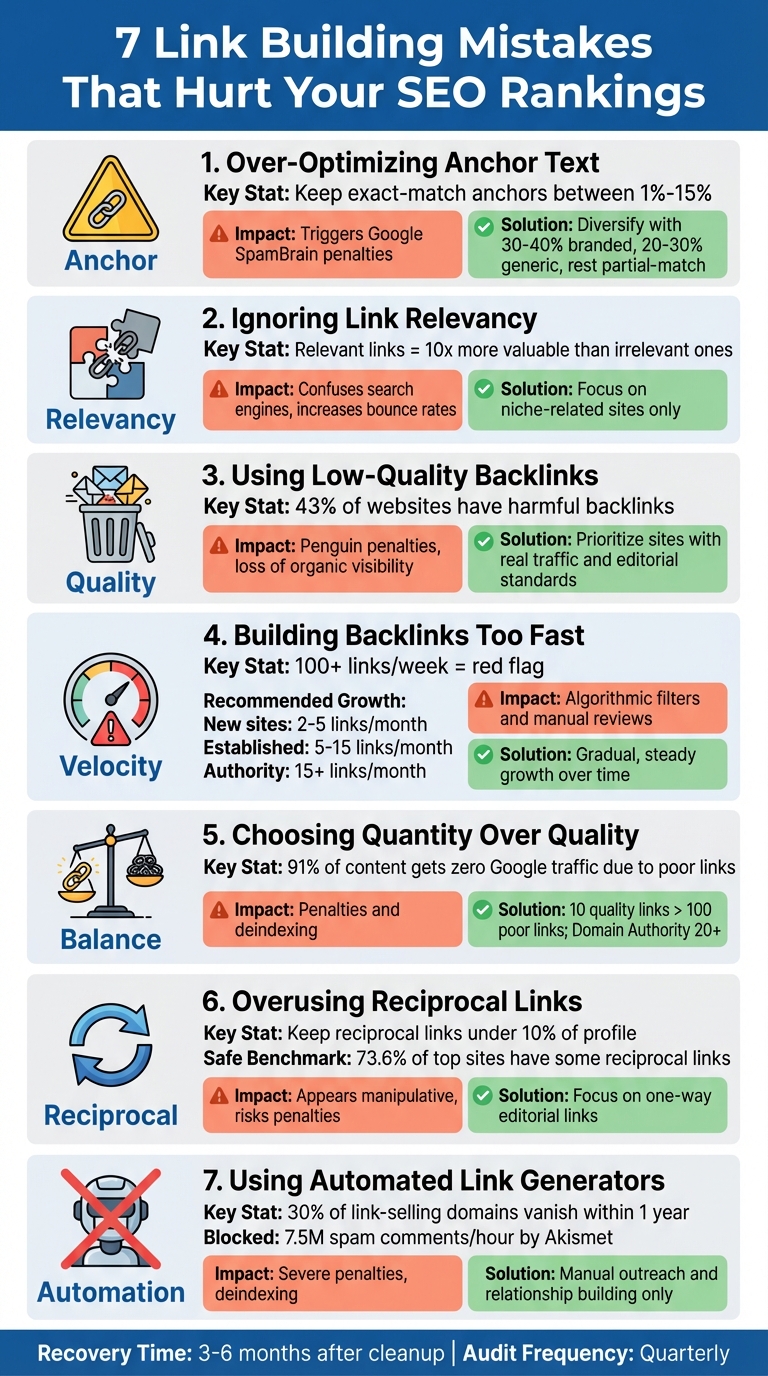
7 Link Building Mistakes That Hurt SEO Rankings - Quick Reference Guide
Link Building Mistakes You're [Likely] Doing (#7 Will Tank Your Site)
sbb-itb-0f47b19
1. Over-Optimizing Anchor Text
Stuffing anchor text with exact-match keywords is a surefire way to raise a red flag with Google. Their algorithms are smart enough to spot unnatural patterns, and overdoing it can look like you're trying to game the system.
Impact on SEO Rankings
If more than 80% of your backlinks feature identical exact-match anchor text, you’re setting off alarms for Google’s SpamBrain. This could lead to algorithmic penalties - or worse, manual actions - that send your rankings plummeting [5].
"Google could view the overuse of the same anchor text as spammy. And as a result, may even lower your page's rankings." - Aaron Haynes, CEO, Loganix [3]
A balanced backlink profile is key. Aim for exact-match anchor text to make up just 1% to 15% of your total backlinks. The rest should be a natural mix: around 30–40% branded anchors (like "Linkzy"), 20–30% generic phrases (such as "click here" or "read more"), and the rest using partial matches or plain URLs [5]. Overloading your links with the same phrase, like "best SEO tools for small biz", can make your profile seem manipulative, which is exactly what Google’s algorithms are designed to catch.
Finding the right balance in your anchor text strategy keeps you in Google's good graces.
Compliance with Search Engine Guidelines
The best way to stay on track? Diversify. Instead of repeating the same keyword phrase, rotate between branded terms, natural language, and descriptive phrases that fit seamlessly into your content. Avoid using identical anchor text more than once for the same target page [8]. Regularly reviewing your backlink profile ensures your anchor text distribution remains natural and varied. The goal isn’t to outsmart search engines - it’s to create a backlink profile that mirrors authentic, organic endorsements.
2. Ignoring Link Relevancy
Getting a backlink from a high-authority website might seem like a win - until you realize the site has nothing to do with your niche. Imagine a car mechanic's blog linking to your baking website. It doesn’t add up, and more importantly, it confuses search engines about your site's purpose.
Why Backlink Relevance Matters
When evaluating the relevance of a backlink, consider three key factors: topical similarity, content alignment, and contextual fit [4]. For instance, a link from an SEO blog to a link-building platform makes perfect sense. On the other hand, a link from a lifestyle blog to the same platform raises questions.
Since 2025, AI search tools and Large Language Models have started focusing on "contextual authority." This means they assess how well a link fits within the broader topic rather than just counting metrics. A good example? A collaboration between an undershirt brand and a luxury suit company on content about dress shirts. This kind of partnership enhances visibility for both brands by establishing clear, context-driven authority [2].
"Context beats the <href> tag." - Brian Dean, Founder, Backlinko [2]
How Irrelevant Links Hurt SEO
Backlinks that don’t align with your niche can lead to higher bounce rates and even penalties from search engines [3][6]. Google's Penguin algorithm, for example, actively penalizes sites with patterns of irrelevant or risky links [13].
"Link relevancy is one of the factors the Penguin algorithm watches for. If many links regularly come from unrelated sites, then you're putting your site at risk of being penalized." - Alexandra Tachalova, Founder, Digital Olympus [13]
Relevant, high-quality backlinks are incredibly powerful - offering up to 10x the value of irrelevant ones [5]. A single editorial link from a respected industry site can carry more weight than hundreds of unrelated links [6]. This makes it clear: quality and relevance should always come first in your link-building strategy.
Staying Within Search Engine Guidelines
To avoid penalties and build a strong backlink profile, focus on securing links from websites that are directly tied to your industry or closely related fields. For example, a SaaS company should prioritize links from tech or productivity blogs rather than generic lifestyle sites [6]. Regular audits of your backlink profile can help you identify and remove links from unrelated or risky sources [9]. And before accepting any link, take a close look at the surrounding content. Does it provide real value and naturally support the link? If not, it’s probably not worth it [6].
Search engines use this contextual information to determine whether your backlinks represent genuine endorsements or manipulative tactics [3]. By prioritizing relevance, you’ll not only protect your site from penalties but also build a stronger foundation for long-term SEO success.
3. Using Low-Quality Backlinks
Backlinks from spammy, irrelevant, or unreliable websites can do more harm than good for your SEO. In fact, they can lead to penalties that significantly hurt your rankings.
Impact on SEO Rankings
Low-quality backlinks can trigger penalties through updates like Google's Penguin algorithm or SpamBrain. These penalties might result in a drop in rankings - or worse, a complete loss of organic visibility. Search engines are quick to devalue links that show manipulative patterns, such as connections to link farms or Private Blog Networks (PBNs). In extreme cases, your entire site could face penalties.
The stats are eye-opening: 43% of websites have potentially harmful backlinks, often without the owners even realizing it [1]. On top of that, 91% of online content gets zero traffic from Google, frequently due to a lack of strong, quality links [1]. These numbers underline how poor-quality backlinks can waste marketing resources and lead to missed opportunities.
So, how can you tell the difference between a good backlink and a harmful one? Let’s break it down.
Evaluating Quality and Authenticity
To build a strong link profile, it’s crucial to recognize the signs of a valuable backlink. A site with little to no real traffic or organic search presence is a red flag. Links from gambling, adult, or pharmacy-related sites are especially risky and should be avoided.
Placement matters, too. Links buried in footers, sidebars, or "link dumps" are far less effective than those naturally embedded within the main content of a page. Additionally, sites with auto-generated, thin, or duplicate content - and those lacking proper editorial standards - are often low-quality sources. If a site has been hacked, penalized, or compromised in the past, any link from it could tarnish your website's reputation.
Here’s a quick comparison of what separates high-quality links from low-quality ones:
| Link Quality Indicator | High-Quality Backlink | Low-Quality Backlink |
|---|---|---|
| Source | Reputable, relevant industry sites | Spammy, irrelevant, or penalized sites |
| Traffic | Consistent organic visitors | Minimal or no organic traffic |
| Placement | Naturally embedded in main content | Footer, sidebar, or hidden links |
| Editorial | Earned through genuine value or relationships | Purchased in bulk or auto-generated |
| SEO Impact | Strengthens authority and rankings | Leads to penalties and weakens the site |
By focusing on these indicators, you can ensure your backlinks align with best practices.
Compliance with Search Engine Guidelines
Google’s Webmaster Guidelines are clear: buying or selling links that pass PageRank is considered a link scheme and is strictly prohibited. Automated link generators and bulk link packages not only violate these guidelines but also increase your domain's spam score, which can lead to de-indexing. For context, Akismet filters over 7.5 million spam comments every hour - showing just how common low-quality link attempts are.
To protect your site, conduct regular backlink audits - ideally every quarter. Tools like Google Search Console, Ahrefs, or Semrush can help identify harmful patterns. Always verify that potential linking sites rank for relevant keywords and have steady organic traffic. If you find toxic links that can’t be removed manually, Google’s Disavow Tool can be a useful last resort for dealing with spammy sources.
"The goal of link-building isn't just to accumulate links, it's to build relationships that create sustained visibility, authority, and relevance." - John Mueller, Google Search Advocate
4. Building Backlinks Too Fast
When it comes to backlinks, speed can be a double-edged sword. Acquiring too many links too quickly can set off alarms with search engines. A sudden spike - say, dozens or even hundreds of links in a short period - can look suspicious and unnatural [4][12].
Impact on SEO Rankings
Adding over 100 links in a single week raises red flags for search engines [5]. Such abrupt growth often triggers algorithmic filters or even manual reviews, leading to penalties like devaluation or de-indexing. A natural backlink profile develops gradually, showing steady and consistent growth over time [1][7]. If your link-building pace doesn’t match the rate at which you’re publishing content, search engines might suspect you’re relying on questionable tactics like automated tools, link farms, or paid schemes [4][5]. This is why focusing on sustainable, quality link-building practices is so important.
Compliance with Search Engine Guidelines
Search engines, including Google, use tools like SpamBrain to spot artificial link patterns [1][5]. Rapid link-building often involves methods that violate their quality guidelines, such as using automated tools, Private Blog Networks (PBNs), or bulk link-buying services. These "link schemes" are explicitly banned and can result in harsh penalties [1][4].
Here’s a quick look at what natural link growth might look like:
| Site Maturity | Recommended Monthly Link Volume |
|---|---|
| New Websites | 2–5 quality links |
| Established Websites | 5–15 quality links |
| Authority Websites | 15+ quality links |
To avoid trouble, spread your link-building efforts over weeks or months instead of cramming them into a few days [5]. SEO tools can help you keep track of your link acquisition rate and ensure it stays within a reasonable range [5][12]. Focus on creating content that naturally attracts links - like original research or in-depth guides. Diversify your backlink sources by exploring guest posts, PR opportunities, and resource pages to maintain a natural and balanced growth pattern [1][4][6][7].
5. Choosing Quantity Over Quality
When it comes to link building, chasing sheer numbers can backfire. A handful of high-quality backlinks will always outweigh a flood of low-quality ones. While it might be tempting to rack up hundreds of links, search engines like Google prioritize quality over quantity. In fact, 10 well-placed, relevant links can deliver far more value than 100 subpar ones [5]. Google’s algorithms are finely tuned to distinguish valuable links from those that are little more than noise.
Impact on SEO Rankings
A few solid backlinks from authoritative sources can do wonders for your rankings. On the flip side, a large collection of poor-quality links can lead to penalties or even removal from search results. Here’s a striking statistic: 91% of content gets no organic traffic from Google, often because it lacks a strong, quality link profile [1]. Tools like Google’s SpamBrain and Penguin are specifically designed to sniff out artificial link patterns. If your link-building strategy leans too heavily on quantity, you risk sudden ranking drops or even manual penalties [6].
Quality and Authenticity of the Backlinks
The difference between high- and low-quality backlinks is stark. High-quality links come from trusted, authoritative sites with real traffic and editorial oversight. In contrast, low-quality links - often from shady link farms or autogenerated content - can hurt your site’s credibility [5]. Be especially cautious of bulk backlink packages, as they’re a major red flag for search engines [5]. Always check whether a referring site has genuine engagement and traffic. If it doesn’t, the link might do more harm than good.
Relevance of Backlinks to Website Niche
Quantity can also erode trust if the links don’t align with your website’s niche. Links from unrelated industries send mixed signals to search engines, making it harder for them to determine your site’s authority on specific topics [14]. Instead, focus on earning links from sites within your niche that have strong topical authority [14]. Relevance is key - stick to links that genuinely tie back to your industry.
Compliance with Search Engine Guidelines
Search engines make their stance on link quality clear. Bulk link schemes and similar shortcuts violate Google’s Webmaster Guidelines and should be avoided [6]. Instead, carefully vet potential link sources. Look for websites with a Domain Authority of 20 or higher, steady organic traffic, and clear relevance to your field [5]. Regularly auditing your link profile using tools like Google Search Console can help you identify and disavow harmful links from spammy or irrelevant sites [5]. By staying vigilant, you can protect your site’s credibility and rankings.
6. Overusing Reciprocal Links
Just like over-optimization or relying on low-quality backlinks, keeping your link profile natural also means being cautious with reciprocal links. Essentially, reciprocal linking happens when two websites agree to link to each other. While this might seem harmless and even natural in some cases, going overboard can be risky. Search engines often flag excessive reciprocal linking as a tactic to manipulate PageRank [5][13]. If your backlink profile is packed with these mutual exchanges, it can come across as artificial to search engine algorithms [7][3]. This makes it crucial to understand how such practices can affect your rankings.
Impact on SEO Rankings
According to Ahrefs, 73.6% of top-ranking sites include reciprocal links, showing that small-scale, natural exchanges are usually fine [13]. However, keeping reciprocal links below 10% of your backlink profile is a good rule of thumb. Exceeding this threshold can lead to penalties, a significant drop in visibility, or even deindexing from search engines altogether [5][12]. Search engines are also skilled at spotting more complex patterns, like three-way link exchanges where Site A links to Site B, Site B links to Site C, and Site C links back to Site A [5].
Compliance with Search Engine Guidelines
Here’s some expert advice to keep in mind:
"Excessive reciprocal linking can appear unnatural to search engines. Instead of trading links indiscriminately, focus on earning links through valuable content and relationships." - Casey Bjorkdahl, Co-founder, Vazoola [7]
To stay on the right side of search engine guidelines, limit reciprocal links to genuine, meaningful partnerships [5]. Authenticity is key - if you're linking to another site purely because of an agreement, it could raise a red flag. Instead, aim for one-way, editorial backlinks that come from creating valuable, shareable content [5]. This approach helps ensure a diverse and natural backlink profile.
7. Using Automated Link Generators
Automated link generators take the risks of low-quality backlinks to an entirely new level. These tools often promise enticing results, like 1,000 backlinks in just 24 hours or even 10,000+ links for as little as $75 [12]. But don't be fooled - this is a shortcut that leads straight to trouble. These tools rely on bots to scatter your website URL across countless low-quality sites, creating unnatural link patterns that are easy for search engines to detect [12]. This approach stands in stark contrast to authentic, content-driven link-building strategies.
Quality and Authenticity of the Backlinks
One major issue with automated links is the complete lack of human oversight. These links are typically placed on link farms or irrelevant sites that exist solely to sell backlinks [10]. For instance, your tech-focused blog might suddenly receive links from unrelated niches, diluting your site's credibility and focus. To make matters worse, tools like Akismet, a widely-used spam prevention service, block over 7.5 million spam comments every hour - many of which are generated by automated bots [12]. This highlights just how pervasive and harmful these tactics can be.
Impact on SEO Rankings
The consequences of using automated link generators can be severe. Search engines are highly adept at spotting unnatural link-building patterns, such as sudden surges in backlinks or an influx of low-quality links. These red flags can lead to penalties, significant drops in rankings, or even complete removal from search results. A study examining 44,000 domains listed in link-selling databases found that nearly 30% of these sites vanished within a year [10]. That’s a clear warning sign of the risks involved.
Compliance with Search Engine Guidelines
Using automated link generators directly violates search engine guidelines, which strictly prohibit manipulative link-building tactics [10]. As Rituraj Sengar, Sr. SEO Analyst at Mavlers, explains:
"The easier a link is to obtain, the less value it typically holds. Bulk link purchases or shady marketplaces can result in penalties, undoing months (or years) of hard SEO work." [9]
If automated tools have already been used, consider using Google’s Disavow Tool to minimize the damage from toxic links. Looking ahead, focus on manual outreach and building genuine relationships. This is the only reliable way to achieve sustainable SEO success. Automation may seem tempting, but real, relationship-based link-building is a strategy worth sticking to.
How Linkzy Helps You Avoid These Mistakes
Linkzy offers a secure and smart way to steer clear of the common pitfalls associated with automated link generators. Instead of scattering your URL across irrelevant platforms, Linkzy ensures backlinks are placed only on contextually relevant sites. This means you won’t end up with mismatched pairings - like a healthcare blog linking to a pet grooming site - which can hurt both user engagement and SEO performance [11][3].
The platform goes a step further by thoroughly vetting each link source. It prioritizes sites with genuine organic traffic and strong authority, helping you dodge toxic backlinks from spammy link farms or low-quality directories [10][9][3]. This careful screening directly addresses the challenges we’ve covered, such as relevancy issues and the risks posed by poor-quality links. The result? A safer, naturally growing backlink profile.
Another key feature is Linkzy’s management of link velocity. Backlinks are placed on active websites with real audiences, not on abandoned domains or spam networks. This ensures a sustainable and organic growth pattern, giving your website a solid foundation for long-term success.
To complement these quality-driven practices, Linkzy offers a range of pricing plans tailored to different needs:
| Plan | Monthly Cost | Credits | Best For | Key Protection Features |
|---|---|---|---|---|
| Free | $0 | 3 credits | Testing the service | Basic quality filtering, niche targeting, no credit card required |
| Starter | $19 | 5 credits | Small businesses | Advanced relevancy filtering, natural link velocity, real-time analytics |
| Pro | $29 | 15 credits | Growing businesses | Full automation with quality control, priority support, anchor text diversity |
Each credit corresponds to one vetted, niche-relevant backlink. The Starter and Pro plans include automatic renewal and can be canceled anytime. Plus, all plans are universally compatible with any website platform, whether you’re using WordPress, Shopify, or a custom-built site.
Conclusion
Bad link-building practices can quickly sabotage your SEO efforts. Missteps like over-optimized anchor text or relying on automated link generators often focus on shortcuts rather than sustainable strategies. Aaron Haynes, CEO of Loganix, puts it plainly:
"If carried out incorrectly, instead of strengthening a site's rankings, it can actually have a catastrophic impact on SERP positions and SEO efforts" [3].
The risks are serious. Modern AI tools, from SpamBrain to ChatGPT, are adept at identifying manipulative links. They emphasize that one high-quality link can be far more impactful than dozens of low-quality ones [1]. Yet, 43% of websites unknowingly harbor harmful backlinks that undermine their rankings [1].
Recovering from penalties is no small task. It often requires months of manual cleanup, and even after securing quality links, it can take 3 to 6 months to see results [12]. The costs of getting it wrong - lost traffic, wasted budget, and a damaged reputation - make prevention a priority.
To avoid these pitfalls, consider a few practical steps. Conduct quarterly audits using tools like Google Search Console, ensure anchor text is naturally varied (keeping exact-match keywords under 15%), and focus on niche sites with stable traffic histories and at least 1,000 monthly organic visits [3]. Building genuine relationships for long-term visibility is far more effective than chasing superficial metrics.
These challenges highlight the importance of a disciplined, quality-first approach - something Linkzy is designed to simplify. If the process feels overwhelming, Linkzy can handle link vetting and natural growth, allowing you to focus on meaningful connections. Try the Free Plan and discover how quality-driven link building can elevate your SEO game.
FAQs
How can I make sure my backlinks are relevant to my industry?
To keep your backlinks relevant, start by targeting websites that align closely with your niche and audience. Focus on sites that discuss topics similar to yours and cater to the same type of readers. When reaching out, suggest content that fits seamlessly with their themes - think case studies, how-to guides, or industry-focused articles.
Before securing any backlink, take a close look at the site’s main topics, its audience, and how their existing links fit into the content. Avoid backlinks from unrelated industries, as they can negatively impact your SEO. Make it a habit to audit your backlinks regularly. Identify and remove any irrelevant links, replacing them with ones from more appropriate sources within your niche. Staying focused on relevance helps you build credibility with both your audience and search engines.
What are the dangers of using automated tools for building backlinks?
Using automated tools to build backlinks might seem like a quick fix, but it comes with some serious risks that can hurt your SEO efforts. These tools often churn out low-quality or spammy links that have little to no connection to your website's content. Search engines like Google are quick to penalize such practices, which can damage your rankings.
Another issue is the lack of personalization and relevance. Automated methods can’t match the effectiveness of links built with careful thought and strategy, which are key to creating a trustworthy backlink profile. Plus, many of these tools rely on outdated or even black-hat techniques that go against search engine guidelines, putting your site's reputation at risk.
To safeguard your SEO performance, stick with manual link-building strategies. Focus on creating meaningful, high-quality links that are relevant and built to last. It’s a slower process, but the long-term benefits are well worth it.
Does the speed of building backlinks impact SEO rankings?
Yes, how quickly you acquire backlinks - commonly called link velocity - can have a big impact on your SEO rankings. A steady, gradual increase in high-quality backlinks shows search engines that your site is growing its authority naturally, which builds trust over time. However, if there’s a sudden surge in backlinks, especially from poor-quality or unrelated sources, it might look suspicious and could lead to penalties or drops in rankings.
Taking a consistent, slow-and-steady approach to link building gives you the chance to create meaningful content that naturally attracts legitimate backlinks. While it might take anywhere from 3 to 12 months to see significant results, this method sets you up for stable, long-term SEO growth.