How to Optimize Anchor Text for Links
How to Optimize Anchor Text for Links
Anchor text is the clickable part of a hyperlink that helps users and search engines understand what the linked page is about. It’s crucial for SEO because it signals relevance and authority to search engines while improving user experience. However, over-optimizing anchor text can lead to penalties, and under-optimizing means missing out on its full potential.
Here’s a quick overview of the key takeaways:
-
Types of Anchor Text:
- Branded: Use your brand name (e.g., "Nike"). Safe and should make up 60–80% of your profile.
- Exact-Match: Matches the target keyword exactly (e.g., "email marketing tips"). Powerful but risky - limit to 1–5%.
- Partial-Match: Includes keywords with modifiers (e.g., "best email marketing tips"). Safer and can make up 5–25%.
- Generic: Non-keyword phrases like "click here." Helps balance your profile (10–20%).
- Naked URLs: Plain URLs (e.g., "www.example.com"). Low risk and natural.
-
Best Practices:
- Keep a natural mix of anchor types.
- Avoid overusing exact-match anchors to prevent penalties.
- Use tools like Ahrefs or Google Search Console to audit your anchor text regularly.
- Match your anchor text to the content it links to for clarity.
-
Quick Tips:
- For homepages, focus on branded anchors (60–70%).
- For blog posts, include more partial-match anchors (10–20%).
- Use contextually placed links in the main body of content for better SEO value.
A balanced and natural anchor text strategy can improve rankings, boost user engagement, and avoid penalties. Keep auditing and refining your approach to stay aligned with search engine standards.
Anchor Text Types Distribution Guide for SEO
Anchor Text SEO Guide - Mastering Offsite Optimization in 2024
sbb-itb-0f47b19
Types of Anchor Text and When to Use Them
Different types of anchor text play specific roles in shaping your link profile. Knowing how and when to use each type can help you build a profile that’s both effective for SEO and safe from penalties. The key is to aim for a natural mix that both search engines and users find credible.
Branded Anchor Text
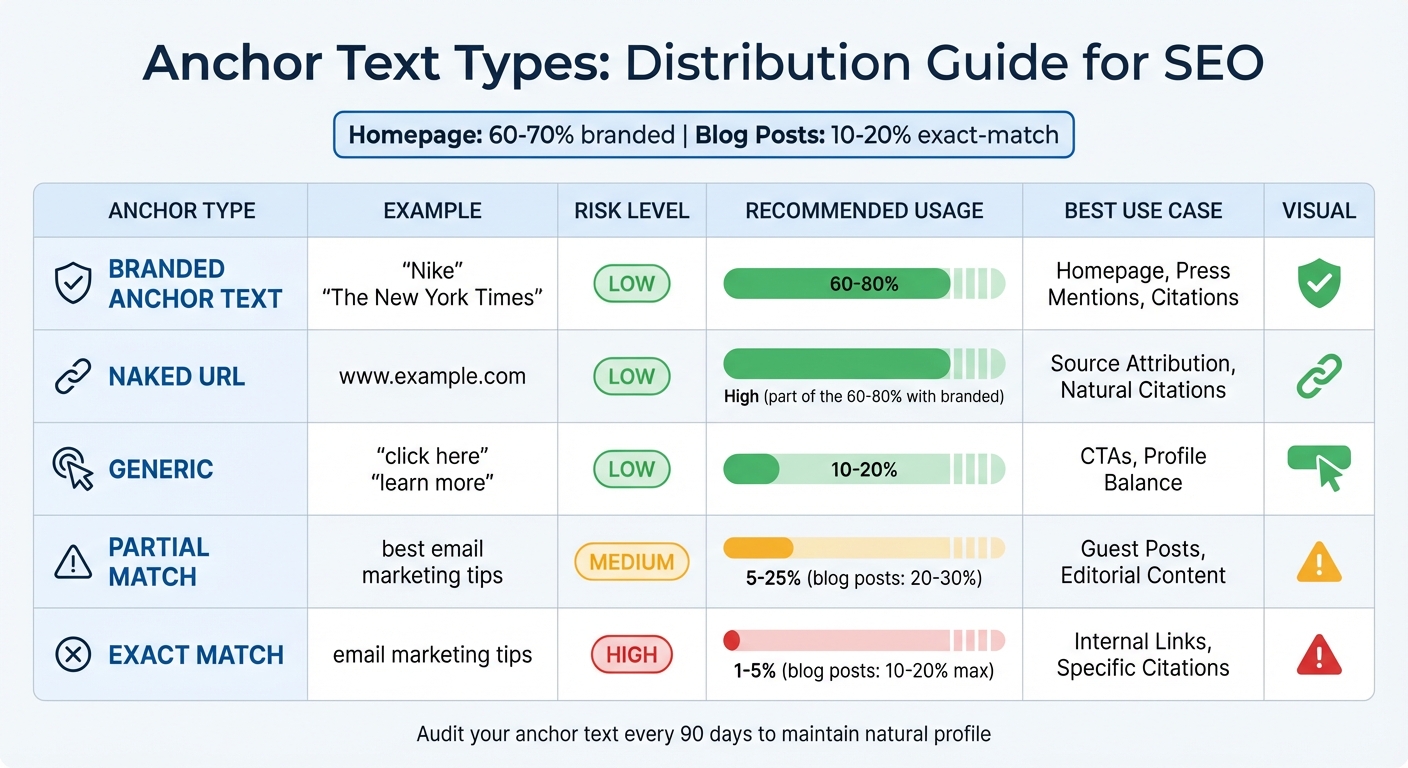
Branded anchor text uses your company or website name as the linked text. Examples include "Linkzy", "Nike", or "The New York Times." These anchors are a cornerstone for building trust and legitimacy. They’re considered low-risk and typically account for 60% to 80% of a healthy profile, along with naked URLs [3].
Branded anchors are great for press mentions, citations, or any reference to your brand. For service pages, they can make up 40% to 50% of your anchor profile, leaving room for other types of anchor text.
Exact-Match and Partial-Match Anchor Text
Exact-match anchors use your target keyword verbatim, like linking "email marketing tips" to a page about email marketing tips. Partial-match anchors, on the other hand, include your keyword along with modifiers, such as "best email marketing tips for agencies."
Exact-match anchors are powerful but risky. They should represent only 1% to 5% of your external links to avoid penalties. Partial-match anchors are safer and can make up 5% to 25% of your profile, providing relevance without raising red flags. For blog posts, partial-match anchors can go up to 20% to 30%, as they naturally attract more diverse anchor text [5].
As one expert explains:
"Exact match anchor text can be used, but sparingly. If Google sees that every backlink pointing to that same... page... uses keyword rich anchor text, it's going to assume something's up." - dofollow.com [4]
Generic and Natural Phrases
Generic anchors include phrases like "click here", "learn more", or "this guide." While they don’t contribute to keyword signals, they’re essential for maintaining a natural link profile. These anchors should make up 10% to 20% of your links [3].
Generic anchors are perfect for calls to action and help balance profiles that might otherwise overuse keyword-rich links. To improve user experience, consider swapping generic phrases like "click here" for more descriptive ones, such as "this helpful guide." Search engines also evaluate the surrounding text, so placing branded anchors in relevant, focused content can amplify their impact [3].
| Anchor Type | Risk Level | Recommended Usage | Best Use Case |
|---|---|---|---|
| Branded | Low | 60-80% | Homepage, Press Mentions, Citations |
| Naked URL | Low | High | Source Attribution, Natural Citations |
| Generic | Low | 10-20% | CTAs, Profile Balance |
| Partial Match | Medium | 5-25% | Guest Posts, Editorial Content |
| Exact Match | High | 1-5% | Internal Links, Specific Citations |
Up next, we’ll look at how to audit your anchor text to ensure these strategies are working effectively.
How to Audit Your Anchor Text
Auditing your anchor text is a critical step in evaluating your backlink profile's impact on SEO. Start by gathering all your backlinks using SEO tools, then categorize each anchor into five types: Branded, Exact Match, Partial Match, Generic, and URL. Once you've collected the data, export it into a spreadsheet that includes columns for anchor text, the linked URL, and domain authority [7].
After organizing your data, calculate the percentage of each anchor type. Compare these percentages to industry standards. For example, if exact-match anchors exceed 10%, it could signal over-optimization [8]. From there, review your data for any red flags.
Spotting Over-Optimization Risks
Over-optimization often happens when too many exact-match or "money" keywords link to the same page. A good rule of thumb is that your homepage should have 60–70% branded anchors, while blog posts can safely handle 10–20% exact-match anchors [5]. Google's SEO guidelines caution against forcing keywords into anchor text: "If it feels like you're forcing keywords into the anchor text, then it's probably too much" [6].
To fix this, focus on adding branded and generic links rather than removing existing ones. You can also replace exact-match anchors with synonyms. For instance, use "SEO tools for online stores" instead of "best SEO software" [6]. If your site uses an Exact-Match Domain (EMD), be extra careful, as branded anchors may overlap with keyword anchors. In such cases, lean more on generic and URL anchors to keep your profile looking natural [5].
Checking Diversity and Relevance
Anchor text diversity and relevance are just as important as avoiding overuse. To achieve this, benchmark your anchor text distribution against competitors in your niche. This helps you understand what search engines consider natural for your industry [8].
Your anchors should also provide an "information scent", meaning the text should give users a clear idea of what they'll find after clicking. Generic phrases like "click here" are okay, but they should be supported by descriptive surrounding text for context [6]. Use exact-match anchors sparingly, and only in high-authority, editorial contexts [8].
Tools for Anchor Text Analysis
Several tools can make anchor text audits more efficient. Here are some popular options:
- Ahrefs: Offers detailed anchor text distribution reports with dofollow filters [9].
- Google Search Console: Provides authoritative data on your site's top anchor phrases. Discrepancies between this data and third-party tools can indicate that Google is ignoring certain links [10].
- Semrush: Includes a Toxicity Score to assess risk.
- Moz Pro: Flags domains with a Spam Score above 30%, signaling potential issues.
- Majestic: Supplies Trust Flow and Citation Flow metrics, along with the surrounding context for each anchor [10].
- Yoast SEO: Alerts you when multiple pages compete for the same focus keyphrase in their anchor text, useful for WordPress and Shopify users [1].
| Tool | Primary Audit Strength | Key Metric for Anchors |
|---|---|---|
| Ahrefs | Competitive Intelligence | Anchors Report (Dofollow filter) |
| Google Search Console | Authoritative Validation | Top Anchor Text (Direct Google Data) |
| Semrush | Risk Assessment | Toxicity Score |
| Moz Pro | Real-time Monitoring | Spam Score / Just-Discovered Links |
| Majestic | Quality/Trust Analysis | Trust Flow (TF) / Citation Flow (CF) |
If you're using an automated backlink-building service like Linkzy, it's especially important to audit your anchor text regularly. This ensures your backlinks remain natural and contextually relevant.
If you discover a high volume of spammy, keyword-stuffed anchors from low-quality sites, consider using the Google Disavow Tool to avoid potential ranking penalties [7]. The goal isn't to have a perfect profile but to maintain one that looks natural and earned - not artificially manipulated.
Building Your Anchor Text Strategy
Once you've completed your anchor text audit, the next step is to turn those findings into a solid plan. The goal here is to create a strategy that combines SEO effectiveness with natural link-building patterns, keeping in mind how advanced search engines operate today [12].
For internal links, you can lean more on keyword-focused anchors. But when it comes to external links, diversity is key [4][11]. Your approach should also match the intent of the content - informational pages work well with descriptive or educational anchors, while transactional pages benefit from action-oriented phrases [11].
Balancing Anchor Text Types
A well-distributed anchor text profile not only keeps you safe from penalties but also builds trust with search engines. The right mix depends on the type of page. For example:
- Homepage: Focus on branded anchors (60–70%) with minimal exact-match usage (1–5%).
- Blog posts: These can handle a bit more exact-match anchors (10–20%) since they target specific topics.
- Service pages: These fall somewhere in between, requiring a balanced approach [5].
Exact-match anchors are a double-edged sword. Used sparingly, they can boost SEO, but overuse can make your profile look artificially optimized. If you’re working with an Exact-Match Domain (EMD), tread carefully - your branded anchors already include keywords, so balance them with URL and generic anchors to keep things natural [5]. For non-EMD domains, branded anchors serve as a safe way to build trust without risking over-optimization [5][12].
To make your strategy even more natural, consider anchor text cycling. Start with branded and URL anchors, then gradually add partial-match anchors. Only introduce exact-match anchors once you’ve established a strong, organic-looking base [5]. This step-by-step approach mirrors how backlinks are typically earned over time.
Matching Anchor Text with Content
Anchor text should set clear expectations about the page it links to. Before finalizing any anchor, check the target page’s H1 tag, SEO title, and main keywords. Your anchor should reflect the page’s topic naturally [13][2]. For instance, an anchor like "meta description best practices" should lead directly to a page focused on meta descriptions - not a general SEO guide [1][2].
To ensure your anchors fit smoothly into the content, try the "Read Aloud" Test. If it sounds awkward or forced, rework it.
Instead of repeating the same keyword, use semantic variations. For example, if your page is about "email marketing automation", mix it up with phrases like "automated email campaigns", "marketing automation tools", or "email workflow software." This variety helps search engines grasp the broader topic while keeping the content natural [13][2].
Also, avoid creating internal competition. Don’t use the same keyword as anchor text for multiple pages within a single post. This can confuse search engines about which page to rank for that term [1]. If rankings seem stuck, try breaking up long keyword phrases. For example, instead of "plumber New York", use either "plumber" or "New York" for a more natural approach [13].
One example of success: A website saw a 180% increase in organic traffic over six months by switching from generic "click here" anchors to descriptive, keyword-relevant ones that aligned with user intent [12].
Best Practices for Contextual Backlinks
A strong anchor text plan gets even better when paired with contextual backlinks. These links, embedded within the main body of relevant, high-quality content, carry far more SEO value than those placed in sidebars or footers [2]. For best results, ensure the anchor text aligns with both the surrounding content and the destination page’s topic [2].
The ideal anchor text ratios depend on your niche. Look at the top five competitors for your target keywords to determine what works best [13]. Mature backlink profiles often show branded and naked URL anchors making up 60–80% of links, with exact/partial-match anchors accounting for just 5–15% [3].
If you’re using tools like Linkzy for automated placements, make sure they complement your manual efforts. Maintain a natural link-building pace and diversify your anchors. Regular audits using tools like Ahrefs or Semrush can help you keep identical anchors below 30% [12].
If you notice over-optimization, dilute it by building new branded or generic links instead of removing existing ones, as removing links can destabilize rankings [3]. Google’s Penguin algorithm, introduced in April 2012, specifically targets unnatural anchor text profiles, so maintaining a natural look is crucial [13].
Lastly, don’t overlook the "context window" - the text surrounding your anchor. Search engines evaluate this to ensure the link fits naturally within the paragraph. The sentences before and after the anchor are just as important as the anchor itself. Make sure the entire placement reads like it was added thoughtfully, not mechanically, for SEO purposes [11].
Monitoring and Updating Your Anchor Text
Keeping a close eye on your anchor text strategy is essential for maintaining a balanced link profile. Regular checks can help you spot and address over-optimization before it impacts your rankings.
Tracking Anchor Text Performance
Start with Google Search Console to understand how Google views your anchor text. Then, use tools like Ahrefs or SEMrush to dive deeper into competitive analysis and identify potential risks. Export your anchor data and leverage pivot tables to quickly detect patterns, like an overuse of certain phrases.
Keep an eye on your anchor text ratios. For instance, if more than 60% of your anchors are exact-match keywords, it could signal over-optimization and put your site at risk of penalties. If your rankings seem stuck, analyzing your anchor text distribution might reveal the problem.
"Anchor text is one of the most powerful relevancy signals we have. But when we see a profile that is overly optimized, it's a red flag that the links may not be earned organically." – Former Google Webmaster Trends Analyst
Make it a habit to audit your anchor text profile every four months. Tools like Moz's "Just-Discovered" feature are excellent for tracking new backlinks in near real time. This ensures that efforts like guest posts or digital PR campaigns contribute to a natural and balanced anchor profile.
Use these insights to refine your strategy and address any issues.
Updating Outdated or Irrelevant Anchors
Once you identify performance issues, the next step is to adjust outdated or overly aggressive anchors. If over-optimization is a concern, don’t remove links outright. Instead, dilute them by creating new branded, generic, or naked URL links.
"Over-optimized profiles are fixed by dilution, building new branded and generic links to reduce the proportion of aggressive anchors, rather than risking unstable removal." – Stellar SEO
Begin with your internal links since they’re entirely within your control. Revise these links to strengthen topical clusters and improve crawl efficiency. For example, tools like Yoast SEO can flag instances where using your focus keyword as anchor text for multiple pages might lead to internal keyword cannibalization.
Before making changes, try the "Read Aloud" Test discussed earlier. Additionally, analyze the anchor profiles of top-ranking competitors in your industry. Search engine expectations can vary by niche, so understanding what works for others can guide your updates.
Keeping Up with SEO Changes
As you refine your anchor text strategy, stay flexible. Search engines now evaluate anchor text within the broader context of surrounding sentences and paragraphs, rather than focusing solely on exact keyword matches. Recent updates emphasize natural integration of anchor text into content.
"Anchor text optimization is no longer about gaming algorithms. It is about supporting clarity, relevance, and trust." – Samuel Darwin, President, LinkDoctor.io
With AI-driven evaluations becoming more advanced, search engines now prioritize semantic understanding. This means moving away from repetitive exact-match keywords and opting for natural, contextually relevant variations. Study the anchor profiles of top-ranking sites to see how they align with these modern standards. As search engines evolve, your anchor text should enhance thematic relevance and seamlessly fit into the overall content structure.
Conclusion
Building a natural, trustworthy link profile comes down to optimizing your anchor text thoughtfully. Strive for diversity: aim for 30–50% branded anchors, 20–30% partial-match phrases, and keep exact-match keywords under 10% to avoid triggering spam filters [8]. While there’s no magic formula - something SEO expert Eric Ward emphasized:
"There is no perfect percentage for keyword anchored vs. non-keyword anchored backlinks…" [8]
These percentages offer a reliable starting point for most websites.
Make it a habit to audit your link profile every 90 days using tools like Ahrefs or SEMrush. Keep an eye out for warning signs, such as identical anchors making up more than 30% of your links [12]. If you notice over-optimization, don’t rush to remove links. Instead, balance things out by adding branded, generic, or naked URL anchors [3]. This method keeps your profile natural and aligns with the recommended quarterly audit cycle.
Here’s a quick tip: apply the "Read Aloud" Test to your anchor text. If it sounds awkward or unnatural when spoken, it’s time for a rewrite [12]. Remember, anchor text does more than just link - it provides context. Google considers the surrounding text to understand the topic of your link [3].
With AI now influencing nearly half of all searches (47%) [12], crafting anchors that clearly signal the linked content is more important than ever. For those looking to save time while maintaining a natural link profile, an automated tool like Linkzy (https://linkzy.ai) can be a game-changer.
FAQs
How do I choose the right anchor text for a specific page?
When crafting anchor text, aim for something descriptive, relevant, and that fits smoothly into your content. The text should clearly indicate what the linked page is about while balancing keyword relevance with natural phrasing.
For example, if you're linking to a services page, use specific terms like "web design services" rather than something vague. Vary your anchor text to keep your link profile looking natural - this helps avoid the pitfalls of over-optimization.
And here's a tip: steer clear of generic phrases like "click here". Not only do they fail to describe the link's destination, but they also miss an opportunity to enhance both the user experience and your SEO efforts.
How can I fix an over-optimized anchor text profile without removing links?
To address an over-optimized anchor text profile without removing links, focus on diversifying your anchor text. Shift away from relying heavily on exact match keywords. Instead, incorporate a variety of anchor types, such as branded anchors, generic phrases (like "click here" or "learn more"), partial match keywords, and even plain URLs. By redistributing your anchor text in this way, you create a more natural and balanced link profile. This approach helps you stay aligned with SEO guidelines while reducing the risk of penalties - all without needing to remove existing links.
How often should I audit my anchor text, and what should I watch for?
Regularly reviewing your anchor text is a smart move - aim for every few months or whenever you spot shifts in your traffic or rankings. Pay close attention to any overuse of exact-match keywords, irrelevant or spammy text, and patterns that seem forced, as these could raise red flags and lead to penalties. To keep your backlink profile looking natural and credible, mix things up by using a variety of anchor text types: branded, generic, partial match, and even plain URLs.