How AI Places Contextual Backlinks
How AI Places Contextual Backlinks
Contextual backlinks are hyperlinks embedded directly within content, making them more effective for SEO than links placed in footers or sidebars. These links help search engines identify relevance and improve rankings by establishing connections between related pages. AI has transformed backlink placement by automating tasks like finding niche-relevant sites, assessing content relevance, and managing link insertion.
Key Points:
- What Are Contextual Backlinks? Links placed within content that naturally fit and provide value to readers.
- Why Use AI? AI speeds up backlink placement by analyzing relevance, scanning websites, and automating outreach.
- How It Works: AI identifies relevant sites, evaluates contextual fit, selects optimal placement, and monitors performance.
- Benefits: Faster link-building, reduced costs, improved SEO results, and better risk management.
- Example Tool: Platforms like Linkzy automate the process, offering features like real-time analytics and niche-specific targeting.
AI has made backlink building faster, scalable, and more precise, focusing on relevance and placement to maximize SEO impact.
🤯 Build Links Automatically (AI SEO Link Builder)🔥
How AI Places Contextual Backlinks
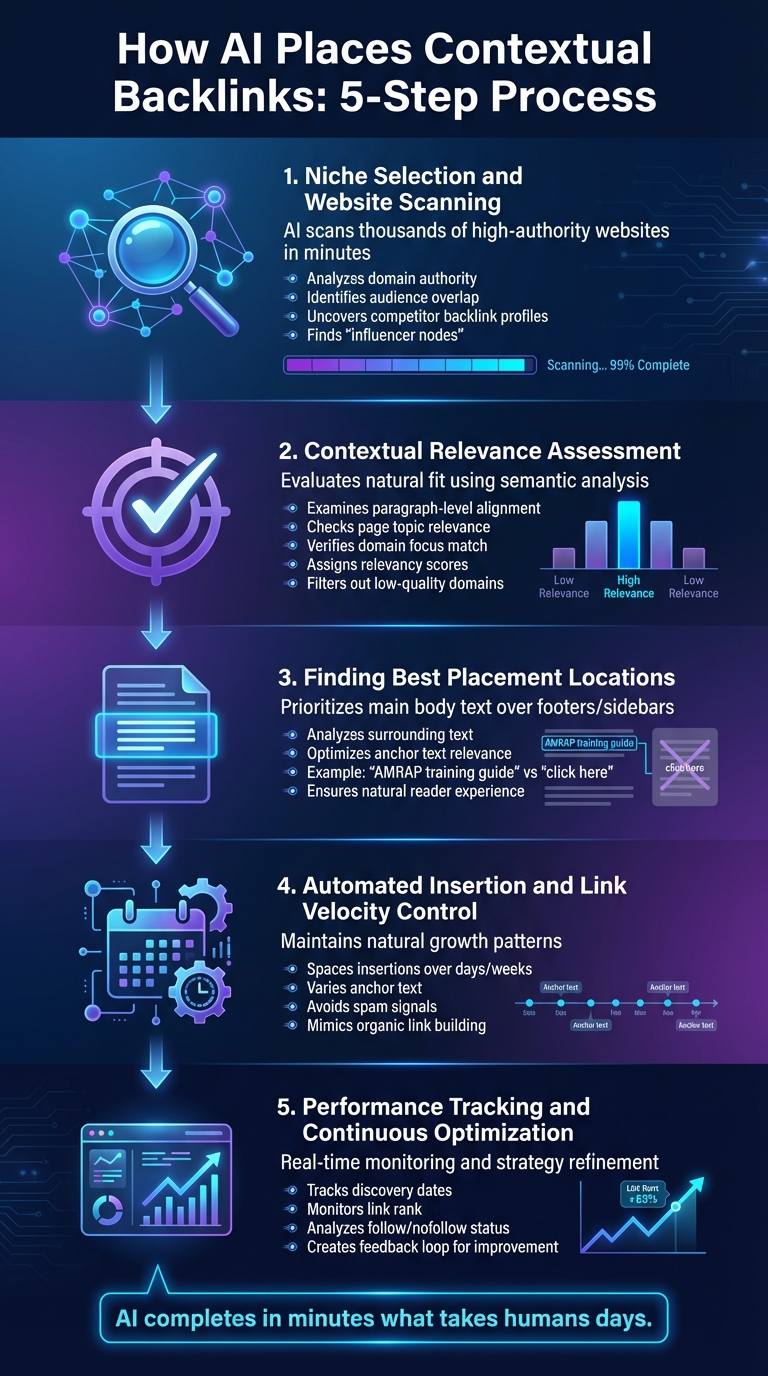
5-Step AI Contextual Backlink Placement Process
AI uses a structured, data-driven approach that mirrors - and often outperforms - the strategies of experienced SEO specialists [1]. Here's a breakdown of how this process works.
Step 1: Niche Selection and Website Scanning
Start by choosing your niche, and let AI comb through the internet to find high-authority websites relevant to your field. Using advanced algorithms, the system identifies patterns and connections across massive datasets, completing in minutes what might take a human days [1]. This includes analyzing factors like domain authority, audience overlap, and content themes to compile a list of potential linking opportunities. Additionally, AI digs into competitor backlink profiles to uncover "influencer nodes" - websites that link to multiple high-value domains within your niche [6]. These insights highlight the most influential sites in your industry and reveal where competitors are gaining their edge. This thorough scan sets the stage for the next step: evaluating contextual fit.
Step 2: Contextual Relevance Assessment
Once potential sites are identified, AI evaluates how well a backlink would fit naturally within the content. It examines factors like topical clustering, co-citation relationships, and semantic relevance to ensure the link feels organic [1]. The system looks at alignment on three levels: the specific paragraph where the link would appear, the overall topic of the page, and the focus of the entire domain [3].
"Contextual means that a machine, like an algorithm or LLM, is able to understand and respond to prompts based on meaning, relationships, and intent instead of just matching keywords."
– Authority Builders [3]
AI assigns each potential placement a relevancy score, measuring how closely the site's content aligns with your goals. It also filters out low-quality or harmful domains that could hurt your rankings or trigger penalties from search engines [7].
Step 3: Finding the Best Placement Locations
Not all parts of a webpage carry the same SEO impact. AI prioritizes links placed within the main body text over those in footers, sidebars, or author bios [3]. It carefully examines the surrounding text to find spots where your link naturally enhances the reader's experience. Anchor text is another critical factor - AI ensures it acts as a clear and relevant label. For instance, in the fitness niche, instead of using vague phrases like "click here", AI might recommend something specific like "AMRAP training guide" when linking within a discussion about workout routines [3]. This meticulous approach ensures that every link placement adds value.
Step 4: Automated Insertion and Link Velocity Control
After identifying the best spots, AI takes care of inserting the links while maintaining a natural growth pattern. To replicate organic link-building, it spaces out insertions over time - days or even weeks - and varies anchor text to avoid triggering spam signals [1][8].
Step 5: Performance Tracking and Continuous Optimization
AI’s job doesn’t end after placing the links. It monitors their performance in real-time, tracking metrics like discovery dates, link rank, and whether the links are followed or nofollowed [5]. By analyzing which placements drive the most SEO value, the system fine-tunes its strategy over time. This creates a feedback loop where AI learns from each placement, refining its approach to consistently improve rankings without requiring constant manual intervention.
Benefits of AI-Optimized Contextual Link Placement
AI-driven link placement has reshaped how backlinks are built, turning what used to be a slow, tedious process into a fast, scalable system powered by data. With AI, backlink campaigns can now reach 10x more prospects, automating key steps like discovery, qualification, and outreach. This frees up human teams to focus on strategic planning instead [4].
The results speak for themselves: businesses adopting AI tools have reported a 35% reduction in outreach costs, a 29% boost in Domain Rating, and the ability to identify toxic domains 2.1x faster [10]. This proactive approach protects websites from penalties that could otherwise take months to recover from.
AI also ensures that backlinks are placed where they matter most - within contextually relevant body content. Search engines like Google, which rank backlinks among their top three factors for SEO as of 2026 [4], prioritize links based on relevance and placement. Links buried in sidebars or footers carry less weight, but AI guarantees your links appear in the content itself, maximizing their impact.
Manual vs. AI-Driven Backlink Placement
The gap between manual and AI-driven strategies becomes clear when you compare their performance:
| Factor | Manual Placement | AI-Driven Placement |
|---|---|---|
| Speed | Slow; requires hours of research per prospect [5] | Fast; automates discovery with one click [5] |
| Scalability | Limited by available manpower [9] | High; sends 1,000+ personalized emails per hour [9] |
| Accuracy | Relies on subjective judgment [4] | Data-backed; evaluates 15+ quality indicators [4][5] |
| Risk Mitigation | Prone to human error and spam patterns | Automates toxic link detection and controls link velocity [9][4] |
AI drastically shortens the timeline for backlink campaigns - what might take days for a team of humans can now be completed in minutes.
Scalability and Cost-Effectiveness
The efficiency AI brings also translates into cost savings and scalability, making it a game-changer for businesses of any size. For small businesses and startups, AI eliminates the need for large SEO teams or expensive monthly retainers. It automates the most time-consuming tasks - like finding prospects, retrieving contact details, and scoring site quality - allowing even a single person to manage campaigns that would typically require an entire team.
The real advantage isn’t just doing more work but doing it smarter. AI evaluates over 15 quality factors to identify the best opportunities, ensuring every dollar spent delivers maximum ROI [4].
"The craft is still human; the heavy lifting is automated" - Single Grain [2]
sbb-itb-0f47b19
How Linkzy Automates Contextual Backlinks
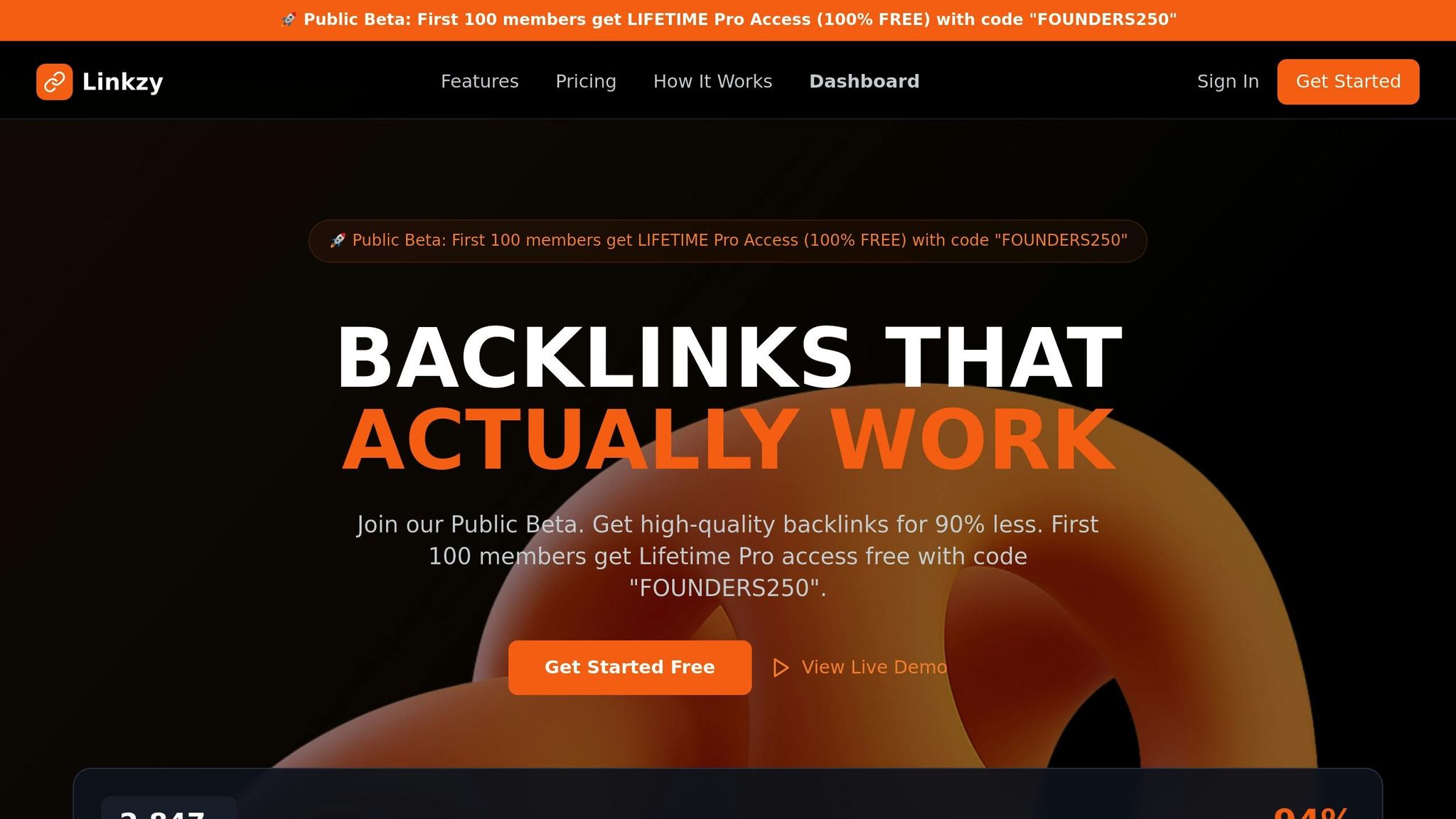
Linkzy takes the concepts of AI-driven backlink building and turns them into a streamlined, automated system. It eliminates the need for a dedicated team or months of manual effort by using AI to handle everything - from identifying niche opportunities to placing links. This means you can focus on your business while Linkzy takes care of the heavy lifting.
The platform evaluates hundreds of data points, like topical relevance, audience overlap, and historical linking trends, to pinpoint the best opportunities for link placement [1][2]. Once it's set up, Linkzy continuously monitors your backlink profile, adjusting to changes in search engine algorithms in real-time [1]. This dynamic process aligns perfectly with the principles of AI-driven backlink strategies.
Key Features of Linkzy
Linkzy’s features are designed to automate and refine every step of backlink building. It uses niche-specific targeting that goes beyond simple keyword matching. By analyzing topical relevance, keyword authority, and related authority within your industry, the system ensures that every link feels natural and fits seamlessly into its context [12].
The platform also provides real-time analytics, giving you instant insights into how each backlink impacts your organic growth. With performance dashboards, you can track ROI for every campaign, see which links are driving results, and monitor success across your entire backlink profile [13]. This transparency helps you understand exactly where your resources are going and what they're delivering.
How Linkzy Simplifies Backlink Building
Getting started with Linkzy is quick and easy. Simply select your niche and add a tracking snippet to your site. From there, the AI takes over - identifying link opportunities, assessing contextual relevance, and placing links on a schedule that mimics natural link growth. This gradual approach, known as natural link velocity, is favored by search engines and ensures organic-looking results.
The platform works seamlessly with any website setup, whether you're using WordPress, Shopify, or a custom-built site. Integration is straightforward, relying on API connections and automated scheduling, so you don't need technical expertise or a complicated setup process.
Linkzy offers three pricing plans:
- Free Plan: 3 credits
- Starter Plan: $19/month for 5 credits
- Pro Plan: $29/month for 15 credits
Paid plans renew automatically but can be canceled anytime.
What sets Linkzy apart is its AI-driven content placement. Links are embedded within naturally flowing text, avoiding forced placements that could raise red flags with search engines. This approach has already shown results, with 65% of businesses reporting improved SEO performance after incorporating AI tools into their processes [11]. It’s a clear example of how automation, when done right, can lead to measurable success.
The Future of AI in Backlink Building
AI is reshaping backlink building, turning it into a strategic tool for boosting digital authority rather than just a technical task. By 2025, 70% of marketing leaders are expected to increase their automation budgets, with the market projected to grow from $6.65 billion in 2024 to $15.58 billion by 2030 [2].
One of the biggest changes is the growing importance of citations. Mentions in AI tools like ChatGPT, Perplexity, or AI Overviews are now just as impactful as traditional backlinks. Search engines are shifting their focus from raw authority metrics, such as Domain Authority or Domain Rating, to analyzing context - how and where a link appears within the content. This means that a link’s relevance and placement within the text matter more than ever [3].
AI is also revolutionizing how link prospects are evaluated. Decision-making engines now use historical linking patterns, audience overlap, and topical similarity to score link opportunities, eliminating much of the manual guesswork. As Tim Soulo from Ahrefs aptly states:
The organizations thriving in this new landscape are those that:
"approach link building as relationship building and use data and AI to inform strategy" [4].
Additionally, AI integrations in browsers and search platforms are redefining how link endorsements are measured. Research highlights three key factors for AI-driven visibility: branded web mentions, branded anchors, and branded search volume - all of which are influenced by contextual backlinks [3].
Key Takeaways
AI-powered backlink building enhances efficiency, scalability, and SEO outcomes. Automated tools now handle tasks like prospecting, relevance scoring, and link placement, freeing up teams to focus on strategy [2][4]. To maximize results, prioritize links embedded within content over those placed on the periphery, and focus on contextual relevance rather than chasing high Domain Authority scores [3]. Tools like Linkzy simplify the entire process - from selecting niches to managing link velocity - making professional-grade backlink strategies more accessible without the high costs or time commitment of traditional agencies.
The future of backlink building isn’t about replacing human expertise but amplifying it. As Single Grain explains:
"Automated link building is not a robot replacement for relationships; it's an engine that handles the repetitive work so your team can focus on strategy." [2]
The real challenge is how quickly you can adopt AI-driven backlink strategies. These advancements are paving the way for even more sophisticated SEO automation in the years ahead.
FAQs
How does AI decide if a contextual backlink is relevant?
AI evaluates the relevance of a contextual backlink by examining the content surrounding the link. It ensures that the link fits seamlessly into well-written, topic-specific content that matches the subject of the linked page. Key factors include the anchor text, the nearby text, and the overall quality of the content.
By analyzing the semantic context and the topical connection between the linking and linked pages, AI ensures the backlink contributes meaningfully. This process boosts search engine rankings by signaling both relevance and authority to search engines.
How does AI improve the process of placing contextual backlinks?
AI streamlines the process of adding contextual backlinks by blending automation, accuracy, and scale. Instead of relying on manual approaches, AI can sift through massive datasets to pinpoint high-quality, niche-specific opportunities in record time. This ensures backlinks are placed in content that aligns seamlessly with the context - something search engines value for improved rankings.
Tasks like evaluating websites, finding prospects, and placing links are automated through AI, saving time and minimizing human error. It also maintains a steady, natural pace for link building, which is critical for sustained SEO growth. Over time, AI tools can refine and improve their strategies by analyzing performance data, making the entire process even more effective in delivering results.
How can businesses ensure AI-generated backlinks follow SEO best practices?
To make sure AI-generated backlinks follow SEO best practices, businesses should prioritize relevance, quality, and transparency. Contextual backlinks - those seamlessly integrated into related content - are particularly effective because they enhance trust and add semantic value that search engines value.
Tools like Linkzy can help by automating the placement of niche-relevant, high-quality backlinks on authentic websites. This approach ensures links are added in a consistent and natural way, staying within SEO guidelines and avoiding tactics like spammy or unrelated links. By focusing on relevance and obtaining links from trustworthy sources, businesses can stay compliant and get the most out of their SEO efforts.