How AI Simplifies Geo-Targeted Link Building
How AI Simplifies Geo-Targeted Link Building
Geo-targeted link building is now faster and more precise with AI tools. Instead of spending weeks manually finding local websites, sending outreach emails, and tracking results, AI automates these tasks. This approach helps businesses secure high-quality local backlinks, which are essential for appearing in AI-generated search answers like ChatGPT and Google AI Overviews.
Key takeaways:
- AI tools identify local websites and automate outreach, saving time and cutting costs by 35%.
- Local backlinks improve visibility in AI-driven search results and traditional search engines.
- AI dashboards track link performance, including mentions in AI-generated responses.
With platforms like Linkzy, even small businesses can efficiently build local backlinks starting at $19/month, leveling the playing field against larger competitors. Geo-targeted link building is no longer just time-intensive - it’s smarter and more accessible.
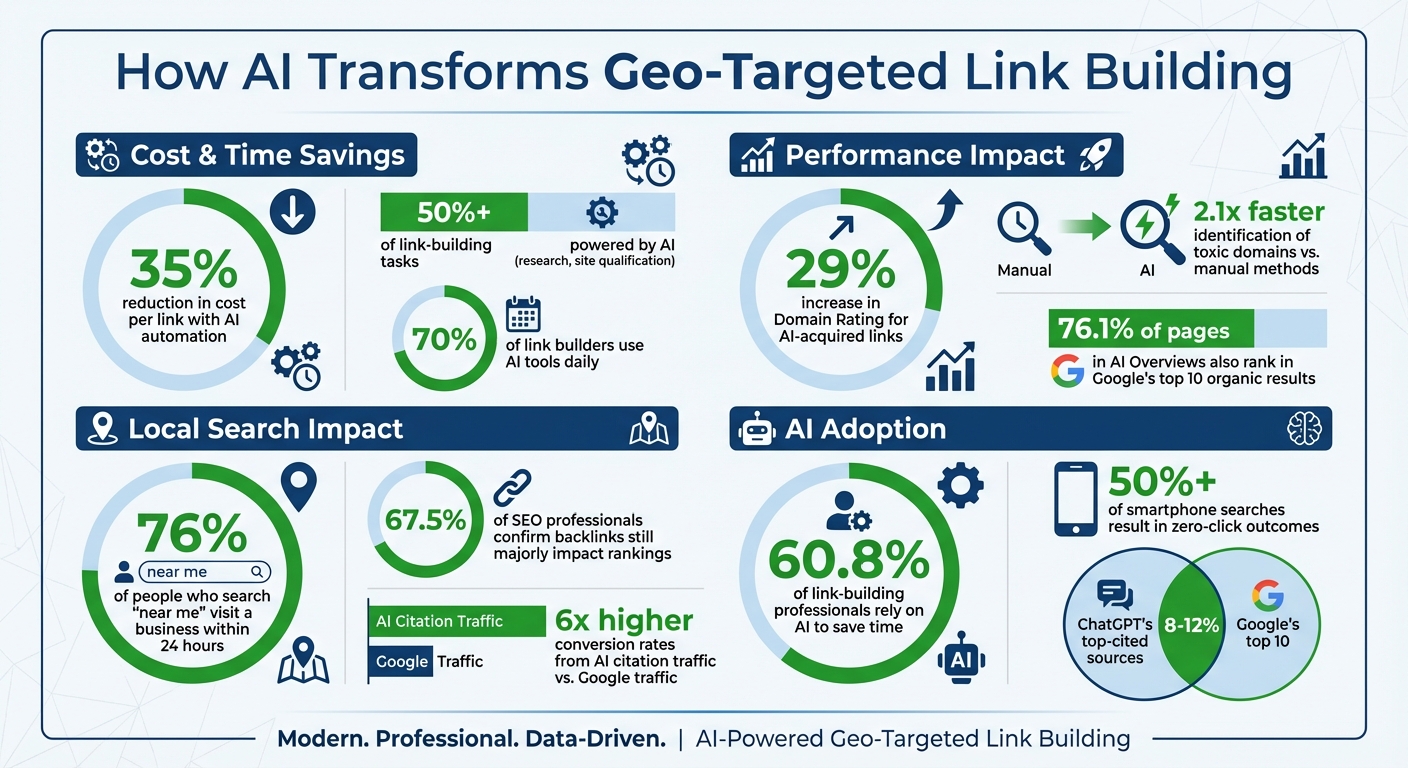
AI-Powered Geo-Targeted Link Building: Key Statistics and Benefits
What is Geo-Targeted Link Building
Definition and Purpose
Geo-targeted link building involves obtaining backlinks from local sources - such as regional news outlets, directories, and country-specific domains (ccTLDs) - to boost your visibility for location-based search queries [1][6]. These links act as a signal of "local relevance" to both traditional search engines and modern AI-driven tools like Perplexity and ChatGPT [1][7]. For instance, having local backlinks helps search engines understand your service area for searches like "plumber in Austin" or "best coffee shop in Brooklyn."
Looking ahead to 2026, geo-targeted link building will play a vital role in Generative Engine Optimization (GEO), ensuring that your business is featured prominently in AI-generated responses [1]. Alex Sandro, Senior Product Manager at Serpzilla, highlights the importance of these links:
For searches locked to a country, ccTLDs and native-language sites send a strong 'this is local' signal [1].
With 67.5% of SEO professionals confirming that backlinks still have a major impact on search rankings, geo-targeted links remain a powerful tool for establishing regional authority [8]. However, the challenges of manual link-building methods reveal some significant hurdles.
Common Problems with Manual Methods
Manually building local backlinks is a slow, labor-intensive process that requires expertise in tasks like prospecting, crafting personalized outreach, and following up effectively [5][6]. Many businesses can only manage a limited number of outreach emails each week, which significantly caps their ability to acquire local links at scale. Automation tools can speed up this process while maintaining relevance and authenticity [5].
Another challenge is maintaining consistent Name, Address, and Phone number (NAP) information across directories. Managing this manually is nearly impossible, and inconsistencies can confuse search engines, ultimately hurting your local rankings [9][4]. With over half of smartphone searches now resulting in zero-click outcomes, businesses that fail to efficiently build local link equity risk being left out of AI-generated answers entirely [7].
The Step-by-Step GEO Strategy to Rank in ChatGPT, Perplexity & AI Overviews
How AI Makes Geo-Targeted Link Building Easier
AI has transformed the once time-consuming task of building local backlinks into a highly efficient, scalable process. Instead of manually searching for relevant websites and crafting outreach emails one by one, AI tools now handle much of the heavy lifting, including prospecting, placement, and monitoring - all in a fraction of the time. In fact, over 50% of link-building tasks, such as research and site qualification, are now powered by AI tools, and 70% of link builders rely on AI daily to streamline their work [10].
The precision AI brings to link building is unmatched. Using Natural Language Processing (NLP), AI ensures your links are placed on websites that align closely with your business's focus. It can filter prospects by country-code Top Level Domains (like .de or .ca) and verify geographic relevance by checking for consistent NAP (Name, Address, Phone) data across directories [1].
Tracking performance has also evolved. AI dashboards now go beyond traditional metrics, monitoring whether your backlinks are cited in generative engines like ChatGPT, Perplexity, and Google AI Overviews - not just in search rankings [1][2]. As SEO expert Matt Diggity puts it:
AI isn't killing SEO. It's creating the biggest opportunity gap I've seen in my 16 years of doing this [10].
Finding Websites by Location and Industry
AI tools are revolutionizing the way websites are identified for link-building campaigns. They crawl search results, competitor backlink profiles, and curated publisher lists to uncover potential link partners at a scale that human teams can't match [5]. By analyzing topical similarity, audience demographics, and historical linking behavior, AI predicts which sites are most likely to deliver results for your campaign [11][5].
These tools also pre-qualify prospects, saving you time by presenting only the most relevant options [11][5]. Certain platforms even offer vetted directories to simplify the process further [1].
AI doesn’t just stop at the obvious prospects. It can identify websites with topical proximity to your business, even if they don’t explicitly mention your target location. By analyzing geographic signals such as domain type, language, and NAP consistency, AI uncovers opportunities that manual research might overlook [1]. The result? A broader, more accurate pool of link prospects tailored to your industry and target markets.
Creating Natural Anchor Text and Link Placement
AI takes the guesswork out of crafting anchor text by generating phrases that reflect how real users naturally phrase their questions. This improves relevance for AI-driven answer engines [1]. Instead of relying on generic or over-optimized keywords, AI creates descriptive, natural-sounding anchors that integrate seamlessly into the content. It also suggests localized variations and entity-rich phrasing to better align your links with the concepts on your target pages [1].
Placement is equally critical. AI prioritizes embedding links within the body copy of a page - rather than in footers, sidebars, or boilerplate text - because this mirrors organic editorial patterns [1][5]. By using techniques like "Smart Topic Matching" and "Auto-Topic Filtering", AI ensures your links appear in content that is semantically aligned with your target page. This approach is crucial for the growing focus on Generative Engine Optimization (GEO), where links need to be placed near "chunk-ready" passages that AI systems can easily cite [1].
To avoid over-optimization penalties, AI systems enforce diversity in your backlink profile. They manage anchor text distribution - balancing branded, URL, and partial-match anchors - to maintain a natural appearance [5]. As Alex Sandro, Senior Product Manager at Serpzilla, explains:
Traditional backlinking is usually after domain‑level authority and generic topical relevance. GEO link building targets retrieval relevance [1].
Internal linking also benefits from AI. Tools like Link Whisper analyze your site’s content to suggest relevant internal links and suitable anchor text, helping search engines build a coherent knowledge graph around your site [13]. Together, well-placed external backlinks and optimized internal links create a link profile that looks organic to both traditional search engines and AI-driven platforms.
Tracking Performance with Analytics
AI doesn’t just help build links - it ensures those links deliver measurable results. Modern AI dashboards track whether your backlinks are driving impact by monitoring "retrieval and citation" in generative engines like ChatGPT, Perplexity, and Google AI Overviews [1][2]. This matters because 76.10% of pages cited in AI Overviews also rank in Google’s top 10 organic results, showing a strong connection between traditional authority and AI relevance [12].
These systems measure more than just the number of links earned. They track link decay (when links break or disappear) and analyze the downstream effects on rankings and revenue, offering insights far beyond vanity metrics [5]. AI tools also flag risky or low-quality links using historical data and pattern-based classifiers, helping businesses avoid penalties. Companies using AI-assisted link building have reported a 29% increase in Domain Rating for acquired links and identified toxic domains 2.1 times faster than manual methods [3]. Additionally, the cost per link has dropped by about 35%, making geo-targeted campaigns more accessible for businesses of all sizes [3].
Some tools go a step further, calculating Citation Probability Scores (CPS) to predict the likelihood of a backlink being cited by AI. These scores consider factors like Domain Authority (30%), Content Structure (25%), Freshness (20%), Evidence Density (15%), and Technical Optimization (10%) [2]. By prioritizing high-CPS backlinks, you can maximize visibility in AI-generated answers.
AI also automates quarterly audits to detect broken or dropped links and suggests new destinations to reclaim lost equity [1]. With this level of detailed tracking, you can easily identify what’s working, refine your strategy, and scale your campaigns to reach new markets effectively.
sbb-itb-0f47b19
How to Use AI for Geo-Targeted Link Building
AI can make geo-targeted link-building campaigns much easier to manage. By automating technical tasks, these tools allow you to focus your energy on strategy and achieving measurable results. Here’s how to get started:
Step 1: Choose Your Niche and Target Locations
Start by defining your business niche and the regions you want to target. Tools like ChatGPT and Claude can help you create hyperlocal search phrases, such as "walk-in dentist Chicago", designed to capture high-intent local searches [14][6]. This is crucial because studies show that 76% of people who search for "near me" end up visiting a business within 24 hours [14].
AI keyword clustering can take this a step further by organizing topics based on search intent and aligning them with specific neighborhoods [6]. For instance, if you’re targeting multiple U.S. cities, AI can uncover neighborhood-specific terms that broader keyword tools might miss. When selecting link prospects, focus on country-specific TLDs (like .us for U.S. sites) and native-language pages. These signals boost local relevance, helping AI algorithms better recognize and rank your content [1].
Using AI to build a focused keyword map ensures your link-building efforts are semantically aligned with your business. This approach benefits both traditional search engines and AI-powered answer engines, creating a strong foundation for your campaign [15].
Once you’ve nailed down your niche and target areas, you can move on to automating your link placements.
Step 2: Set Up Automated Backlink Placement
Automating backlink placement can save time and ensure consistency. Tools like Linkzy make this process straightforward by matching your content to relevant sites on a natural schedule. All you need to do is select your niche, add a tracking snippet to your site, and let the AI handle the rest.
The main advantage here is scale. AI crawlers scan search results, publisher directories, and competitor backlinks, evaluating link prospects based on topical relevance, audience overlap, and historical trends [5]. These systems also manage anchor text diversity and link velocity to ensure your backlink profile looks natural and avoids penalties [5].
For geo-targeted campaigns, focus on securing links from sites with clear NAP (Name, Address, Phone) details and local domain signals [1]. Automation can also extend to personalized outreach by using content snippets tailored to each prospect [16].
Once your automated placements are in motion, the next step is tracking and refining your campaign.
Step 3: Track and Adjust Your Campaigns
To measure success, look beyond traditional keyword rankings. Instead, track how often your content is cited in AI-generated answers. Research shows that only 8–12% of ChatGPT’s top-cited sources overlap with Google’s top 10 search results, highlighting the need for dedicated AI tracking [17].
Use weekly audits with niche-specific queries to measure your Share of Answers, a metric that reflects your visibility in AI-driven search environments [17]. AI analytics can also help you segment traffic by source, using UTM parameters to differentiate visitors from AI citations versus traditional search [17][2]. Companies earning traffic from AI mentions report conversion rates up to six times higher than those from Google traffic [17][2].
Another useful metric is the Citation Probability Score (CPS), which predicts how likely your pages are to be referenced. Factors like domain authority, content structure, freshness, and evidence density all play a role [2]. Perform quarterly audits to repair broken or dropped links, particularly on structured pages with FAQs and clear headings - formats that AI engines tend to favor [1].
As Krishna Kaanth from MaximusLabs puts it:
The strategy fundamentally shifts from 'winning the keyword' to 'winning the mention pool' [17].
Adjust your geo-targeting efforts based on performance data. If certain cities or regions show stronger results, reallocate your resources to focus on those areas. Keep fine-tuning your campaign to maximize visibility and conversions driven by AI insights.
Using Linkzy for Geo-Targeted Link Building
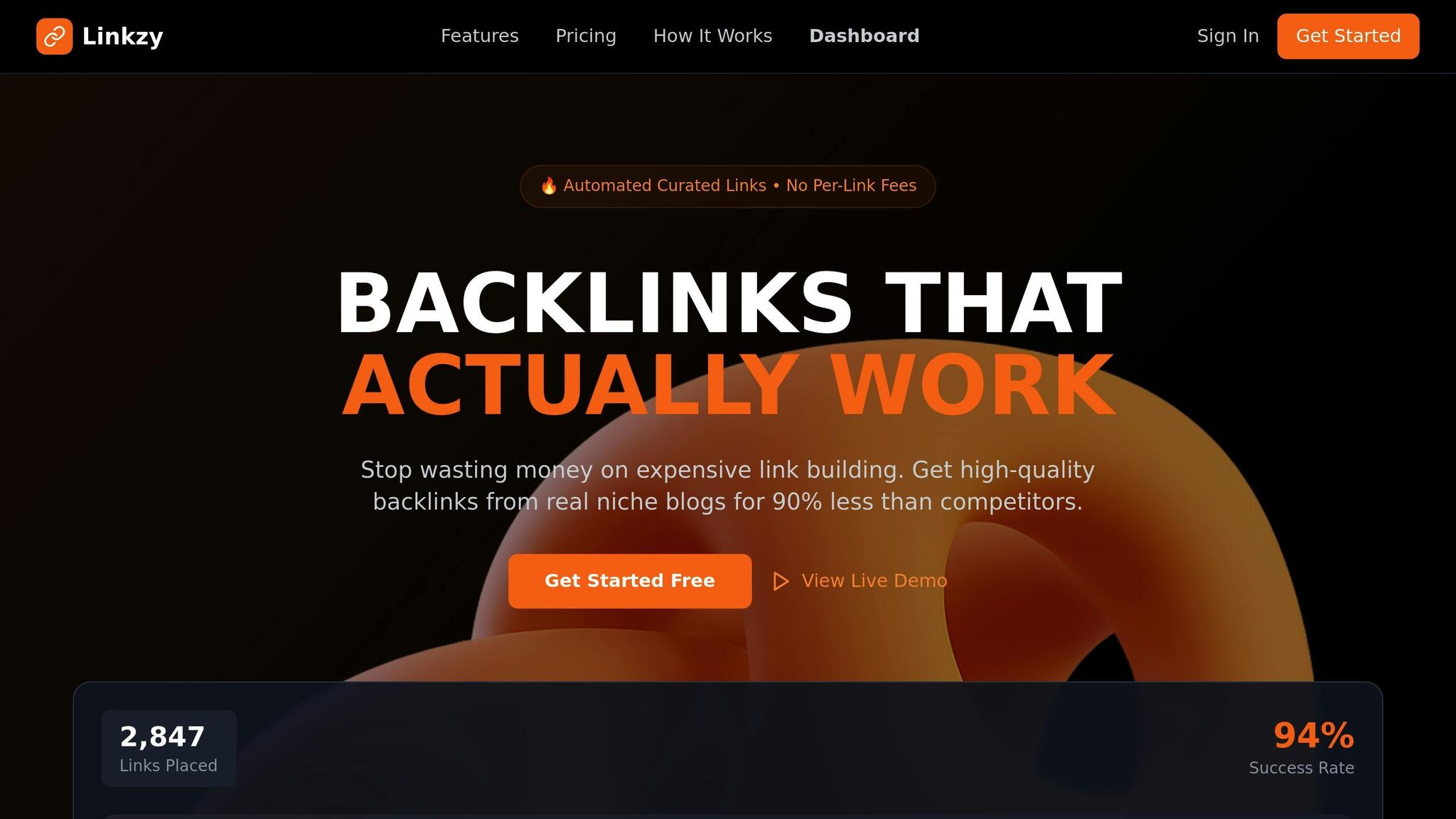
Linkzy takes the guesswork out of geo-targeted link building by automating key processes. From identifying location-specific publishers to placing contextual backlinks on a natural schedule, this platform simplifies the entire process, making it accessible for small businesses. Here’s a closer look at how Linkzy’s features can elevate your geo-targeted link-building strategy.
Main Features
Automated Placement eliminates the hassle of manual outreach and negotiating with publishers [16][19]. Linkzy’s AI finds the most relevant pages and places backlinks automatically. For small business owners, this solves one of the most time-consuming aspects of traditional link building [18].
Niche-Specific Targeting ensures your backlinks are placed on sites that are highly relevant to your industry [16]. The AI focuses on matching anchor texts to content with strong topical relevance, rather than just chasing high domain authority. This mirrors how modern search engines prioritize context and relevance when evaluating sources [1].
Real-Time Analytics provide insights into your campaign’s performance. You can monitor link health, track metrics, and identify issues like link decay or anchor text changes that could impact SEO [5]. This feature is particularly helpful for geo-targeted campaigns, where measuring local search rankings and "near me" queries is critical [20].
Universal Platform Compatibility ensures Linkzy works seamlessly with any website platform, whether you’re using WordPress, Shopify, or a custom-built site. With API and WordPress integration options, even small businesses without technical expertise can benefit.
Dmytro Sokhach, Founder & CEO of Editorial.link, highlights its affordability:
Prices start at $20-30, so it's an affordable solution for local businesses with tight budgets or SEO agencies that build links at scale [16].
Plans and Pricing
Linkzy offers plans designed with small businesses in mind:
| Plan | Price | Credits | Key Features |
|---|---|---|---|
| Free | $0 | 3 credits on signup | Test the service with no credit card required; access to high-quality backlinks. |
| Starter | $19/mo | 5 credits monthly | Niche-specific targeting, standard automated placement, cancel anytime. |
| Pro | $29/mo | 15 credits monthly | Real-time analytics, priority support, full platform compatibility, cancel anytime. |
The Free plan is a great way to test Linkzy’s fit for your niche before committing to a paid plan. Each credit corresponds to one backlink placement on a relevant publisher site. All plans renew automatically but offer the flexibility to cancel anytime. The Pro plan includes priority support, ideal for businesses needing quicker assistance.
Conclusion
Geo-targeted link building has become far more efficient, thanks to AI stepping in to handle what used to be weeks of manual work. Today, 60.8% of link-building professionals rely on AI to save time [21], and those who’ve adopted it report a 35% drop in outreach costs per link [3].
This shift isn’t just about saving time - it’s about achieving better results. As search evolves with AI-driven tools, geo-targeted backlinks are more important than ever. In fact, 76.1% of pages featured in Google’s AI Overviews also rank within the traditional top 10 organic results [12]. This highlights the growing importance of local relevance, whether you’re targeting AI-powered search engines or traditional rankings. Tools like ChatGPT and Perplexity prioritize sources with strong geographic and topical signals, making local backlinks a critical factor.
Platforms like Linkzy simplify this entire process. Instead of spending hours researching local publishers or negotiating link placements, you can benefit from automated backlink placement on niche-focused sites with consistent link velocity. Plus, with real-time analytics, you can monitor performance effortlessly. And with plans starting at just $19/month, even small businesses can compete with larger players.
As Cassandra Rosas, SEO Outreach Manager at Omniscient Digital, aptly says:
In 2025, if you're building links, pitching media, or running SEO without AI in the mix, you're not ahead of the curve - you're behind it [21].
AI-powered tools make scaling local SEO easier than ever. Are you ready to take advantage of them?
FAQs
How does AI make geo-targeted link building easier and more effective?
AI has made geo-targeted link building much more efficient by taking over tasks that used to eat up hours of manual work. It can quickly identify local websites, evaluate geographic signals like domain extensions or local citations, and prioritize the best backlink opportunities - all with impressive speed and accuracy.
On top of that, AI simplifies outreach efforts by creating personalized content at scale, including tailored email pitches and anchor text suggestions. It even handles link placement, ensuring the posting schedule feels natural, while keeping tabs on search trends to make sure your backlinks stay aligned with local search intent. Tools like Linkzy use AI to provide high-quality, niche-specific backlinks on real user websites, making geo-targeted link building faster, smarter, and more scalable than ever.
How do local backlinks influence AI-driven search rankings?
Local backlinks work as geographic endorsements, signaling to search engines powered by AI which local sources can be trusted and are relevant. This helps search algorithms prioritize websites with strong, niche-specific link profiles, especially when those links come from well-regarded local sites. By creating geo-targeted backlinks, your site becomes a trusted resource for a specific area, boosting its visibility in AI-generated search results.
AI systems also rely on these local signals to interpret the context behind geographically focused searches like “best coffee shops in Seattle.” When your site has geo-relevant backlinks, it aligns better with user intent, enhancing both traditional SEO rankings and your chances of being featured in AI-driven search answers. Tools like Linkzy make this process easier by automating the creation and placement of high-quality, location-specific backlinks, helping businesses improve their online presence across the U.S. effortlessly.
How can small businesses use AI tools like Linkzy to improve their link-building efforts?
AI-powered link-building tools like Linkzy make it easier for small businesses to gain high-quality, niche-specific backlinks without the hassle of extensive manual outreach or hiring a full SEO team. These tools work by analyzing keywords, page context, and target sites, then automatically creating and placing contextual backlinks on real websites. The result? Less time and effort spent on link-building.
For businesses in the U.S., these tools offer some clear advantages. They come with affordable monthly plans, allow for quicker implementation, and help target local search terms that attract nearby customers. By using AI, small businesses can boost their local search rankings, build trust in their brand, and generate more leads - all while focusing their energy on running their business.