How Backlinks Build Trust Online
How Backlinks Build Trust Online
Backlinks are a core part of building credibility online. They act like endorsements for your website, signaling to search engines and users that your content is reliable and worth engaging with. High-quality backlinks from reputable sources can improve your search rankings, enhance your brand's online reputation, and establish authority in your niche.
Here’s why backlinks matter:
- Search engines trust them: Backlinks help search engines evaluate your site’s expertise and authority using frameworks like Google’s E-E-A-T (Experience, Expertise, Authoritativeness, Trustworthiness).
- Users trust them too: Links from respected sources create confidence in your brand before users even visit your site.
- Quality over quantity: A few relevant, well-placed links are more impactful than many low-quality ones.
- Relevance is key: Backlinks from sites in your niche carry more weight than random, unrelated links.
To succeed, focus on building natural, diverse, and contextually relevant backlinks while avoiding spammy or irrelevant links. Tools like Linkzy can simplify the process by automating outreach and helping you secure meaningful connections.
Backlinks are more than just SEO tools - they’re trust signals for both search engines and users, helping your brand stand out in an increasingly competitive digital landscape.
Google's #1 Ranking Factor: TRUST and How To Build It With Backlinks
How Backlinks Signal Trust to Search Engines and Users
Backlinks serve a dual purpose - they're trust signals for both search engines and users. Grasping how each group interprets these links can help you shape a stronger online presence.
How Backlinks Build Search Engine Trust
Search engines rely on backlinks to gauge your site's credibility, using frameworks like Google's E-E-A-T (Experience, Expertise, Authoritativeness, and Trustworthiness). When reputable sites link to your content, it’s like getting a stamp of approval for your authority in your field [4][5].
"Think of EEAT as the report card for your website's quality, and backlinks are the graded assignments and teacher recommendations that prove you've earned your marks." - Digital Kulture [4]
Modern algorithms, such as BERT and MUM, go beyond just counting links - they analyze the context around them to determine intent and relevance. For example, a link from a niche-specific site, like an automotive blog linking to a car parts retailer, carries far more weight than one from a random, unrelated site [3][4].
The pace of link growth, known as link velocity, also plays a role. A steady, natural increase in backlinks signals genuine authority. On the other hand, sudden spikes in backlinks can raise red flags and may lead to penalties for spammy behavior. Google's Penguin update constantly evaluates and devalues unnatural links in real time, ensuring only authentic backlink patterns contribute to your ranking [3][4].
But backlinks don’t just matter to algorithms - they also influence how users perceive your brand.
How Backlinks Build User Confidence
When your brand shows up in Google's AI Overviews, it’s a reflection of trust earned through a strong backlink profile [1][8]. These overviews now appear in more than 60% of commercial searches, and sites with solid backlink profiles are frequently chosen as cited sources [8].
Backlinks also help search engines expand their Knowledge Graph, linking your brand to key concepts and entities. This can unlock features like Knowledge Panels in search results - an instant signal of credibility for users [4]. For instance, when someone sees a detailed Knowledge Panel for your brand, they’re more likely to trust you, even if they don’t realize backlinks played a role in creating it.
The source of the backlink matters just as much to users. Links from respected publications or editorial mentions act as subtle endorsements. When someone clicks on a link to your site from a reliable news outlet or an industry blog, they arrive with a sense of trust already established. This is why digital PR has become such a powerful tool - it secures mentions in high-authority spaces that users inherently trust [8].
What Makes Backlinks Trustworthy
Not all backlinks are created equal. The ones that truly matter are those with measurable qualities that build trust, while low-quality links can actually harm your site by inviting penalties.
Quality Over Quantity
Authority and trust are not interchangeable. A site might boast a high Domain Authority (DA) or Domain Rating (DR), but that doesn't automatically make it trustworthy. As BacklinkGrid explains:
"Trust provides a floor of safety. Authority without trust creates risk" [6].
The most reliable backlinks come from sites with a stable history (at least two years old), consistent ownership, and strict editorial standards [6][10]. These sites should also maintain steady organic traffic without the kind of sudden drops that suggest penalties from search engine algorithms [9].
Experts also suggest checking a site's Spam Score - aiming for it to stay below 30 - and ensuring a Trust Ratio of at least 0.15 to minimize risks [10].
Before accepting any link, take the time to verify the site's transparency. Look for clear "About" pages, physical contact details, and real team members with credentials that can be confirmed, like LinkedIn profiles [1][6]. Also, review the site's outbound links. If it connects to questionable industries like unregulated supplements, gambling, or essay-writing services, it's better to avoid it [9][10].
A trustworthy backlink profile also benefits from being diverse and naturally built over time.
Diversity and Natural Placement
Building trust isn’t just about quality - diversity and natural placement are equally important.
A varied backlink profile holds more weight than one filled with repetitive links. For instance, ten backlinks from ten different reputable domains are far more valuable than a hundred links from a single site [2]. Additionally, a natural profile should include a mix of link types: dofollow, nofollow, sponsored, and UGC (User-Generated Content) tags [4][7]. A profile consisting solely of dofollow links can look suspicious.
Google’s SpamBrain AI is designed to identify link networks and neutralize their impact before they can influence your rankings [4]. Moreover, links placed naturally within a page’s main content are much more valuable than those found in footers or sidebars, which may be considered manipulative or devalued by search engines [4][7]. With advancements like Google’s BERT algorithm, the context of a link matters significantly. For example, a link embedded within a positive review or used as an authoritative citation carries far more weight.
Recency and Relevance
The timing and relevance of backlinks are just as crucial as their quality and diversity.
Relevance is key. As Stellar SEO puts it:
"A backlink is no longer just a vote. It is a context signal that helps Google decide which entities belong together, which topics a site is qualified to rank for, and which references are independent versus manufactured" [9].
Search engines now calculate the "semantic distance" between topics using advanced vector embeddings. For example, a link from a plumbing supplier to a plumber - where the topics are closely related - is far more valuable than one from a tech gadget blog, which might be seen as irrelevant noise [9]. Links from sites that consistently cover your niche carry more weight than isolated mentions, which can appear out of place [9].
Consistent, contextually relevant links from frequently updated sites build stronger trust [6][9].
By 2026, backlinks will not only influence search rankings but will also serve as trust signals for AI systems [1]. These systems will assess not just the number of links but also who is linking to you and how they describe your brand. As Linkbuilder.io explains:
"Trust is no longer about counting links; it's about verifying content quality, relevance, and accuracy" [1].
sbb-itb-0f47b19
How to Build Trust with Backlinks
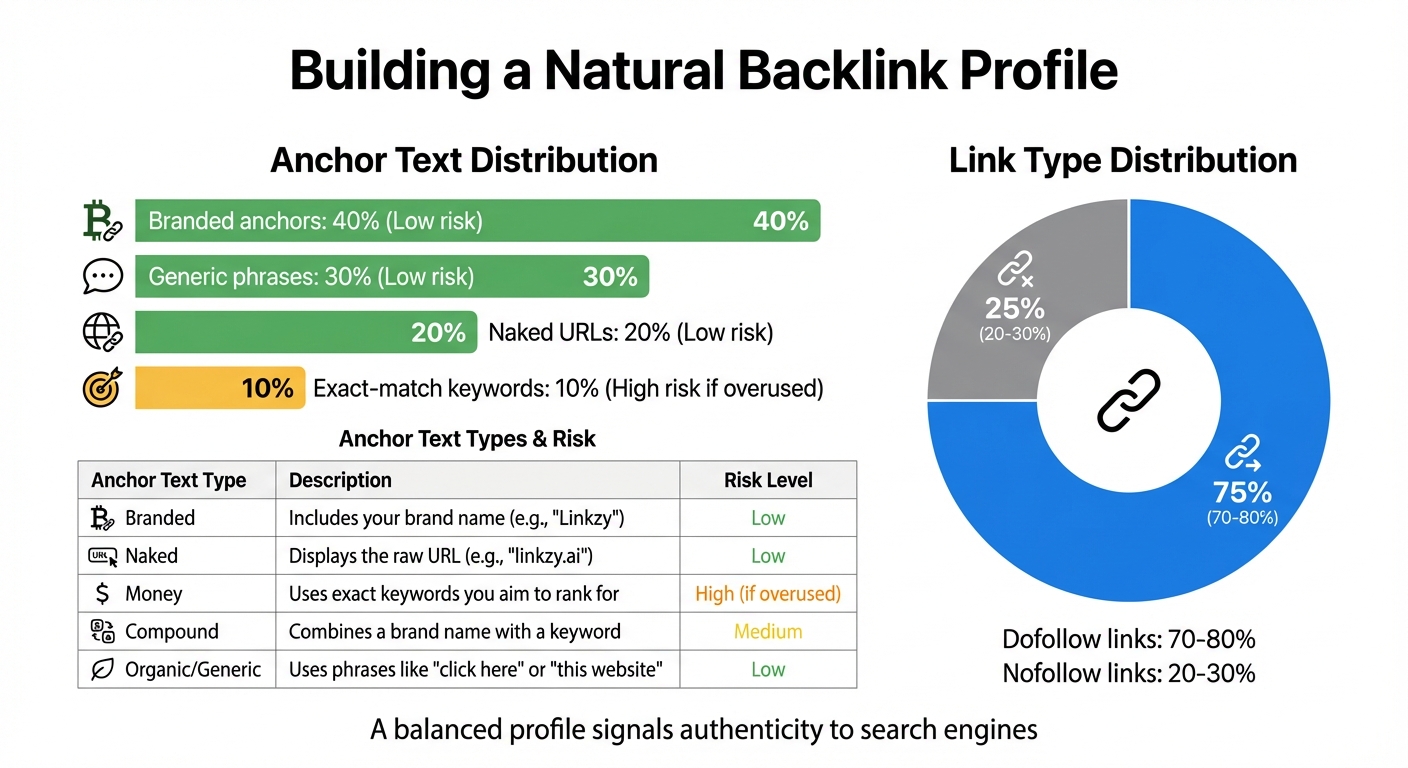
Natural Backlink Profile: Anchor Text and Link Type Distribution
To establish trust with backlinks, it's crucial to audit your existing links, create high-quality ones, and keep a close eye on your progress over time.
Step 1: Audit Your Existing Backlinks
Start by reviewing your current backlinks. Look for broken links that lead to 404 errors and redirect them to active, relevant pages to recover lost link equity [12]. Also, identify harmful links from spammy websites, non-indexed domains, or sites flagged for malware [11]. Tools designed for backlink audits often highlight issues like "Spam TLDs", "Mirrored Pages", and "Spammy Anchor Text" [11].
Pay special attention to your anchor text distribution. A natural profile generally includes around 40% branded anchors, 30% generic phrases, 20% naked URLs, and just 10% exact-match keywords [16].
| Anchor Text Type | Description | Risk Level |
|---|---|---|
| Branded | Includes your brand name (e.g., "Linkzy") | Low |
| Naked | Displays the raw URL (e.g., "linkzy.ai") | Low |
| Money | Uses exact keywords you aim to rank for | High (if overused) |
| Compound | Combines a brand name with a keyword | Medium |
| Organic/Generic | Uses phrases like "click here" or "this website" | Low |
Once you have a clear understanding of your backlink profile, the next step is building quality links.
Step 2: Use Linkzy for Automated Backlink Building
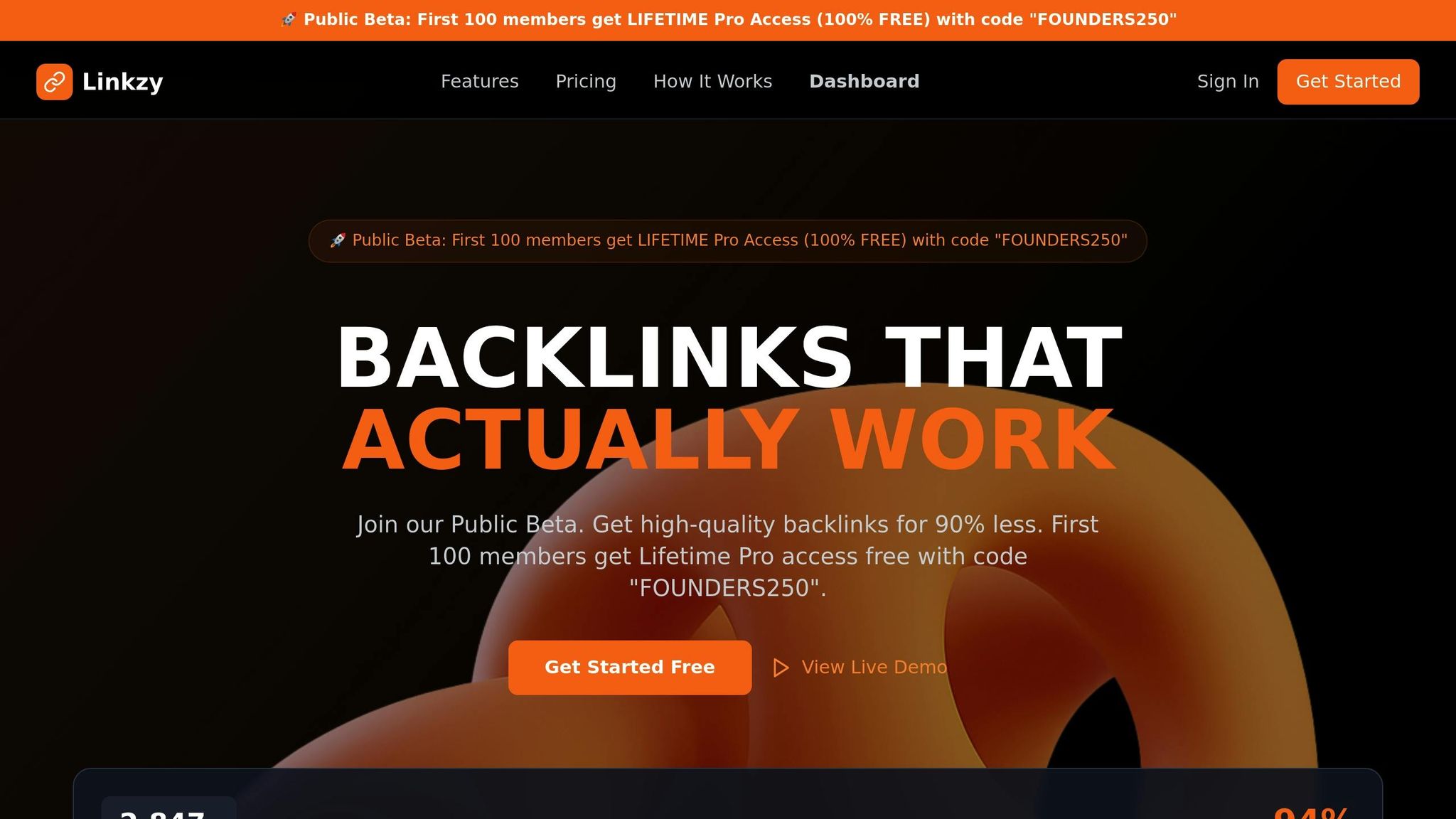
Manually building backlinks can be time-consuming. That's where Linkzy comes in - it automates the process while ensuring the link-building pace remains natural and trustworthy to search engines. By selecting your niche and integrating a simple tracking snippet, Linkzy's AI identifies the most relevant backlinks for your keywords through one-click link prospecting [13].
The platform goes further by discovering potential authors, analyzing their website interests, and collecting contact details [13]. What makes Linkzy stand out is its AI-driven, personalized outreach. Using advanced language models like Claude 3.7 Sonnet, it crafts tailored messages for each prospect, ensuring your backlinks land on genuine websites within your niche. Plans start at $19/month for 5 credits, making it accessible even to small businesses.
Once your automated strategies are in place, turn your attention to securing brand-specific and high-value links.
Step 3: Focus on Brand and Targeted Links
Aim to acquire links from highly trusted "seed sites", such as .gov and .edu domains or major news outlets - sites that search engines view as authoritative [19]. As Eric Schmidt, former CEO of Google, famously said:
"Brands are the solution, not the problem… brands are how you sort out the cesspool" [19].
Another effective tactic is converting unlinked brand mentions into backlinks [18]. These are often easy wins since the website already recognizes your brand. Additionally, linking to authoritative sources in your own content signals to search engines that your material is well-researched [19], further boosting your credibility.
Step 4: Monitor and Optimize Your Backlink Strategy
When evaluating your backlink profile, focus more on the variety of referring domains than sheer link count. Search engines value diversity over multiple links from the same source [16]. Also, ensure your link growth is gradual - sudden spikes can raise red flags and trigger spam filters [16]. A balanced backlink profile typically includes about 70% to 80% dofollow links and 20% to 30% nofollow links [16].
Use monthly reports to track long-term trends [16]. Linkzy’s real-time analytics can help identify which backlinks drive meaningful traffic [16]. Regularly audit your profile to spot and disavow toxic or low-quality links that could lead to penalties [14][16][17]. Considering that 55% of web pages currently have no backlinks [15], consistent monitoring and optimization can give you a substantial edge over competitors.
Conclusion
Backlinks continue to play a critical role in how Google ranks websites [20]. However, their function has grown far beyond just tallying votes. Search engines and AI now analyze the context of each link, using backlinks to assess content quality, map entity relationships, and identify which brands are part of trusted topic networks [1][9].
The emphasis on quality over quantity has never been stronger. A single authoritative backlink can have more impact than thousands of low-quality links [20]. This makes it essential for website owners to focus on securing links from relevant, reputable domains and maintaining a natural backlink profile. Such an approach signals real authority to both search engines and users.
To build trust, start by auditing your existing links, prioritizing quality over sheer numbers, and tracking your progress consistently. The good news is, you don’t have to tackle this manually. Tools like Linkzy can streamline the entire process, ensuring natural link growth and niche relevance - factors that search engines reward. With plans starting at $19/month, even small businesses can enhance their backlink strategy without the heavy lifting of outreach.
Kick things off by auditing your current links, and let automation help you scale while keeping relevance and quality front and center. The websites that earn trust are the ones that dominate search rankings.
FAQs
How do I find high-quality backlinks for my website?
To spot high-quality backlinks, focus on links from trusted, well-established websites that align with your niche. These sites should consistently produce strong content and maintain a positive online reputation.
Pay attention to authority metrics like Domain Authority (DA) and Page Authority (PA) when evaluating potential backlinks. It's also important that the links are contextually relevant to your site's content and come from sources with natural link patterns. Steer clear of links from spammy or unrelated sites, as these can damage your site's credibility and hurt its SEO performance.
By prioritizing links from reliable, niche-specific sources, you can enhance your website's reputation with both users and search engines.
What are the dangers of having poor-quality or spammy backlinks?
Low-quality or spammy backlinks can wreak havoc on your website's SEO and overall reputation. Search engines often interpret these links as manipulative or unnatural, which can lead to penalties, a drop in rankings, or even being completely removed from search results. These consequences can make it incredibly challenging to regain visibility and rebuild your site's authority.
On top of that, spammy backlinks can undermine your site's trustworthiness. They send a signal to search engines that your content might not be reliable. To safeguard your SEO efforts, it's crucial to keep a close eye on your backlink profile and disavow any harmful links. This helps ensure your site maintains a clean, credible, and trustworthy online presence.
How does Google’s E-E-A-T framework affect the value of backlinks?
Google’s E-E-A-T framework - which stands for Experience, Expertise, Authority, and Trustworthiness - is a major factor in how backlinks influence your website's SEO performance. Think of backlinks as virtual endorsements. When other websites link to yours, it signals to Google that your site is credible and reliable, directly tying into the "Authority" and "Trustworthiness" aspects of E-E-A-T.
The quality of these backlinks matters just as much as their quantity. Links from well-regarded, niche-specific websites can significantly enhance your site's authority and expertise in Google's eyes. This, in turn, helps establish your content as trustworthy and valuable, which can lead to better search engine rankings. With E-E-A-T playing an ever-growing role in SEO, earning high-quality backlinks isn't just helpful - it’s crucial for gaining trust from both Google and your audience.