How To Analyze Competitor Backlink Quality
How To Analyze Competitor Backlink Quality
Backlinks are a major factor in SEO rankings, but not all links are created equal. High-quality backlinks from trusted, relevant sites carry significantly more weight than a large number of low-value links. To improve your SEO, analyzing your competitors' backlink strategies can reveal opportunities to strengthen your own.
Key Takeaways:
- Focus on backlinks from authoritative, niche-relevant sites.
- Prioritize unique referring domains over total backlink counts.
- Use tools like Ahrefs, Semrush, or Moz to gather and evaluate backlink data.
- Look for patterns in how competitors gain links (e.g., guest posts, resource pages, broken link building).
Steps to Get Started:
- Identify 3–5 competitors targeting the same audience and keywords.
- Use SEO tools to collect backlink data, focusing on metrics like domain authority, dofollow ratios, and anchor text diversity.
- Evaluate link quality based on relevance, placement, and traffic metrics.
- Replicate successful strategies, avoid harmful links, and consider automation tools like Linkzy for scaling efforts.
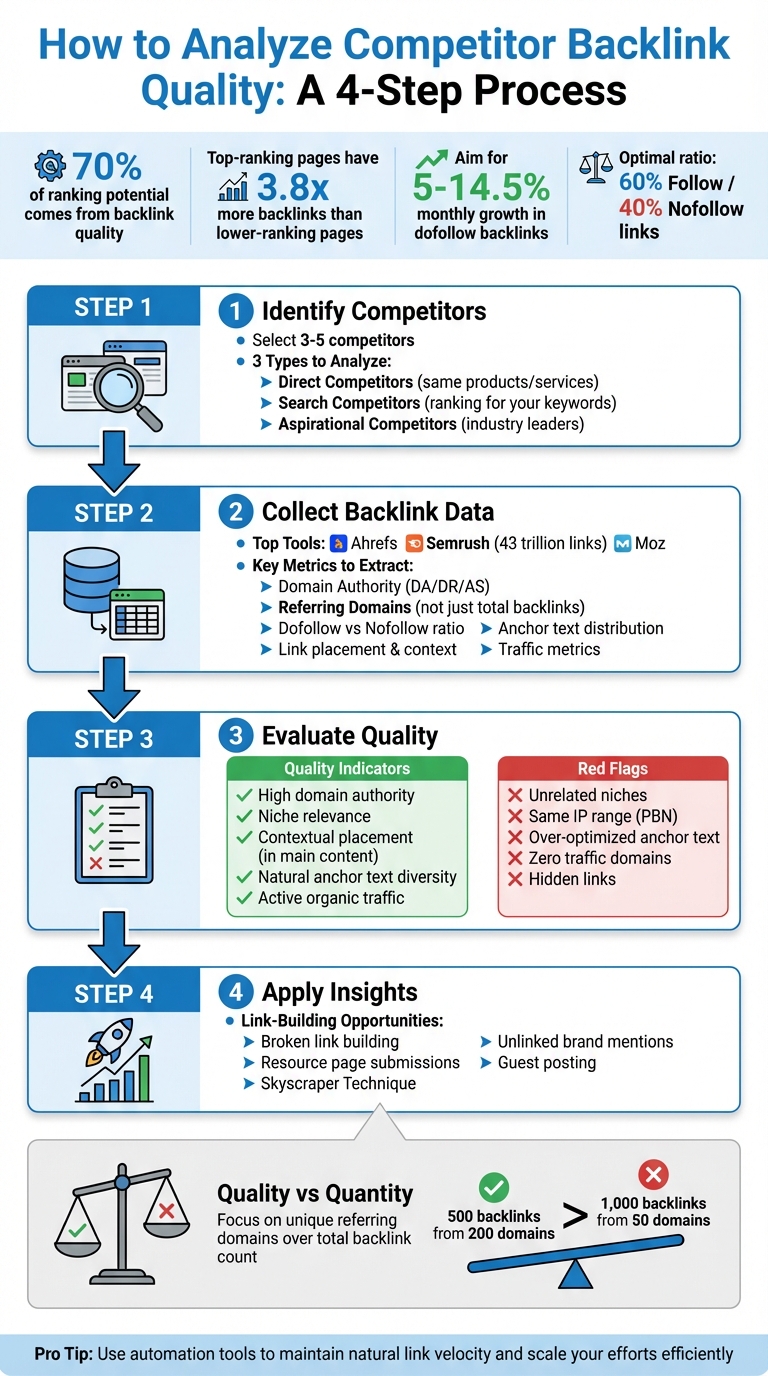
4-Step Competitor Backlink Analysis Process for SEO Success
How to Do a Basic Backlink Analysis on Your Competitors
sbb-itb-0f47b19
Identifying Competitors for Backlink Analysis
When analyzing backlinks, it’s smart to zero in on 3–5 competitors whose audiences and keywords closely align with yours. The idea is to find websites targeting the same audience and keywords - not just any site in your industry. Once you’ve got that focus, it’s time to dig into the different types of competitors to fine-tune your analysis.
Types of Competitors to Analyze
Direct competitors are businesses offering similar products or services to the same market. For example, if you run an online pet pharmacy, companies like Chewy or PetCare Rx would be your direct competitors.
Search competitors are websites ranking for your target keywords, even if they don’t sell the same products. For instance, a pet health blog might compete with your pharmacy for informational search terms like "best flea treatments for dogs."
Aspirational competitors are industry leaders with strong domain authority, setting the bar for success in your niche. These top players often have significantly more backlinks - on average, 3.8 times more than lower-ranking pages [1][2].
"Your SEO competitors are brands that are organically ranking in the top spots for your target keywords." - Moz [1]
How to Build Your Competitor List
Now that you know the types of competitors to target, it’s time to build your list. Start by conducting targeted searches and using trusted SEO tools. Search for your primary keywords on Google and track the top 10 sites that appear consistently. Avoid overly broad websites that don’t focus on your niche.
SEO tools can make this process faster and more precise. For example, Moz’s True Competitor tool pinpointed Chewy, PetCare Rx, PetCo, Walmart Pet Rx, and VCA Hospitals as top SERP competitors for 1800petmeds.com by analyzing keyword overlap [1]. Similarly, tools like Ahrefs’ Organic Competitors report or Semrush’s Traffic Analytics can help you identify rivals by shared ranking keywords and traffic data. Focus on competitors with high keyword overlap, as this signals you’re targeting the same audience. Also, keep an eye on sites experiencing recent growth in rankings, as their strategies are likely more relevant to current trends [5].
With this refined list, you’ll have a solid foundation for gathering data and shaping your backlink strategy.
Collecting Backlink Data
To outpace your competitors, start by collecting their backlink data using specialized SEO tools. This data will help you uncover patterns and opportunities to strengthen your own backlink strategy.
SEO Tools for Backlink Analysis
Ahrefs is a go-to platform for detailed backlink analysis. It offers insights into referring domains, anchor text distribution, and link placement. Use the Site Explorer feature to dive into competitors' backlink profiles, including historical trends and link velocity. This tool gives you a clear picture of who is linking to them and how their link-building efforts have evolved.
Semrush brings a broader SEO toolkit to the table. With a database of over 43 trillion links [3], it’s particularly effective for analyzing multiple competitors at once. The Backlink Analytics tool not only shows where links originate but also estimates the traffic value of referring domains, helping you prioritize high-value opportunities.
Moz is known for its Domain Authority (DA) metric, which measures the strength of a website. As Moz explains, "Domain Authority® (DA) is best used as a comparative metric when investigating your true competitors" [1]. Their Link Explorer helps you evaluate the authority of backlink sources and track changes over time, offering a reliable way to compare competitors' link profiles.
When pulling data, apply the "one link per domain" filter. This ensures you’re not skewing results with multiple links from the same site, such as site-wide links in footers or navigation menus [3].
Once you've gathered the data, focus on extracting metrics that directly impact the quality of backlinks.
Key Metrics to Extract
Certain metrics are indispensable when evaluating backlinks. Here’s what to prioritize:
Domain strength metrics like Domain Rating (DR), Domain Authority (DA), or Authority Score (AS) give you a quick read on the credibility of linking websites. Strong scores indicate trusted sources, making them valuable for building your own link profile [1].
Referring domains versus total backlinks is a critical factor. A competitor with 1,000 backlinks from just 50 domains is less impressive than one with 500 backlinks from 200 unique domains. Why? Because having links from a diverse range of sites carries more weight. Focus on analyzing the count of unique referring domains rather than total backlinks.
Link attributes - dofollow versus nofollow - are another key consideration. Dofollow links pass SEO authority, while nofollow links don’t directly influence rankings. A strong backlink profile typically includes about 70% dofollow links, and top-ranking pages often gain 5% to 14.5% more dofollow backlinks each month [2].
Anchor text distribution sheds light on how naturally a competitor's link profile has grown. Look at branded anchors (e.g., company name), naked URLs, money keywords (exact match terms), and compound anchors (brand plus keyword). Avoid over-optimization, as too many exact-match keywords can lead to penalties. Instead, aim for a balanced and diverse anchor text profile.
Link placement and context play a big role in link quality. Links embedded within the main content of a page are far more valuable than those tucked into sidebars, footers, or navigation menus [3]. Search engines view contextual links as more natural and trustworthy.
Traffic metrics from referring domains are essential to ensure the quality of backlinks. Check the organic traffic estimates for each linking site. Links from active, well-visited websites carry far more weight than those from abandoned blogs or spammy link farms.
Evaluating Backlink Quality
Separating strong backlinks from weak ones is essential for improving SEO performance. A proper evaluation digs deeper than surface-level metrics, aiming to identify links that genuinely boost rankings while steering clear of those that might harm them.
Assessing Link Authority
When assessing a backlink’s authority, metrics like Moz’s Domain Authority (DA) and Page Authority (PA), Ahrefs’ Domain Rating (DR) and URL Rating (UR), and Semrush’s Authority Score (AS) are great starting points. These tools provide a snapshot of a linking site's strength.
For a more detailed look, consider Majestic’s Trust Flow and Citation Flow. A high Citation Flow paired with a low Trust Flow can indicate spammy sources, so cross-check this with actual human traffic data to avoid link farms [7]. A site with a high DR but minimal or declining organic traffic is often a penalized link farm [12]. Additionally, verify the credibility of authors for editorial links that hold higher value [6].
Beyond metrics, ensure that these authoritative sites align with your niche for maximum SEO benefit.
Analyzing Relevance and Context
Relevance plays a crucial role in determining how impactful a backlink will be. According to Page One Power, "The two most important aspects of a high-quality link are relevancy and human value" [4]. This means evaluating whether the linking page and the overall website are topically aligned with your niche [9][10].
The placement of a link also matters. Links embedded higher in the main body text tend to pass more "link juice" than those buried at the bottom [9][6]. Search engines also analyze the text surrounding a link to determine its relevance [10]. Ideally, a backlink should add clear value to the audience of the linking site.
Contextual placement is generally more impactful than navigational links. Links within the main content outperform those in headers, sidebars, or footers. In fact, about 70% of a website’s ranking potential is influenced by the quality of the sites linking back to it [10].
Once relevance is confirmed, it’s essential to check for any warning signs that might indicate a harmful backlink.
Spotting Red Flags
Identifying potential issues can help you avoid backlinks that could damage your SEO. Be cautious of links from unrelated niches or sudden surges from questionable sources like gambling or pharmacy sites [4][6][7][10].
Keep an eye on IP diversity. Too many links from the same C-Class IP range often point to a Private Blog Network (PBN) [6][7]. You can use the "site:domain.com" search operator to see if a linking site is indexed. If it isn’t, the site might be penalized [10].
Anchor text over-optimization is another red flag. A natural backlink profile generally has a balance of about 60% Follow to 40% Nofollow links [8]. However, an overuse of exact-match anchor text can trigger penalties under Google’s Penguin algorithm. As Greg Heilers and Morgan Taylor from Jolly SEO explain, "Bad backlinks are a problem not just because they can lead to penalties by Google. Backlinks with a negative traffic trajectory also provide a decreasing ROI as they age" [11].
Specialized tools can help you identify and remove risky links [11]. Hidden links - those visible to crawlers but invisible to users - are another major concern, as they can lead to manual penalties or de-indexing. Domains with zero traffic are usually link farms or penalized sites, offering no SEO value [12].
Using Backlink Insights to Improve Your Strategy
After analyzing competitor backlinks and spotting patterns, it’s time to turn those insights into practical link-building tactics. The idea is simple: emulate what’s working for your competitors while steering clear of their missteps.
Identifying Link-Building Opportunities
Start by examining how your competitors acquired their backlinks. Was it through guest posts, resource page submissions, expert interviews, or PR outreach? Understanding the context behind their links can help you uncover opportunities.
One effective tactic is broken link building. Use your tools to find 404 pages on competitor sites that still have active backlinks. Then, reach out to the linking sites and suggest replacing the broken link with your relevant content.
Another strategy is to replicate the success of popular content formats. Use "Best by links" reports to identify competitor content - like original research, tools, or comprehensive guides - that naturally attracts backlinks. Then, create something even better using the Skyscraper Technique. For example, Brian Dean of Backlinko increased his organic traffic by 110% in just two weeks by improving popular competitor content and reaching out to the original linking domains [2].
You can also focus on unlinked brand mentions. Look for instances where competitors’ brands are mentioned without a hyperlink and apply the same approach to your brand. Additionally, use search operators like "Keyword inurl:resources" or "Keyword useful resources" to find resource pages that might link to your content.
When building your prospect list, prioritize quality over quantity. Focus on active follow links from authoritative sites, especially those placed contextually within the main content rather than in footers or sidebars. A single high-quality backlink often outweighs dozens of low-value ones. While these methods take time, automation can help you scale your efforts effectively.
Automating Backlink Placement
To complement manual efforts, automation can simplify and speed up your link-building process. Manual outreach can be inconsistent and time-intensive. As SEO expert Peter Attia puts it, "If you're not getting responses, you're not getting links. It takes a lot of trial and error to find what works" [1].
This is where tools like Linkzy come in. Linkzy uses AI to automate backlink placement on niche-relevant, genuine websites. It identifies opportunities for contextual links while maintaining a natural growth rate. This is crucial because top-ranking pages typically gain 5% to 14.5% more dofollow backlinks each month [1][2]. Monisha Agarwal, CEO of Growth Accelerators, emphasizes, "Sudden, aggressive link growth can attract penalties from Google. Link growth should align with content development" [13].
With Linkzy, setup is quick and works across any website platform. You simply select your niche, integrate a tracking snippet, and the tool places contextual backlinks on a consistent schedule designed to boost your rankings. It’s a practical way to scale your efforts without compromising quality.
Linkzy offers a free plan with 3 credits for testing, and paid plans start at $19/month for small businesses or $29/month for growing ones.
Finally, set up automated notifications in your SEO tools to monitor when competitors gain new backlinks. This lets you respond quickly and ensures your strategy evolves alongside your niche’s needs. Combining competitor tracking with automation creates a scalable, effective link-building approach that keeps you ahead of the game.
Conclusion and Next Steps
Dive into competitor backlink analysis to uncover strategies that can elevate your rankings. The quality of your backlinks plays a crucial role in determining your search performance. As Indexly aptly states, "In the world of SEO, your backlinks are both your strongest allies and your greatest threats - knowing which is which is where the real power lies" [14].
Key Takeaways
- Focus on quality over quantity: A single authoritative, niche-specific backlink can outweigh numerous low-quality ones.
- Relevance is key: Links from thematically related websites carry more SEO weight and pass stronger "link juice."
- Placement matters: Embedding links within the main content ensures maximum SEO impact.
Regularly auditing your backlink profile is essential to spot and address toxic links that could harm your rankings.
Steps to Start Your Backlink Analysis
To get started, identify 3–5 competitors who rank for your target keywords. Use tools like Ahrefs, Semrush, or Moz to gather detailed backlink data, paying close attention to unique referring domains rather than just the total number of backlinks. Narrow your focus to "Active" and "Dofollow" links - these are the ones that contribute real SEO value.
Next, assess each link for its authority, relevance, and placement. Identify patterns in how your competitors acquire their backlinks. Are they leveraging guest posts, resource pages, or broken link-building opportunities? Once you spot what’s working, replicate these strategies. You can also set up automated alerts to track when competitors secure new high-value backlinks, allowing you to act quickly.
To scale your efforts efficiently, consider automation. Tools like Linkzy can simplify the process by placing contextual backlinks on niche-specific websites for you. Maintaining a natural link velocity - aiming for a 5%–14.5% monthly increase in dofollow backlinks - can mimic the growth patterns of top-ranking pages [2]. With pricing starting at $19/month and a free tier offering 3 credits, you can test these tools without any upfront investment. Combining manual analysis with smart automation ensures a sustainable and competitive link-building approach.
FAQs
How can I evaluate the quality of a competitor's backlinks?
To assess the quality of a competitor's backlinks, start by examining the domain authority or authority score of the websites providing those links. These scores give you a glimpse into how credible and influential the linking site is.
Next, look at how relevant the linking domain is to your specific niche and evaluate its trustworthiness. Backlinks from well-regarded sites within your industry or topic area tend to have a stronger impact on SEO.
There are plenty of tools available to help you analyze these factors and dig deeper into backlink quality. Generally, the best backlinks come from legitimate, authoritative websites that naturally connect with your industry or content.
What are the best tools for analyzing competitor backlinks?
To dig into competitor backlinks, tools like Ahrefs, Semrush, and Moz are your go-to options. These platforms offer a wealth of data, including referring domains, anchor text details, and metrics to assess link quality.
With these tools, you can see exactly where your competitors are getting their backlinks, identify trends, and pinpoint potential opportunities for your own link-building efforts. Features such as backlink gap analysis and link profile comparisons make it simple to measure your site against competitors and uncover valuable link sources you may have missed.
Using these insights, you can craft focused outreach strategies that not only strengthen your backlink profile but also help improve your search engine rankings.
Why is it important for backlinks to be relevant to your niche?
Backlinks play a big role in SEO, but it’s not just about getting any link - it’s about getting the right ones. When a website links to your content and shares a similar niche or industry, it sends a strong signal to search engines that your content is credible and connected to the topic. This can help boost your rankings.
But it’s not just about rankings. Relevant backlinks also bring in more targeted traffic. That means visitors are more likely to engage with your content or even convert into customers. Search engines prioritize quality over sheer numbers, so focusing on links that fit naturally with your content is essential for building a solid SEO strategy.