Internal Links vs. Backlinks: Impact on Domain Authority
Internal Links vs. Backlinks: Impact on Domain Authority
If you want to improve your website's domain authority and search rankings, you need to focus on two key link types: internal links and backlinks. Here's a quick breakdown:
- Internal Links: These connect pages within your website. They help distribute authority across your site, improve navigation, and assist search engines in understanding your site’s structure.
- Backlinks: These are links from other websites to your site. They act as endorsements, signaling to search engines that your content is trustworthy and valuable.
Both are essential for SEO, but they serve different purposes. Internal links are fully under your control and provide immediate results, while backlinks require external effort and take longer to show impact. Together, they play a complementary role in boosting your site's authority and performance.
Quick Comparison
| Factor | Internal Links | Backlinks |
|---|---|---|
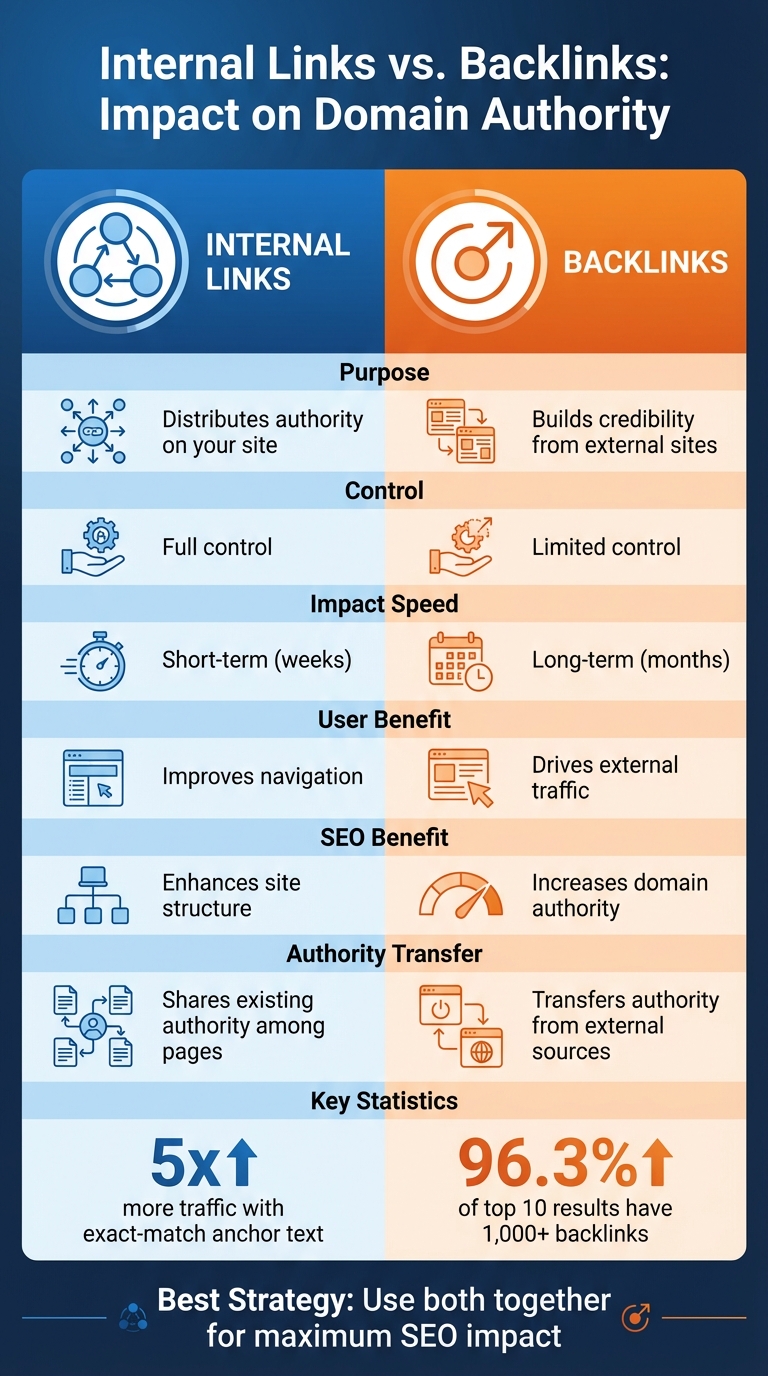
| Purpose | Distributes authority on your site | Builds credibility from external sites |
| Control | Full control | Limited control |
| Impact Speed | Short-term | Long-term |
| User Benefit | Improves navigation | Drives external traffic |
| SEO Benefit | Enhances site structure | Increases domain authority |
To maximize results, use internal links to guide authority flow and backlinks to establish trust with search engines. Together, they create a strong foundation for SEO success.
Internal Links vs Backlinks: Complete SEO Comparison Chart
BACKLINKS VS. INTERNAL LINKS AS RANKING FACTORS FOR ADVANCED SEO ON GOOGLE - SEO Conspiracy S01E16
sbb-itb-0f47b19
How Internal Links Affect Domain Authority
Internal links might not have the same external validation as backlinks, but they play a critical role in distributing authority throughout your site. Without a strong internal linking strategy, the authority your site earns won't reach the pages that need it most. As Jonas Sickler, Senior Brand Marketing Analyst at Terakeet, explains:
"Internal links are like the wires from your circuit breaker to your outlets. No matter how many wires you have in your home, your lights won't work if you don't connect your house to the grid [backlinks]" [3].
Let’s dive into how internal linking can refine your site’s structure and boost user engagement.
Improving Site Structure and User Experience
Internal links help organize related pages into clusters, creating a clear structure for search engines to understand. For example, linking a pillar page about "SEO strategies" to supporting articles like "keyword research" or "on-page optimization" builds a hierarchy that's easy for both users and crawlers to navigate. This approach not only improves your site's structure but also keeps visitors engaged by guiding them to relevant, useful content.
A good rule of thumb is to ensure that any important page is no more than three clicks away from your homepage. This makes it easier for search engines to crawl high-priority pages, like those that drive revenue, and ensures these pages receive the authority they need. A well-designed internal linking structure amplifies the flow of authority across your site.
Distributing Link Equity Across Pages
When your homepage or a widely-read blog post earns backlinks, the authority it gains doesn’t automatically trickle down to every other page on your site. Internal links serve as pathways to distribute this authority to pages that need it most, such as newer content or transactional pages that are harder to attract backlinks for naturally.
A helpful tactic is the "Middleman Method." This involves linking high-authority informational pages to product or service pages that could benefit from extra authority. This strategy helps boost rankings and conversions for key pages. Just avoid using "nofollow" tags on internal links, as they cause PageRank to "evaporate" rather than being redistributed, wasting valuable authority [3].
Helping Search Engines Index Your Site
Pages without internal links, often referred to as "orphaned pages", are essentially invisible to search engines. Regular site audits can help identify these pages, allowing you to connect them to relevant content using contextual links.
When adding internal links, use keyword-rich anchor text instead of generic phrases like "click here." This not only provides search engines with semantic context but also strengthens your topical authority, helping pages rank for their target keywords. For the best SEO impact, place these links within the main content rather than in footers or sidebars.
How Backlinks Affect Domain Authority
Backlinks play a crucial role in boosting domain authority by acting as a signal of trust between websites [4]. When other sites link to your content, it tells search engines that your material is valuable enough to be referenced. This trust network directly impacts your rankings. In fact, about 96.3% of websites appearing in the top 10 search results have over 1,000 unique domain backlinks [4].
External Validation and Credibility
Think of backlinks as digital endorsements. When a respected website links to your content, search engines interpret it as a vote of confidence. For instance, one website built 103 backlinks from relevant domains (with Domain Ratings between 30 and 50+), which resulted in it ranking for 9,631 keywords - 2,245 of which landed on page one [4].
Smaller sites can see even more dramatic results. SEO expert Chris Tzitzis helped a small business/government niche site with just 15 pages. By building 53 backlinks over four months, the site’s Domain Rating jumped from 1.7, and its organic traffic skyrocketed by approximately 2,000%, climbing from 160 to 3,337 monthly visits [4].
Quality Over Quantity
When it comes to backlinks, quality trumps quantity. A single, high-authority link from a niche-relevant site can outperform dozens of low-quality ones. It’s not just about collecting links - it’s about being part of the right conversations [5].
Search engines and AI models have also evolved. Starting in 2026, they began prioritizing "co-citations." This means that even if your brand isn’t linked directly, being mentioned alongside trusted authorities in your field can boost your credibility [5].
For example, UnderFit partnered with luxury suit brand Black Lapel in 2025–2026 to craft a strategic blog post on formalwear. The content naturally integrated UnderFit within relevant, high-quality material. This collaboration not only drove over 150 sales in a year but also established a branded association that AI models now highlight in menswear-related searches [5]. The takeaway? Focus on securing links from publishers already ranking for your target topics to maximize relevance [5].
Challenges of Building Backlinks
Despite their importance, building backlinks isn’t easy. Over 55% of web pages have no backlinks at all [6]. Traditional outreach often requires a significant time investment, relationship-building, and multiple follow-ups - without any guarantees of success. Plus, webmasters are frequently overwhelmed with similar requests, making it even harder to stand out.
One effective tactic is the "Moving Man Method." This involves finding websites that have rebranded or moved to new URLs, then reaching out to sites still linking to the outdated URL and suggesting your relevant content as a replacement [5]. For example, when SEOMoz transitioned from seomoz.org to moz.com, savvy SEOs used this method to identify hundreds of sites linking to the old .org domain, successfully earning high-authority links, including from .edu domains [5].
To simplify the process, tools like Linkzy offer automated solutions for building high-quality, niche-relevant backlinks. This allows you to focus more on creating great content while the tool handles the heavy lifting.
Internal Links vs. Backlinks: Direct Comparison
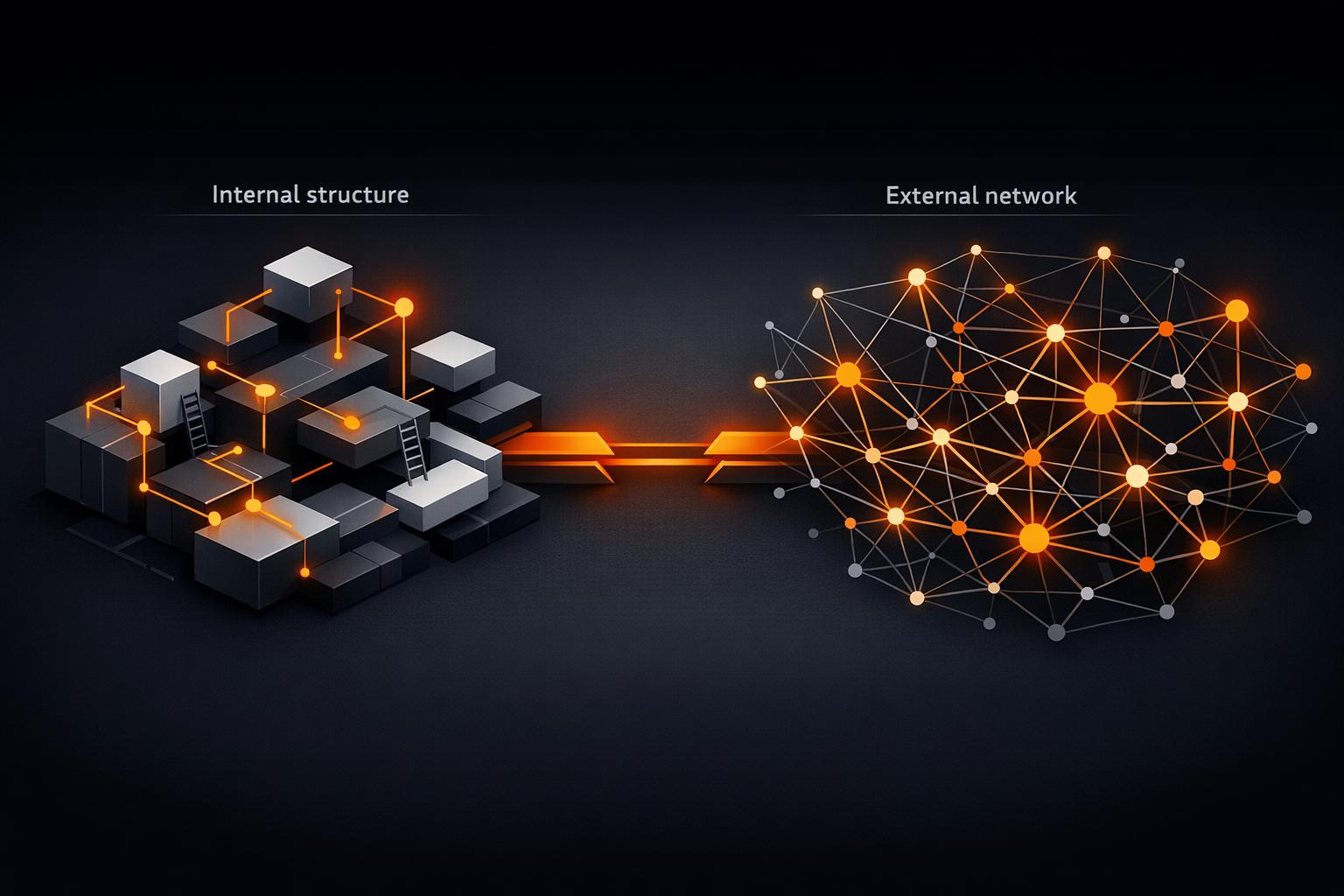
The main distinction between internal links and backlinks boils down to control. With internal links, you have complete authority over their placement and anchor text, allowing you to immediately influence SEO by redistributing link equity across your site. In contrast, backlinks rely on external websites, making them harder to secure and slower to impact your search visibility and domain authority.
Adjustments to internal linking can yield noticeable results in just a few weeks. This is because search engines quickly recrawl your site and pick up these changes. On the other hand, building backlinks is a long-term endeavor - it often takes months before you see measurable improvements in rankings and authority [2].
Backlinks play a crucial role in helping search engines discover your site and verify its credibility. Meanwhile, internal links strengthen your site’s structure, ensuring link equity flows effectively between pages. Here’s a practical tip: if a page on your site earns a strong backlink, consider adding internal links from that page to your high-priority pages. This approach amplifies the overall authority of your site.
Below is a side-by-side comparison of internal links and backlinks:
Comparison Table: Internal Links vs. Backlinks
| Factor | Internal Links | Backlinks |
|---|---|---|
| SEO Impact | Redistributes link equity and defines structure | Boosts domain authority and credibility |
| Control | Full control over placement and anchor text | Limited control, depends on external sites |
| Authority Transfer | Shares existing authority among your pages | Transfers authority from external sources |
| Effect Speed | Short-term (weeks for noticeable changes) | Long-term (months to see results) |
| User Benefit | Improves navigation and content discovery | Drives traffic from external sources |
| Crawl Benefit | Enhances indexing and crawl efficiency | Helps search engines find new pages/sites |
This breakdown highlights how both internal links and backlinks serve distinct but complementary roles in your SEO strategy.
How to Optimize Internal Links and Backlinks for Domain Authority
Best Practices for Internal Linking
When linking pages within your site, exact-match anchor text can make a huge difference. Research shows that using precise keywords in your anchor text can drive five times more traffic than vague terms like "click here" [7]. For example, if you're linking to a page about "email marketing strategies", use that exact phrase instead of something generic.
However, don't rely solely on precision - mix it up. Studies reveal that using varied anchor texts improves Google rankings [7]. For instance, you can alternate between phrases like "SEO tips" and "search optimization strategies" to keep your links diverse. Just be cautious not to overdo it - pages overloaded with 50+ internal links may see their traffic diluted [8].
Another smart move? Update older content by linking it to newer articles. This not only helps pass authority to your fresh pages but also keeps your site well-connected [8]. And always use dofollow links for internal linking to ensure PageRank and anchor text value are effectively passed to the destination pages [8].
Once you've nailed internal linking, it's time to tackle backlinks - and automation can make that process much easier.
Building Quality Backlinks with Automation
Manually building backlinks can be a time sink. Tools like Linkzy simplify the process by automating the placement of contextual backlinks on niche-relevant websites. With just a few steps - selecting your niche, adding a tracking snippet to your site - you can start receiving backlinks on a schedule optimized for natural link growth. This allows you to focus more on creating content.
But remember, quality over quantity is the golden rule for backlinks. A two-year study found that just five high-quality links from websites with Domain Authority over 50 drove 216% more organic traffic than 50 low-quality links [9]. These premium backlinks also helped sites rank for 37% more competitive keywords and improved organic traffic conversions by 89% [9].
"When Google can't decide which of several pages has the best content, it often defaults to considering which site has earned the most trust through quality backlinks." – Magnus Schmidt, International Link Building Specialist [9]
Linkzy ensures your backlinks come from real websites within your industry, aligning with the quality standards search engines prioritize. Pricing starts at $19/month for small businesses, with a Pro Plan available at $29/month, offering additional credits and priority support.
By combining automated backlinking with a solid internal linking strategy, you can significantly boost your site's authority.
Combining Internal Links and Backlinks
To get the most out of your linking strategy, integrate internal links with your backlink efforts. For instance, when you earn a strong backlink to a specific page, add internal links from that page to other high-priority content. This spreads the authority boost across your site instead of keeping it isolated on a single page.
One effective tactic is creating linkable assets that naturally attract backlinks. For example, in 2024, CookUnity published a statistics page on vegan Americans, which earned 658 backlinks and increased their Authority Score from 44 to 48 within a year [10]. Statistics pages are particularly powerful - Backlinko found that while these pages made up only 16% of their content, they generated 32.17% of their high-quality backlinks [10].
Another strategy is building content hubs, which link a central "pillar" page to several related "cluster" pages. This structure not only strengthens topical authority but also gives search engines a clear understanding of your site's hierarchy [1]. When external sites link to your pillar content, the internal links within your hub ensure the authority flows to related pages, maximizing the SEO impact of every backlink you earn.
Conclusion
Internal links and backlinks work hand in hand to strengthen your site's domain authority. Backlinks boost your site's credibility by earning validation from external sources, while internal links ensure that authority flows effectively across your pages and helps search engines make sense of your website's structure. As Google's John Mueller explains:
"It's one of the biggest things that you can do on a website to kind of guide Google and guide visitors to the pages that you think are important" [1].
Internal links give you immediate control and can produce noticeable results quickly, whereas backlinks require time and effort to establish credibility [2]. To achieve the best results, it's important to use both methods thoughtfully. Combining these strategies allows you to see quicker wins while also setting the stage for sustained growth.
For those looking to streamline their backlink strategy, Linkzy offers a straightforward solution. At $19 per month, it automates outreach for high-quality, niche-specific backlinks while maintaining a natural link-building pace. This frees you up to focus on refining your internal linking strategy and creating content that ranks.
FAQs
What’s the best way to use internal links to improve my website’s SEO?
Internal links are the threads that tie your website together, making it easier for both users and search engines to explore your content. They play a crucial role in improving crawlability, spreading authority from top-performing pages, and enhancing the relevance of your site’s content - all of which can boost your SEO efforts.
To get the most out of internal links, start by organizing your site with a clear structure. Aim to keep important pages within three clicks from your homepage. Use descriptive, keyword-rich anchor text that blends naturally into your content, and focus on linking from high-traffic or cornerstone pages to related, less-visible ones. Be mindful not to overload a page with links, as this can overwhelm users and search engines alike.
It’s also a good idea to routinely check for orphan pages - those without any internal links pointing to them. Update older posts with links to newer content and ensure your sitemap accurately represents your site’s current structure. These steps not only make it easier for search engines to index your pages but also contribute to stronger overall SEO performance.
How can I build high-quality backlinks to improve my website's authority?
Building top-notch backlinks starts with creating content that others can't resist referencing. Think about assets that naturally attract links - things like in-depth guides, original research, or even interactive tools. You can also consider writing guest posts for respected, niche-specific websites or reaching out to journalists and influencers with compelling stories or exclusive data. Another smart tactic? Broken-link building. This involves finding broken links on authoritative websites and suggesting your content as a suitable replacement.
If you're looking to simplify the process, tools like Linkzy can be a game-changer. They automate the placement of contextual, niche-relevant backlinks on real websites, giving you a consistent stream of quality links without the manual hassle. At the same time, focus on building strong relationships within your industry and keeping your website technically sound - both of which make it easier for others to link to your content.
How do internal links and backlinks work together to boost domain authority?
Backlinks and internal links work hand-in-hand to boost your site's domain authority. Backlinks are links from other websites that act like votes of confidence, signaling to search engines that your content is reliable and worth referencing. These links pass authority from the referring site to yours, increasing your site's trustworthiness in the eyes of search engines.
Internal links, meanwhile, help spread that authority across your site. They guide search engines in crawling and indexing your pages, define your site's structure, and direct link equity to key content. Essentially, backlinks strengthen your site's overall authority, while internal links ensure that authority is distributed effectively to improve rankings and relevance throughout your site.