Types of Backlink Sources: A Complete Guide
Types of Backlink Sources: A Complete Guide
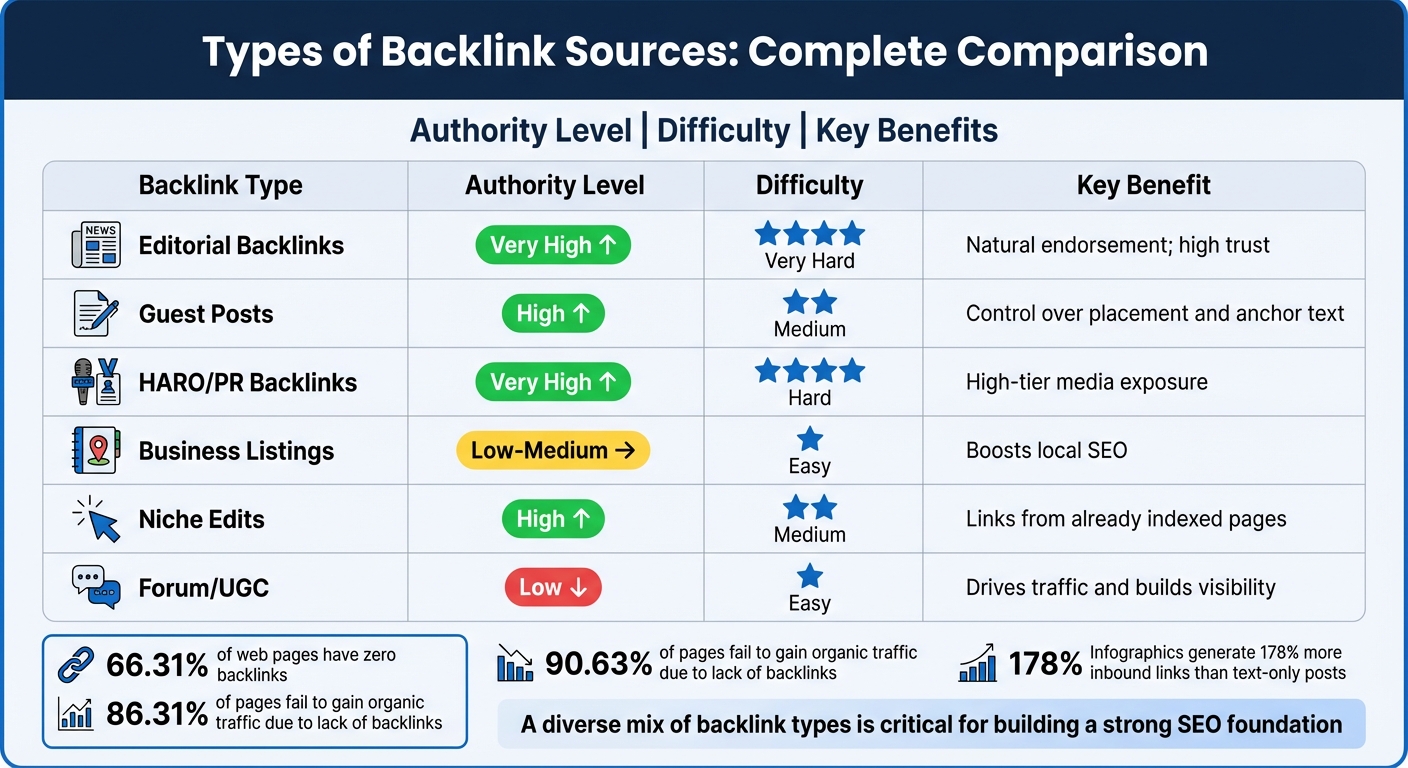
Backlinks are essential for improving your website's search engine rankings. They help signal to search engines that your content is valuable and trustworthy. Here's the key takeaway: A diverse mix of backlink types is critical for building a strong SEO foundation.
Key Backlink Sources:
- Editorial Backlinks: Earned naturally when others link to your content.
- Guest Post Backlinks: Links placed in articles you write for other sites.
- HARO Backlinks: Links gained by providing expert quotes to journalists.
- Business Listing Backlinks: Links from directories like Google Business Profile or Yelp.
- Forum and UGC Backlinks: Links from community platforms like Reddit or Quora.
Quick Facts:
- 66.31% of web pages have zero backlinks.
- 90.63% of pages fail to gain organic traffic due to a lack of backlinks.
- A mix of dofollow and nofollow links is important for a natural backlink profile.
Quick Comparison
| Backlink Type | Authority Level | Difficulty | Key Benefit |
|---|---|---|---|
| Editorial | High | Hard | Natural and trusted by search engines |
| Guest Posts | High | Medium | Control over placement and anchor text |
| HARO/PR | Very High | Hard | High-tier media exposure |
| Business Listings | Low-Medium | Easy | Boosts local SEO |
| Forum/UGC | Low | Easy | Drives traffic and builds visibility |
To succeed, focus on quality over quantity and maintain a balanced, diverse backlink profile. Tools like Linkzy can help automate the process while ensuring steady progress.
Backlink Types Comparison: Authority, Difficulty, and Benefits Guide
Backlink Types in SEO
Main Types of Backlink Sources
The source of a backlink plays a big role in its SEO value, how hard it is to get, and its impact on rankings. Knowing the differences between these sources helps you focus your link-building efforts and use your time and resources wisely.
"The types of backlinks you have is just as important as the quantity." - Adam Steele, Loganix [3]
There are five main types of backlink sources, each serving a specific purpose in your SEO strategy. Editorial backlinks come from journalists or creators who naturally link to your site, offering strong authority but needing exceptional content to earn. Guest post backlinks let you choose the placement and anchor text in content you contribute. HARO backlinks connect you with reporters seeking expert input. Business listing backlinks help with local SEO through directory listings. Lastly, forum and UGC backlinks (user-generated content) drive referral traffic through active community participation. Together, these sources help create a diverse and natural backlink profile.
SEO benchmarks suggest that a website's homepage typically needs 40 to 50 backlinks, while individual pages may require anywhere from 1 to 100, depending on competition [4]. With around 46 different sub-types of backlinks available [3], building a varied profile signals to search engines that your authority is earned naturally.
Editorial Backlinks
Editorial backlinks are earned when journalists or content creators link to your site naturally. These are often the result of creating exceptional content like original research, detailed guides, unique data, or innovative tools. For example, a journalist might cite your industry report, or a blogger could include your resource in a "best of" list. While these links carry significant authority, they’re also the hardest to obtain since they rely on others noticing and valuing your content.
Guest Post Backlinks
Guest posting involves writing articles for other websites in exchange for a backlink. By pitching relevant blogs and crafting high-quality articles, you can secure links that fit naturally within the content.
| Feature | Pros | Cons |
|---|---|---|
| Guest Post | Control over placement and anchor text [1] | Time-consuming; risk of poor-quality sites if outsourced [2] |
The secret to success here is prioritizing quality. Publishing thoughtful, well-crafted content on reputable sites will always outperform flooding low-value blogs with generic articles.
HARO Backlinks
HARO, or Help a Reporter Out (now called Connectively), connects experts with journalists seeking quotes, data, or insights. By responding quickly and offering valuable input, you can earn editorial backlinks.
For example, in May 2024, SE Ranking shared unique data about Google's AI Overviews, which earned them multiple high-quality backlinks and boosted their industry authority [2]. HARO links not only improve your backlink profile but also enhance your E-E-A-T (Experience, Expertise, Authoritativeness, Trustworthiness) [1]. However, competition is intense, so your responses need to be timely, concise, and highly relevant.
Business Listing Backlinks
Business listing backlinks come from directories like Google Business Profile and Yelp. These links are essential for local SEO but don’t carry much individual weight. To maximize their value, focus on reputable directories with accurate, updated information and active user reviews. Overusing low-quality directories or spamming them can hurt your credibility.
Forum and UGC Backlinks
Forums like Reddit, Quora, and other industry-specific platforms offer backlinks that are often nofollow but can still drive referral traffic and increase brand visibility. The key is to engage meaningfully - answer questions, provide insights, and naturally include links where relevant. Avoid spamming or forcing links into discussions, as this approach can backfire.
Next, we’ll dive into advanced backlink strategies that build upon these foundational approaches.
Advanced Backlink Methods
Once you've established foundational backlinks, it's time to explore strategies that add depth and variety to your link profile. These advanced methods not only enhance your site's authority but also ensure a more diverse backlink portfolio.
Reciprocal Backlinks
Reciprocal backlinks happen when two websites agree to link to each other. While this can occur naturally, it’s important to avoid explicit or aggressive link exchanges.
"It's natural for local businesses with neighboring locations to link to each other's websites. These types of reciprocal backlinks would not cause any problems." - John Mueller, Search Advocate, Google [1]
Examples of natural reciprocal links include partnerships between local businesses or event collaborations [1]. However, search engines are quick to flag artificial patterns. Avoid risky tactics like "ABC backlinks" (where Site A links to B, B links to C, and C links back to A) or Private Blog Networks. These schemes aim to manipulate rankings but often lead to penalties [1].
Image and Infographic Backlinks
Visual content, such as images and infographics, is a powerful way to attract backlinks. Infographics, in particular, are highly shareable and simplify complex information. In fact, they generate 178% more inbound links than text-only posts [6][9] and can boost website traffic by over 12% [6][8].
When creating visuals, focus on producing high-quality, original designs. Use relevant keywords in filenames and alt text, and provide embed codes to encourage proper attribution [5][6][9]. For example, Venngage increased their monthly organic traffic from 275,000 to 900,000 visitors by leveraging SEO-optimized infographics between November 2017 and March 2019 [9].
"Design it for easy copy-and-credit, using one headline figure per panel and make the infographic landscape 1200 × 675 px with a discreet 'Source: Brand.com' footer so even lazy embeds will send a link." - Isaac, Marketing Director, 3wh [6]
Keep an eye out for uncredited uses of your visuals and request proper attribution when necessary [7][10]. Focus on creating "evergreen" assets, such as how-to guides or industry-standard charts, which can continue earning backlinks over time [7][10].
Webinar, Podcast, and Video Backlinks
Engaging in multimedia content - like webinars, podcasts, or videos - can generate backlinks through speaker bios, event landing pages, show notes, and video descriptions. This approach not only diversifies your backlink sources but also strengthens your E-E-A-T (Experience, Expertise, Authoritativeness, Trustworthiness) [1][2][12].
Video content, in particular, is 53 times more likely to improve organic rankings and can increase click-through rates by 41% [11][13]. When participating in a podcast or webinar, ensure your website is linked in the event materials. For videos, optimize metadata and include transcriptions to improve indexing [11][13].
"Websites rich in multimedia content tend to keep visitors engaged longer, reducing bounce rates and signaling to search engines that the content is valuable, thereby improving the site's search rankings." - John, Author at Alli AI [11]
Resource Page and Scholarship Backlinks
Resource pages are curated lists maintained by educational institutions, industry blogs, or organizations, designed to connect their audience with useful tools and information. Earning a spot on these pages can provide high-authority backlinks, especially when hosted on .edu or .org domains.
To find these opportunities, search for resource pages relevant to your niche using terms like "industry + resources" or "topic + helpful links." Reach out with a clear explanation of why your content is a valuable addition. Highlight its unique benefits, such as original research, comprehensive guides, or free tools.
Scholarship backlinks follow a similar principle but involve creating a scholarship program for students. Academic websites often maintain scholarship directories and will link to your program. While this requires an upfront investment - typically $500 to $2,000 per scholarship - the backlinks from .edu domains carry significant weight. These links are trusted by search engines due to their association with reputable academic institutions [2].
sbb-itb-0f47b19
Using Automated Backlink Services with Linkzy
Automated backlink services can be a game-changer for businesses looking to simplify their link-building efforts. For small businesses without the resources for a dedicated SEO team, manually building backlinks can be a major time drain. This is where automated backlink services step in, taking care of tasks like link placement, outreach, and performance tracking.
Linkzy is designed to automate the process of placing niche-relevant backlinks on real user sites. Using AI, it identifies contextual opportunities and schedules links in a way that looks natural, avoiding any sudden spikes that might raise red flags. All you need to do is select your niche, add a tracking snippet, and let Linkzy handle the rest.
The platform works seamlessly with any website, whether you’re using WordPress, Shopify, or a custom-built site. It also provides real-time analytics so you can monitor how your backlinks are performing. For businesses looking for deeper integration, Linkzy offers API access and WordPress plugins, making it a versatile tool for a variety of needs.
| Plan | Price | Monthly Credits | Best For |
|---|---|---|---|
| Free Plan | $0 | 3 credits | Testing the service |
| Starter Plan | $19/mo | 5 credits | Small businesses |
| Pro Plan | $29/mo | 15 credits | Growing businesses with higher link needs |
The pricing is designed to suit businesses at different stages of growth. The Free Plan gives you three credits to try out the platform without requiring a credit card. The Starter Plan, priced at $19 per month, includes five credits - ideal for maintaining steady link-building progress. For businesses with more ambitious goals, the Pro Plan offers 15 credits monthly, along with priority support, for $29 per month. All paid plans renew automatically, but you can cancel anytime, offering flexibility as your needs evolve.
How to Build a Diverse Backlink Profile
Creating a backlink profile with links from a variety of sources is key to staying on the right side of Google's algorithms. If your profile is packed with only dofollow links or relies heavily on exact-match anchors, it can come across as manipulative. Instead, aim to build links that reflect how they naturally accumulate over time - some from editorial mentions, a few from directories, maybe some from forums, and others from guest posts. This kind of variety mirrors the natural link-building process.
Having a diverse backlink profile also acts as a safeguard against algorithm updates. For example, if you've been leaning heavily on one approach, like guest posting, and Google decides to devalue that tactic, your rankings could take a hit. A mix of link types ensures that even if one method loses its effectiveness, your overall strategy remains intact.
"SEOs also often pay a lot of attention to diversity, so to naturalize your link building strategy for Google, you'll need to get different types of backlinks." - Daria Chetvertak, SEO and Content Marketing Expert, SE Ranking [2]
The table below breaks down the pros and cons of various backlink types, helping you create a strategy that balances authority, scalability, and effort. For instance, editorial links are highly authoritative but tough to obtain, while business listings are easy wins, especially for local SEO, though they don’t carry much ranking power. The best approach combines high-authority links (like editorial and HARO/PR) with scalable tactics (guest posts, niche edits) and foundational links (business listings, UGC/Forum).
| Backlink Type | Authority Level | Difficulty | Pros | Cons |
|---|---|---|---|---|
| Editorial | Very High | Very Hard | Natural endorsement; high trust | Difficult to control or predict |
| Guest Posts | High | Medium | Targeted audience; brand exposure | Can be low quality if outsourced |
| HARO/PR | Very High | Hard | High-tier media placements | High competition; time-sensitive |
| Business Listings | Low-Medium | Easy | Verifies business legitimacy | Low SEO "link juice" |
| Niche Edits | High | Medium | Links from already indexed pages | Requires outreach to existing content |
| UGC/Forum | Low | Easy | Direct community engagement | Often nofollowed; high spam risk |
| Free Tools | Very High | Very Hard | High viral potential; natural links | High development cost/time |
To further refine your strategy, vary your anchor text - use a mix of branded, partial-match, and generic phrases. This prevents over-optimization and helps Google understand your content's context better.
Monthly backlink audits are another must. These audits help you identify and remove harmful links, such as those from spammy directories or private blog networks (PBNs), before they can hurt your site. And remember, quality always beats quantity. A single high-quality link from a trusted source like The New York Times can easily outperform dozens of low-quality links from directories. Focusing on quality ensures your backlink profile remains natural and effective, aligning with the broader strategies discussed earlier.
Conclusion
Building a strong backlink profile isn't about gathering random links - it’s about crafting a thoughtful strategy that reflects natural growth. Many websites either skip link building altogether or dive in without a plan, leaving them without the authority needed to rank effectively.
A well-rounded strategy blends high-authority links with scalable methods to ensure steady progress. This means combining editorial links with guest posts, HARO outreach, and business listing backlinks. Keeping your link profile diverse is key. Why? Because if Google decides to devalue a specific link type, your rankings won’t take a nosedive. To stay ahead, vary your anchor text and perform monthly audits to identify and remove toxic links before they harm your site.
"A healthy link building profile should be diverse, but it should primarily consist of organic backlinks earned through high-quality content." - Daria Chetvertak, SEO Expert, SE Ranking [2]
Tools like Linkzy can simplify this process by using AI to generate consistent, niche-relevant links. As highlighted earlier, these tools help maintain a natural link-building pace while diversifying your sources, aligning perfectly with the principles of organic growth.
Prioritize quality and authentic connections over sheer volume or transactional links. By using a strategic mix of link types and staying proactive with regular audits, you’ll create a backlink profile that supports long-term SEO success.
FAQs
How can I choose the best types of backlinks for my website?
The right backlinks for your website hinge on your SEO goals, target audience, and the credibility of the sources. High-quality backlinks, like editorial links from reputable websites or niche-specific directories, are ideal. These links not only boost your site's authority but also signal relevance to search engines. For instance, earning editorial links through top-notch content can enhance your SEO while driving referral traffic.
It's essential to align your backlink strategy with your niche and audience. Guest blogging is a great way to connect with others in your industry and engage a targeted audience. On the other hand, steer clear of links from low-quality directories - they can hurt your site's reputation. A balanced backlink profile that emphasizes relevance, authority, and organic growth is the foundation for lasting SEO success.
What are the dangers of depending too much on a single type of backlink?
Relying heavily on just one type of backlink can make your website's link profile look suspicious to search engines. This could lead to penalties, particularly if those backlinks are low quality or appear manipulative.
To keep your rankings steady, focus on building a diverse backlink strategy. By mixing up your backlink sources, you create a more natural and trustworthy link profile, which strengthens your SEO efforts over the long haul.
What’s the best way to keep my backlink profile natural and well-rounded?
To keep your backlink profile looking natural and diverse, aim to secure links from a mix of trustworthy sources. These might include editorial mentions, guest posts, niche directories, and partnerships with related websites. Steer clear of low-quality or manipulative links - they can do more harm than good to your SEO efforts.
Make it a habit to regularly review your backlink profile. This helps ensure your links remain relevant and closely tied to your website’s niche. Focusing on quality over quantity and staying consistent will set the stage for strong, long-lasting SEO results.