How Seasonal Trends Affect Link Velocity
How Seasonal Trends Affect Link Velocity
Seasonal trends can drastically impact how your website gains or loses backlinks. Here's what you need to know:
- What is Link Velocity? It's the rate at which your site gains or loses backlinks over time. A steady, natural increase signals growth, while sudden spikes or drops may trigger penalties.
- Why It Matters: Search engines like Google use link velocity to assess your site's credibility. Consistent backlink growth often improves rankings, while unnatural patterns can hurt visibility.
- Seasonal Trends: Industries experience predictable backlink surges. For example:
- Retail sees spikes during holidays like Black Friday.
- B2B companies gain links during events like product launches or conferences.
- How to Optimize:
- Plan link-building efforts around key seasons or events.
- Focus on getting links from high-quality sources.
- Maintain steady link-building during slower periods to avoid declines in site authority.
- Tools to Use: Platforms like Google Search Console, Ahrefs, and SEMrush help monitor link velocity and seasonal patterns.
Key takeaway: Align your link-building strategy with seasonal trends to build credibility and avoid penalties. Even small, consistent efforts (e.g., 5–15 backlinks/month for new sites) can make a big difference over time.
What Is Link Velocity and Why Backlink Speed Can Make or Break Your SEO
sbb-itb-0f47b19
What Is Link Velocity and Why Does It Matter?
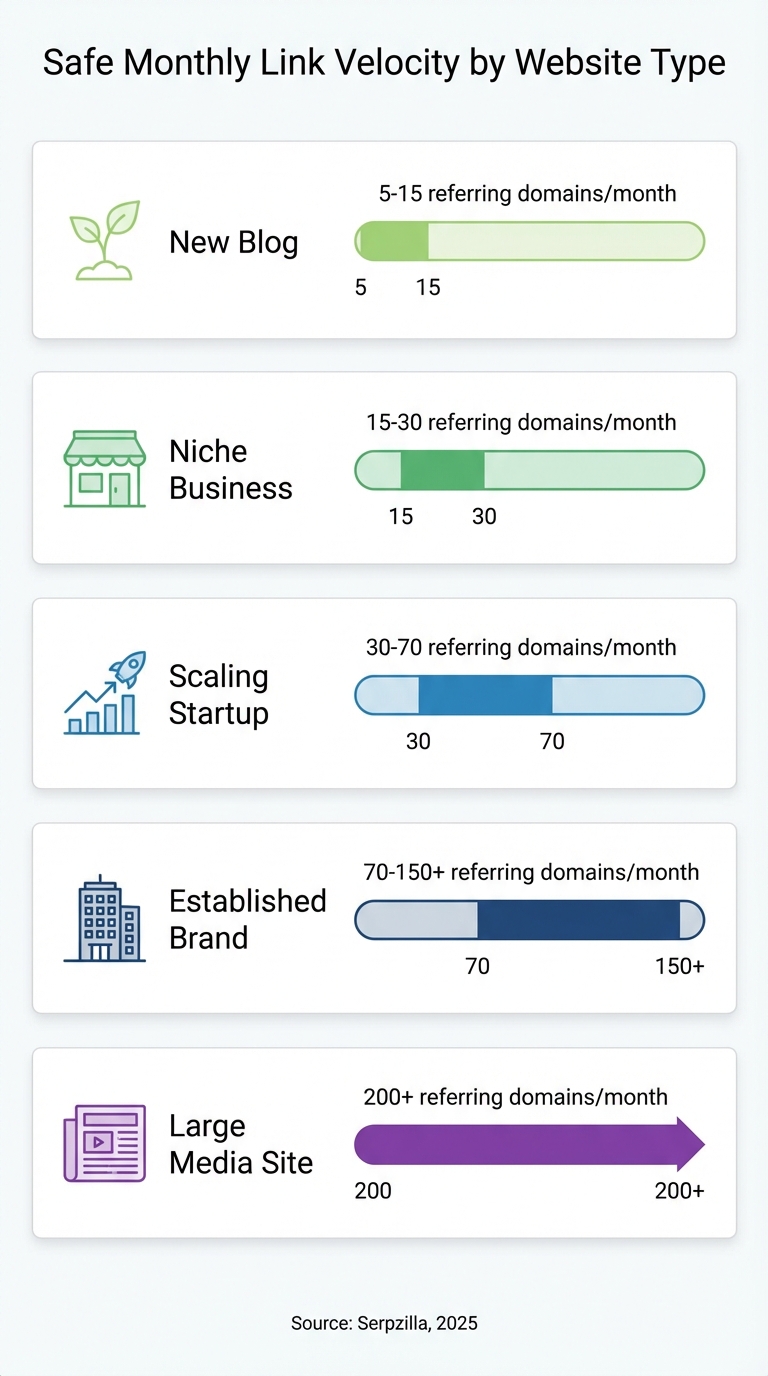
Safe Monthly Link Velocity Benchmarks by Website Type
Link velocity measures how your backlinks change over a specific time frame. The formula is simple: (New Referring Domains – Lost Referring Domains) / Time Period [8]. For instance, if your site gained 20 new backlinks and lost 5 in a month, your link velocity would be 15 backlinks per month.
This metric gives search engines insight into your site's backlink growth pattern. Think of it as a "heartbeat" for your website's credibility and popularity [3]. Consistent, organic backlink growth suggests that your content is resonating with users and gaining recognition. Over time, this steady growth builds what search engines refer to as "Domain Trust", signaling that your site is a reliable authority in its field [4].
The Role of Link Velocity in SEO
Maintaining a natural link acquisition pace is essential to avoid triggering spam filters like Google's Penguin algorithm. Google’s John Mueller emphasizes this point:
"If we see a huge spike in links without any clear reason – especially from low-quality sites – that's something our algorithms take into account" [2].
The pattern of link growth matters more than sheer numbers. A slow, steady increase in backlinks from high-quality, relevant sources signals healthy growth and boosts trustworthiness and rankings [2]. On the flip side, sudden surges in backlinks from irrelevant or low-quality sites can raise red flags, leading to penalties or devaluation [2]. Sites flagged for unnatural link velocity often experience organic traffic losses of 50% or more [10]. Negative link velocity - when you lose more links than you gain - can also hurt rankings by signaling declining relevance [8][1].
Understanding these patterns is crucial for managing your site's backlink profile effectively.
Key Factors That Influence Link Velocity
Several factors shape the pace at which backlinks are acquired. High-quality content is at the top of the list - shareable assets like original research or engaging infographics naturally attract links [3]. Competition within your niche also plays a role. For example, tech news websites generally have faster link velocity compared to hobby blogs [3]. Domain age is another consideration. Newer websites should aim for a gradual buildup (around 5–15 links per month) to establish trust, while older sites with established authority can handle a faster growth rate [3][2].
Seasonal trends are another key factor. These natural fluctuations are often seen as legitimate by search engines [3]. For example, retail sites might experience backlink spikes during the holidays, while B2B companies might see growth tied to industry events or funding announcements. Active marketing efforts - like influencer partnerships, press releases, or viral campaigns - can also boost link velocity in ways that appear organic to search engines [3].
| Website Type | Safe Monthly Link Velocity (Referring Domains) |
|---|---|
| New Blog | 5–15 / month |
| Niche Business | 15–30 / month |
| Scaling Startup | 30–70 / month |
| Established Brand | 70–150+ / month |
| Large Media Site | 200+ / month |
How Seasonal Trends Impact Link Velocity
Seasonal trends naturally influence link velocity, and search engines are well aware of these shifts. These trends generally fall into two buckets: time-based (like summer or winter) and event-based (think Black Friday, the Super Bowl, or Valentine’s Day) [11]. Recognizing these patterns is crucial for distinguishing between regular seasonal changes and potential issues in your backlink profile. This understanding helps you fine-tune your link-building strategy to align with these fluctuations. Let’s break down how to identify such trends and their practical implications.
E-commerce sites, for example, often see predictable link velocity spikes around holidays and major sales events [1][11]. On the other hand, SaaS and B2B companies may experience similar surges tied to industry-specific events, such as conferences, product launches, or viral research reports [2][12]. These "contextual surges" are a natural reflection of real-world events, and search engines typically view them positively rather than as spammy behavior [2].
Identifying Seasonal Trends in Your Industry
To pinpoint seasonal trends, start by analyzing historical search volume data over a period of 3–5 years. This helps you differentiate consistent seasonal patterns from one-off anomalies [13]. Tools like Google Trends are invaluable here - just input key industry terms to discover when interest typically peaks during the year [11][16]. For instance, searches for "patio furniture" or "tax software" follow predictable seasonal cycles, creating clear link-building opportunities.
Dive into your Google Search Console data, reviewing at least a full year’s worth of traffic and backlink activity. This can reveal recurring spikes or dips in performance [11]. Don’t forget to consider regional differences. For example, searches for "patio umbrellas" might peak earlier in warmer climates [11][7]. Additionally, keeping an eye on your competitors’ backlink activity can highlight their seasonal link-building strategies, giving you insight into industry trends [11][14].
"Seasonal trends are not always obvious. Failing to consider them when analyzing site traffic or creating an SEO report could end up wasting a lot of your time and resources." - Munene Mumbi, SEO Manager, WordLift [11]
Examples of Seasonal Effects on Link Velocity
Let’s look at some real-world examples to see how these trends play out across industries.
In February 2024, Munene Mumbi, WordLift’s SEO Manager, observed a traffic dip for a private jet leasing client. After investigating with Google Trends, he found the decline was tied to the Super Bowl period - a seasonal trend. Once the event ended, traffic and link interest normalized. This insight saved the team from mistakenly attributing the drop to a Google Core Update [11].
Retail sites, on the other hand, typically see dramatic increases in link velocity during the holiday shopping season, especially around Black Friday [1][11]. For B2B software companies, spikes often occur at the end of fiscal quarters when businesses finalize purchases. Similarly, tax preparation services naturally attract more backlinks between January and April [13][14]. Industry events, such as conferences, also create concentrated periods of link acquisition as attendees write blogs, share presentations, and reference products they discover [2][12].
Product launches and funding announcements generate what are known as "organic trust signals." For instance, receiving 1,000 links from reputable news outlets signals credibility, whereas the same number of links from low-quality forums might trigger spam alerts [2]. The key takeaway? Seasonal and event-based spikes are directly tied to real-world activities, which justifies the increased attention they receive from search engines.
Optimizing Link Velocity for High and Low Seasons
Adjusting your link velocity to match seasonal trends can help you avoid penalties and boost your SEO performance. For example, a spike in links during events like a product launch or Black Friday makes sense, but the same surge during quieter periods might raise red flags. Let’s dive into how to handle link velocity during both high and low seasons.
Strategies for High Seasons
During busy periods, increased link velocity can be justified by actual events. The trick is to focus on getting links from credible, high-authority sources rather than low-quality or automated networks.
Start planning your link-building efforts 3–6 months in advance to establish a solid foundation of authority [11][7]. Use evergreen URLs like /holiday-specials instead of year-specific ones, such as /deals-2025. This approach lets you accumulate link equity over time. Best Buy, for instance, reuses the same Black Friday URL every year, retaining SEO authority and past backlinks [15].
Create content that naturally attracts links, such as gift guides, trend reports, or data studies, to make the most of peak seasons [11]. Digital PR campaigns and co-marketing partnerships can also help you secure editorial links from respected publications. For example, in 2025, Notion launched Notion Mail and gained hundreds of backlinks from major tech sites like TechCrunch and TechRadar. This spike was seen as natural because it coincided with a legitimate product launch [5].
"Google's looking for signals that match real-world popularity growth. If your site's on nobody's radar and suddenly picks up 200 links in a week, it better be because you broke a story or got some national press. Otherwise, it looks bought."
- Ivan Vislavskiy, CEO and Co-founder, Comrade Digital Marketing Agency [5]
Benchmarking against competitors is another smart move. For instance, if industry leaders typically gain 15 referring domains per month but scale up to 25+ during peak seasons, you can safely aim for similar numbers [5]. A FinTech SaaS case study showed that aligning with market averages - 14–18 new referring domains per month and scaling to 25+ during PR events - led to a 312% increase in monthly organic leads over two years [5]. This approach ensures your link growth mirrors genuine visibility trends.
Strategies for Low Seasons
When the seasonal buzz dies down, it’s crucial to maintain steady link-building efforts. A sudden drop in link acquisition could signal to search engines that your site is losing relevance, making it tougher to rank for competitive terms [17][5].
Focus on long-term strategies like guest blogging, byline contributions, and outreach within your industry to build foundational links [17][10]. Evergreen content is another key asset. Posts that answer "What" and "Why" questions tend to attract 25.8% more links than "How-to" articles [9]. Regularly updating your evergreen content with fresh data and insights can help maintain a steady flow of backlinks [17][10].
Broken link campaigns are another effective strategy. Find and replace broken links within your niche to earn high-quality backlinks [17][10]. Instead of relying on large-scale PR campaigns, pitch one story or industry study each month to keep editorial links trickling in year-round [5]. For newer sites, aiming for 5 to 10 backlinks per month is a solid start, while established small-to-medium businesses (SMBs) might target 30 to 100 backlinks monthly [2].
"Building your links naturally means that you are matching your growth to how your industry earns attention. Tech brands see quick spikes right after launches while local businesses grow slower through directories & community mentions."
- Chris Kirksey, CEO, Direction.com [5]
Keep an eye on your competitors during slower periods and aim to match their link-building pace to stay competitive [5]. Remember, the quality of your links matters more than the speed at which you acquire them. Google prioritizes the relevance and authority of linking sources over sheer quantity [17][10]. For many websites, a sustainable goal is around 3 to 5 backlinks per week [5]. Consistent link-building, even during quieter times, helps reinforce your site’s authority throughout the year.
Using Linkzy to Manage Seasonal Link Velocity
To handle the ups and downs of seasonal link velocity, having an automated, efficient system in place is crucial.
Managing seasonal link velocity manually isn't just tedious - it’s risky. Linkzy simplifies this process by automating backlink scheduling to match natural industry trends. Its AI-powered platform ensures a consistent flow of links during slower times and ramps up activity during busy seasons - all while avoiding spam filter triggers [2].
One standout feature is its niche-specific targeting. By selecting your industry vertical, Linkzy places backlinks on websites that are contextually relevant. This approach reinforces what Sergey Pankov, CEO at Serpzilla.com, refers to as a vital "trust signal":
"Link velocity is a trust signal. A steady pace of relevant, high-quality backlinks tells search engines your content is valuable and worth ranking" [8].
Step-by-Step: Setting Up Linkzy for Seasonal Optimization
Getting started with Linkzy is straightforward. Here’s how it works:
- Select your niche: Choose your industry to ensure backlinks align with safe velocity benchmarks [8]. For example, new blogs might aim for 5–15 new domains per month, while established brands can handle 70–150+.
- Install the tracking snippet: Monitor your backlink profile seamlessly across platforms [8][19].
- Configure velocity settings: Tailor your link acquisition to your seasonal calendar. For instance, if prepping for a major event like Black Friday, you can schedule a gradual increase in backlinks months before the peak, then taper off as the season winds down. This ensures your backlink growth mirrors natural industry trends.
These steps enable the platform to optimize your link-building efforts effectively.
Benefits of Linkzy for Seasonal Link Building
Linkzy keeps your link-building efforts consistent year-round, helping you avoid negative link velocity (losing more links than you gain), which can hurt rankings [8][19].
Its niche targeting sources backlinks from relevant websites, promoting diversity and avoiding "donor mono-diets" - a common pitfall of relying on a single type of link source [8][18]. Businesses using AI-driven link building with manual oversight have reported a 30–50% boost in backlink acquisition efficiency while maintaining natural velocity patterns [2].
The platform also smooths out your link graph after campaign spikes. For example, if a product launch generates a sudden surge of backlinks from press coverage, Linkzy can adjust the ongoing link velocity to create a gradual decline instead of a sharp drop. This helps avoid algorithmic red flags, as highlighted by John Mueller, Google’s Search Advocate:
"If we see a huge spike in links without any clear reason – especially from low-quality sites – that's something our algorithms take into account" [2].
Finally, Linkzy’s pricing is accessible for businesses of all sizes. The Starter Plan, at $19/month, includes 5 credits per month - perfect for small businesses maintaining steady link velocity during off-seasons. The Pro Plan, at $29/month, offers 15 credits and priority support, making it ideal for growing businesses scaling up during peak periods while staying within safe velocity limits.
Measuring and Adjusting Link Velocity Over Time
Keeping a close eye on link velocity through weekly, monthly, and quarterly analyses is key to spotting trends and fine-tuning your strategy. Weekly tracking provides short-term insights, while monthly reviews help identify consistent patterns. Quarterly assessments, on the other hand, reveal seasonal shifts that might influence your approach [8]. This ongoing analysis ensures your link-building efforts stay aligned with the ebb and flow of seasonal trends.
Tools for Monitoring Link Velocity
To stay on top of your link velocity and adapt to seasonal trends, you’ll need reliable tools that offer real-time data. Start with Google Search Console, a free resource that shows which links Google has indexed for your site [4][23]. For more in-depth tracking and analysis, consider these advanced tools:
- Ahrefs (starting at $99/month): This tool features a "New & Lost" referring domains report, letting you monitor daily and weekly link growth [20][24].
- SEMrush ($99/month): Offers detailed backlink audits, helping you spot sudden spikes, toxic links, or lost domains [4][23].
- Majestic SEO (starting at $49.99/month): Provides both current and historical backlink data, making it ideal for evaluating the quality and age of your backlinks [20][24].
For a visual representation of link growth, tools like LinkResearchTools offer heatmaps that display 24 months of data in a color-coded format. This can highlight annual spikes during events like Christmas or summer sales [21][22]. Additionally, automated alerts from Ahrefs or SEMrush can notify you of sudden changes, such as a potential negative SEO attack or content decay [23][24]. Using these tools regularly ensures you’re equipped to adjust your strategy as needed.
Benchmarks for Different Types of Websites
Benchmarks can help you gauge what’s considered a "natural" link velocity for your niche, especially when you compare your site to the top 3–5 competitors. For instance, in the FinTech sector, one case study found that the average site gained 14–18 new referring domains per month, while top competitors hit 25 or more. By ramping up efforts during PR events to match these leaders, the company in the study saw a 312% increase in monthly organic leads over two years [5].
In general, websites that maintain a steady 10% monthly link growth rate often experience an average ranking improvement of 15 positions year-over-year [20]. These benchmarks are crucial for calibrating your link-building efforts based on your site’s maturity and the competitive landscape.
Conclusion
Matching your link velocity to seasonal trends helps build trust with search engines by reflecting authentic popularity shifts. When backlink growth coincides with product launches, industry events, or holiday campaigns, Google views these spikes as genuine rather than manipulative [2][6]. In fact, pages ranking at the top of Google have 3.8 times more backlinks than those in positions 2 through 10 [3].
To stay relevant, maintain a steady baseline during slower periods and diversify your backlink sources during peak seasons. Even adding 5–15 links per month can make a difference [2][4]. During busier times, aim for a mix of sources - news sites, blogs, and directories - to mimic natural backlink variety [4][1].
"Building your links naturally means that you are matching your growth to how your industry earns attention." - Chris Kirksey, CEO, Direction.com [5]
For a streamlined approach, Linkzy can automate the process by placing backlinks on a consistent, natural schedule. Its AI ensures links are added at a steady pace, avoiding unnatural spikes and preventing stagnation during quieter months.
Finally, use tools like Ahrefs or SEMrush to regularly monitor your link patterns. Post-season audits are also key to maintaining natural growth [10][3][25].
FAQs
How can I tell a seasonal link spike from a spammy one?
A seasonal link spike happens when there's a natural, predictable increase in backlinks due to events, holidays, or campaigns tied to your niche. For example, retail websites often experience these spikes around Black Friday or during the holiday shopping season.
On the other hand, spammy spikes are abrupt and typically come from low-quality or unrelated sources. These lack any meaningful context. Watch out for warning signs like sudden, massive jumps in links, a high number of low-authority domains, or patterns that seem unnatural.
What should I do if my backlinks drop in the off-season?
If you notice a drop in backlinks during the off-season, it's time to tweak your approach to maintain a steady and natural link-building pace. Steer clear of overly aggressive tactics that might raise red flags with search engines. Instead, consider using tools like automated backlink services. These can help you maintain a consistent stream of high-quality, niche-specific links throughout the year. This strategy not only keeps your backlink profile strong but also reduces the impact of seasonal dips on your SEO performance.
How do I set a safe link velocity for my site?
To maintain a safe link velocity, aim for consistent and gradual backlink growth over time. Sudden surges in link acquisition can raise red flags with search engines, as they actively monitor for unnatural patterns that might lead to penalties.
Using tools like Linkzy can simplify the process by automating the creation of steady, high-quality backlinks. This approach helps ensure your link velocity remains natural, aligns with your site's authority, and supports your search engine rankings effectively.