How To Optimize Content For Niche Backlinks
How To Optimize Content For Niche Backlinks
In 2026, niche backlinks are more important than ever for SEO. While high-authority links from big sites help, links from industry-specific sites signal expertise and relevance to search engines. These links improve rankings, build topical authority, and strengthen E-E-A-T (Experience, Expertise, Authoritativeness, Trustworthiness). Here's how to earn them:
- Research Your Niche: Understand your audience’s pain points using tools like Reddit, YouTube, and customer reviews.
- Create Link-Worthy Content: Focus on original research, detailed guides, and interactive tools that others want to reference.
- Optimize On-Page SEO: Use strong titles, meta descriptions, and internal/external links to boost discoverability.
- Outreach Strategy: Identify relevant websites, personalize your pitches, and follow up to secure backlinks.
- Track and Refine: Regularly monitor your backlink profile to improve strategies and recover lost links.
The key is quality over quantity - target niche-relevant sites to boost rankings and attract engaged traffic.
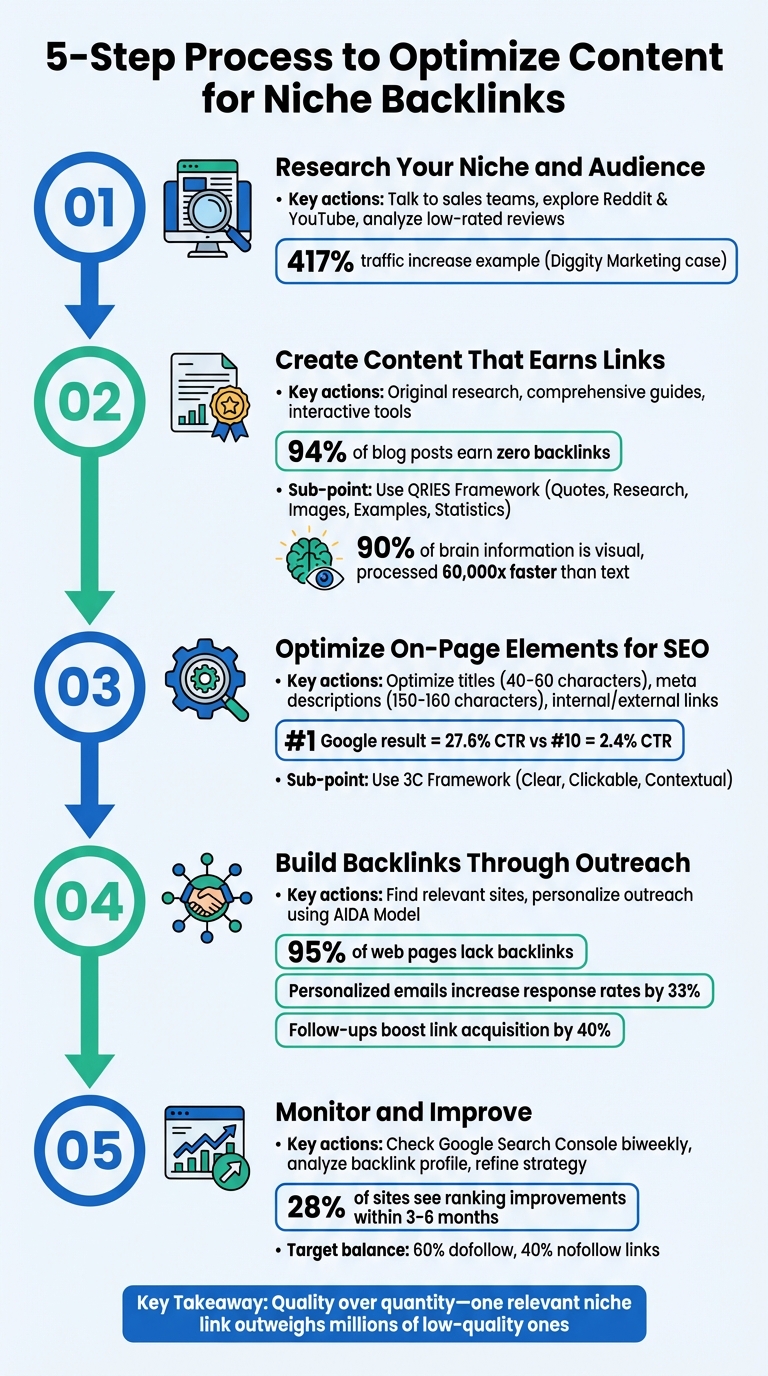
5-Step Process to Optimize Content for Niche Backlinks
How to Create Backlinks For Website
sbb-itb-0f47b19
Step 1: Research Your Niche and Audience
Before you even think about writing, you need to understand who you're writing for and what challenges they face. A great starting point? Your sales and customer success teams. These teams have direct contact with your audience and can provide valuable insights into how buyers think, speak, and what concerns they bring up. Sitting in on demos can also be a goldmine - it’s where you’ll hear the real language your audience uses and the issues they care about most [5].
Another way to dig deeper is by exploring platforms like Reddit and YouTube. Both are filled with unfiltered conversations. On Reddit, skip the clunky native search by using Google’s search operator: site:reddit.com 'your keyword'. This helps you zero in on niche discussions where people are candid about their problems [5]. Similarly, check out top YouTube video comments. You can even use AI tools to spot recurring frustrations in these comments, giving you a better sense of the emotional impact certain problems have on your audience [5]. These raw insights will help you pinpoint exactly what your audience struggles with.
Identify Pain Points and Interests
To uncover specific gaps and unmet needs, dive into low-rated reviews on platforms like Amazon, G2, or Trustpilot. These reviews often highlight what’s missing or what frustrates users the most [5]. Another trick? Expand Google’s “People also ask” section by clicking on multiple questions. This generates a detailed list of queries that reflect real search intent - not just guesses [6].
Here’s an example of why this works: In January 2025, Diggity Marketing helped an e-commerce client boost traffic by 417% over eight months simply by addressing audience pain points through strategic content updates. This translated to $48,000 more in monthly revenue and a 112% overall revenue increase [7]. The secret? They understood their audience’s needs and delivered content that solved their problems.
Use these pain points to steer your keyword selection and content strategy.
Perform Keyword Research
Now, take those insights and turn them into a solid keyword strategy. Focusing on niche-specific pain points ensures your content attracts high-quality backlinks and engages your audience. Tools like Semrush (starting at $79/month after a 7-day free trial) can help you analyze competitor gaps - keywords they rank for but you don’t. This reveals untapped opportunities to meet your audience’s needs [6][9].
A good example of this in action is Zapier, which grew to 1.6 million monthly search visits by targeting specific "how-to" queries their audience was searching for [7]. Instead of chasing high-volume keywords, they honed in on the exact phrases their users were typing into Google.
When researching keywords, aim for a mix of informational intent (like “how to clean leather shoes”) and commercial intent (like “leather shoe conditioner”) that align with your niche [9]. Semrush categorizes keyword difficulty from 0-14% (very easy) to 70-100% (very hard). Focus on those in the 15-49% range - these are competitive enough to matter but still achievable [9]. Considering that 62.2% of writers struggle with saturated niches [7], finding the right keywords is a critical step in standing out.
Step 2: Create Content That Earns Links
Once you know what your audience is looking for, the next step is creating content that other websites want to link to. The secret? Offer something valuable. Writers, bloggers, and journalists need a reason to reference your work - something they can't easily find elsewhere.
Here’s a reality check: 94% of blog posts earn zero backlinks [12]. To stand out, you need to create what’s called a "linkable asset." This type of content acts as a go-to resource for creators looking for original data, expert insights, or detailed guides.
Some of the best linkable assets include original research, data-driven studies [7, 17], comprehensive guides, and interactive tools [7, 18]. For example, original research offers unique insights that journalists and bloggers crave, while definitive guides become trusted resources over time. Interactive tools, like calculators or templates, solve specific problems and keep users coming back. By understanding your audience's needs, you can craft content that encourages others to link to your work.
Write In-Depth, Detailed Content
Long-form content tends to attract more backlinks [3] because it thoroughly explores a topic, leaving readers with little need to look elsewhere. A good tip? Spend 80% of your time on research and 20% on writing [13]. When you’ve done your homework, the writing process becomes much smoother.
To make your content stand out, use the QRIES Framework:
- Quotes from experts
- Research that’s thorough and credible
- Images to support your points
- Examples from real-world scenarios
- Statistics that are verifiable
For instance, the agency Animalz published "The Animalz Content Marketing Benchmark Report 2021", which became one of their most-linked articles because it offered original industry data [14]. Similarly, NerdWallet’s "star rating methodology" for financial products - explaining how factors like fees and customer service are evaluated - makes their reviews highly linkable [15].
Focus on topics that naturally attract links while aligning with your niche’s expertise. Keep in mind, you’re writing for two groups: your customers and the writers, editors, and SEOs who rely on credible sources.
"When you've thoroughly researched and understood the topic, then writing becomes faster and easier." – Backlinko [13]
Add Visual and Interactive Elements
Detailed analysis is important, but adding visuals can take your content to the next level. Visuals are powerful tools for earning links. Research shows that 90% of the information processed by the brain is visual, and visuals are processed 60,000 times faster than text [19, 21]. Charts, diagrams, and infographics simplify complex data, making it easier for others to link to your content.
Interactive content is even more effective. It generates twice as many conversions as static content, and quizzes alone see 52.6% higher engagement [19, 24]. Tools like calculators, quizzes, and maps provide instant, personalized value, which naturally attracts editorial links [20, 21, 23].
When designing visuals, aim for shareability. For example, modern infographics should be modular, allowing publishers to embed only the sections that are most relevant to their audience. This approach increases the chances of earning multiple backlinks [10]. Also, make clickable elements obvious - using visual cues like borders or 3D effects can dramatically improve interaction. In fact, one study found that a simple button redesign increased clicks by 416% [11].
To boost engagement, use charts for data, diagrams for explaining complex ideas, and screenshots to showcase tools. These visual elements not only break up the text but also make your content more memorable and linkable. By combining in-depth information with strong visuals, you’ll create content that informs your audience and signals authority to search engines. This aligns perfectly with building backlinks that strengthen your niche expertise.
Step 3: Optimize On-Page Elements for SEO
Creating great content is only part of the equation. If search engines struggle to understand your content - or it doesn’t appear in the right searches - you’re leaving visibility and backlink opportunities on the table. Fine-tuning on-page elements makes your content easier to find and more appealing for others to link to. With strong content already in place, optimizing these details can amplify both its reach and linkability.
When your page titles, descriptions, and links align with what your audience is actively searching for, you increase the chances of being discovered and referenced. Even Google highlights this:
"The most basic signal that information is relevant is when content contains the same keywords as your search query" [25].
Optimize Titles and Meta Descriptions
Your title tag is the first thing people notice in search results, and it plays a key role in earning clicks. The #1 result on Google averages a click-through rate (CTR) of 27.6%, while the #10 result drops to just 2.4% [16]. That’s a huge gap, and your title can make all the difference.
To craft strong titles, use the 3C Framework:
- Clear: Clearly communicate what the page is about.
- Clickable: Use compelling, attention-grabbing words.
- Contextual: Include your primary keyword.
For example, instead of a generic title like "Guide to Email Marketing", opt for something like "How to Master Email Marketing: A Step-by-Step Blueprint." The second version is more specific and engaging.
Front-load your keywords by placing the most important terms at the beginning of your title, as both users and search engines tend to focus on the first few words [16]. Keep titles between 40 and 60 characters; this range tends to attract 8.9% more clicks on average [16]. Remember, Google rewrites over 60% of title tags and 70% of meta descriptions [16][17], so avoid vague or repetitive phrases like "Home" or "Services."
For meta descriptions, aim for 150–160 characters, use active language, and include a clear call-to-action [17]. While meta descriptions don’t directly influence rankings, they impact CTR, which can send positive signals to search engines. Titles with positive emotional language tend to perform better, achieving a 4.1% higher CTR compared to those with negative sentiment [25].
Use Relevant Internal and External Links
Links play a dual role: they help users navigate your site and signal authority to search engines. Both internal and external links contribute to establishing your expertise in a niche.
For internal links, use descriptive, keyword-rich anchor text. Instead of vague phrases like "click here", go for something like "learn more about keyword research strategies." A "hub-and-spoke" or "topic cluster" model works well: supporting pages link back to a central "pillar" page, helping search engines understand your content’s structure and relevance [18][20][24].
Place internal links near the top of your page to encourage engagement and reduce bounce rates [19][23]. Link from high-authority pages, such as your homepage or cornerstone content, to newer or underperforming pages to give them a visibility boost [18][23][24]. Ensure all internal links are "dofollow" so they can pass link equity (PageRank) throughout your site [19][20][23]. Avoid "orphan pages" by making sure every page on your site has at least one internal link pointing to it [20][23][24].
John Mueller, Google’s Search Advocate, highlights the importance of internal linking:
"It's one of the biggest things that you can do on a website to kind of guide Google and guide visitors to the pages that you think are important" [18].
For external links, focus on citing reputable and authoritative sources. Linking to respected publications, academic studies, or industry leaders demonstrates expertise [18][21][22]. Introduce external links with context, explaining why the source is relevant or valuable. This not only enhances credibility but also makes your content more useful and linkable [22].
Here’s a quick breakdown of link attributes and their roles:
| Link Attribute | When to Use | SEO Impact |
|---|---|---|
| Dofollow (Default) | Standard internal links and trusted external sources. | Passes link equity and authority. |
| Nofollow | Links to untrusted sources, paid links, or user-generated content. | Prevents passing authority. |
| Sponsored | Links tied to advertisements or paid placements. | Signals commercial relationships to Google. |
| UGC | Links in comments, forums, or user-submitted areas. | Indicates non-editorial placement. |
Regularly revisit older posts to add internal links to newer, relevant content [20][23]. This keeps your site’s structure dynamic and ensures your valuable content remains interconnected. By refining these on-page elements, you make it easier for search engines to grasp your niche focus - and for others to confidently link to your work.
Step 4: Build Backlinks Through Outreach
Creating well-optimized content is only half the battle - your work won't gain traction if it goes unnoticed. With a staggering 95% of web pages lacking backlinks [26], waiting for organic links to roll in isn't realistic. Outreach is how you connect your content with the right platforms, ensuring it gets the visibility it deserves. The trick? Targeting the right websites and crafting messages that make linking to your content an easy choice.
Find Relevant Websites and Blogs
The first step is identifying websites and blogs already engaging with topics in your niche. Google search operators can help you uncover opportunities quickly. For example:
intitle:"write for us" + [your niche]to find sites accepting guest postsinurl:resources + [your topic]to locate resource pages that might link to your content
For instance, searching intitle:"guest post" fitness will reveal blogs actively looking for contributors.
Another effective strategy is competitor backlink analysis. Tools like Ahrefs or Semrush can show you "Link Intersects", which highlight sites linking to your competitors but not yet to you. Additionally, keep an eye out for unlinked brand mentions - instances where your brand is mentioned but not hyperlinked. These can be goldmines, with conversion rates often hitting 30% to 50% [26].
When prioritizing potential link sources, focus on three key factors: Domain Authority (DA), organic traffic, and relevance to your topic. As a Google source explains:
"The total number of backlinks a website has doesn't matter at all [for ranking]; one good link from a relevant site can be more impactful than millions of low-quality ones" [26].
In short, quality beats quantity every time. Even a single link from a respected, relevant site can give your content a major boost.
If you’re looking to streamline the process, platforms like Linkzy (https://linkzy.ai) can take the heavy lifting off your plate. Linkzy identifies niche-specific websites and secures contextual backlinks for you. All you need to do is specify your niche, integrate a tracking snippet, and let the system handle the rest. This hands-free approach delivers consistent, high-quality links optimized for search rankings.
Once you've built a targeted list of prospects, the next step is reaching out in a way that grabs attention and converts opportunities into backlinks.
Personalize Your Outreach Messages
Generic, mass-sent emails are almost always ignored. In fact, 91.5% of cold outreach emails go unanswered [26], and 64% of recipients decide whether to open an email based entirely on the subject line [27]. On the other hand, personalized emails can increase response rates by about one-third [29].
Start your email with a personalized touch - mention something specific about the recipient's site, like a recent article, an achievement, or a unique perspective they’ve shared. This shows you’ve done your homework and aren’t just blasting out a template. A great way to structure your pitch is using the AIDA Model:
- Attention: Open with a personalized hook to grab their interest.
- Interest: Highlight what makes your content stand out.
- Desire: Explain how linking to your content benefits their audience.
- Action: End with a clear call-to-action, such as, "Would you consider adding this resource to your guide on [topic]?"
Keep your email concise - around 150 words is ideal, as response rates are significantly higher for short, focused messages [28]. And don’t forget to follow up! Sending a polite follow-up 5–7 days after your initial email can boost link acquisition by 40% [28].
To make your outreach even more effective, use tools like Hunter.io to find and verify the right editor’s email address instead of relying on generic ones. Always offer clear value upfront. This could be a high-quality guest post, fixing a broken link on their site, or providing them with original data they can reference.
As Brian Dean from Backlinko wisely states:
"Personalization is critical. It's the single biggest thing that separates spammers from pros" [29].
Step 5: Monitor and Improve Your Backlink Strategy
Building backlinks isn’t a one-and-done task. It requires regular monitoring to identify harmful links, uncover missed opportunities, and address any decline in referring domains. Keeping track of performance helps you focus on what works and avoid wasting time on ineffective tactics.
Analyze Your Backlink Profile
Start with Google Search Console’s "Links" report, which is free and updated regularly. Check it biweekly to see which sites are linking to you, your most-linked pages, and the anchor text being used. This can help you spot issues like negative SEO attacks or sudden changes in your link profile [4][31][35]. For a deeper dive, tools like Ahrefs (which tracks over 30 trillion links [32]) or Semrush can provide metrics like Domain Rating and link velocity, giving you a clearer picture of your backlink growth [32][33].
Search engines prefer a steady flow of natural link acquisition rather than sudden spikes. Aim for a balance of about 60% dofollow links and 40% nofollow links for a natural-looking profile [30]. Also, prioritize links from contextually relevant sites, as they carry more weight. As Stellar SEO explains:
"A backlink is no longer just a vote. It is a context signal that helps Google decide which entities belong together and which topics a site is qualified to rank for" [4].
Use Google Analytics to track referral traffic (Acquisition > All Traffic > Referrals) and see if your backlinks are actually driving visitors who engage with your content or convert into customers [35].
If manually tracking all this data feels overwhelming, tools like Linkzy can simplify the process. Linkzy monitors your backlink profile in real time, ensuring consistent link placement and natural link velocity. It also provides detailed analytics to show which links are delivering results, saving you the hassle of juggling multiple SEO tools.
Once you’ve analyzed your backlink profile, use the insights to fine-tune your content and outreach strategies.
Refine Your Content and Outreach
Based on your findings, categorize your backlinks by type - guest posts, resource pages, editorial mentions, or directories. This helps you identify which formats are most effective [30][34]. For example, if guest posts consistently bring in high-quality links, focus more on that approach. Similarly, if certain topics attract more backlinks, create more content around those themes.
Pay attention to your anchor text distribution. A balanced profile for 2025 should include around 40–50% branded anchors, 15–20% naked URLs, 20–25% generic phrases, and only 1–5% exact-match keywords [36]. A profile that leans too heavily on exact-match anchors can raise red flags with search engines.
Don’t forget to monitor lost links monthly and take steps to recover them [36]. Links can disappear when sites are redesigned or content is removed. Reaching out to reclaim high-value lost links can help maintain your SEO momentum. Additionally, set up Google Alerts for your brand name to catch unlinked mentions and turn them into backlinks [35].
There are plenty of examples showing the impact of refining your backlink strategy. In 2017, the New York Times cleaned up harmful links and saw a 20% boost in organic traffic within three months [32]. Similarly, WebFX cut down the time spent on manual backlink reviews by 60% by using automated tools for detecting toxic links [32]. These cases highlight how data-driven adjustments can make a big difference in your SEO results.
Conclusion
Creating a strong backlink profile starts with producing high-quality, niche-specific content that naturally attracts attention from respected industry websites. As Brittney Fred, SEO Analyst at Linkflow, emphasizes:
"A handful of high-quality, niche relevant links can outweigh dozens of generic ones" [1].
These focused links help position your site as a credible authority, enhance your E-E-A-T signals, and bring in visitors who are already interested in what you offer.
Backlinks continue to play a key role in Google's ranking algorithm, consistently ranking among the top three factors [37]. Studies reveal that nearly 28% of websites experience ranking improvements within three to six months of gaining new links, while around 16% notice changes in the first month [2]. Think of building links as cultivating meaningful business connections.
Refining your strategy regularly is essential. Check your backlink profile every six months to identify and address harmful links, update older content to keep it appealing as a "link magnet", and assess which outreach strategies are delivering the best results. The websites that perform well over time don’t rely on shortcuts - they focus on building genuine authority [8]. This ongoing effort is the backbone of a successful SEO approach.
Whether you're manually reaching out to industry blogs or leveraging tools like Linkzy to streamline niche-relevant link placements, the core principles remain unchanged: develop content that earns links, target the right websites, and stay dedicated to the process. Link building is a continuous effort, requiring patience, regular adjustments, and a commitment to steady, authentic growth.
FAQs
What makes a backlink “niche-relevant”?
When a backlink is considered “niche-relevant,” it means it originates from a website that operates in the same or a closely related industry or topic as yours. This relevance is judged by factors such as the website’s primary focus, how well the content aligns contextually, and the anchor text used. Search engines prioritize these signals because they help build trust and authority within your specific niche, improve rankings, and attract more targeted traffic.
How can I choose topics that naturally earn backlinks?
To attract backlinks organically, focus on crafting content that stands out as useful, relevant, and unique within your field. Choose topics that solve specific problems, introduce fresh perspectives, or offer practical tools. Content that’s well-researched, engaging, and tailored to your audience - like educational guides or entertaining resources - naturally draws attention and shares. By addressing genuine needs with high-quality, niche-focused material, you increase the likelihood of earning links without asking for them.
How long does it take to see SEO gains from niche backlinks?
Backlinks usually begin to influence Google rankings about 10 weeks after being acquired. While the initial indexing process typically takes 1–2 weeks, more visible SEO benefits often emerge within 4–6 months. However, the timeline can differ based on factors such as the quality of your content, how relevant the backlinks are to your niche, and the effectiveness of your overall SEO strategy.