Guest Posting vs Automated Links: Cost Comparison
Guest Posting vs Automated Links: Cost Comparison
Guest posting and automated links are two popular link-building strategies, but they come with different costs, time requirements, and scalability. Here’s the key takeaway:
- Guest Posting: Costs range from $150 to $1,500+ per link. It involves manual outreach, content creation, and negotiation, making it time-consuming and expensive. Scaling requires more staff and resources, with risks like low-quality links and potential Google penalties.
- Automated Links (e.g., Linkzy): Costs $80–$200 per link or as low as $29/month for 15 credits. Automation handles the entire process, cutting costs by up to 70% and reducing time investment. It scales easily without additional staff, but quality control is essential.
Quick Comparison
| Feature | Guest Posting | Automated Links (Linkzy) |
|---|---|---|
| Cost per Link | $150–$1,500+ | $80–$200 |
| Time Investment | High (manual outreach, etc.) | Low (automated process) |
| Scalability | Requires more staff | Scales without extra staff |
| Quality Risk | 85% low-quality sites | Requires vetting for quality |
| Long-Term Value | Risk of penalties, attrition | Focused on steady results |
Guest posting offers high editorial standards but is resource-intensive. Automated tools like Linkzy cut costs and time while simplifying scaling. A balanced approach combining both methods can maximize results while minimizing risks.
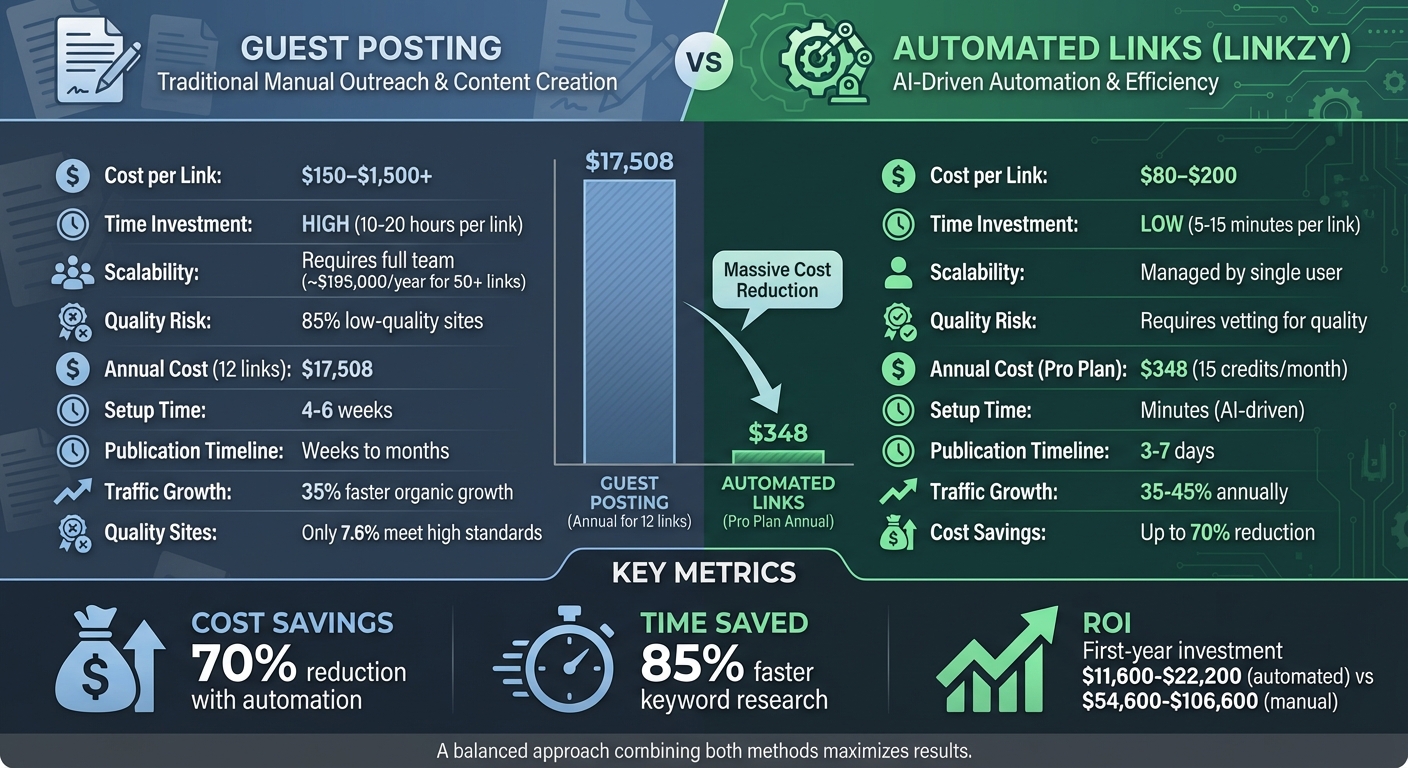
Guest Posting vs Automated Links: Cost and ROI Comparison
How We Built 1,664 Quality Links for $8 Each (Ep. 347)
Cost Breakdown and Pricing
Guest posting operates on a pay-per-link basis, with costs climbing as the quality of the host site improves. On average, website owners charge about $365 per link directly. However, if you go through a vendor, that price can jump to around $1,459.06. The increase covers services like outreach, vetting, and coordination [1][3].
The price you pay also heavily depends on the domain rating (DR) of the host site. For instance:
- Links from a DR 41–50 site average about $462.
- Placements on DR 71–80 sites cost roughly $1,008.
- Top-tier domains with a DR of 81+ and over 100,000 monthly visitors typically cost $957.08 directly - or between $2,800 and $3,800 if purchased through a vendor [3][7].
"If you're buying top-tier links at just under $1k, you're way overpaying on what you could... Pay for 10 guest post links and you've spent just short of $10k."
- James Brockbank, Managing Director at Digitaloft [3]
Hidden Costs Add Up
Beyond the link price, guest posting comes with additional expenses. Here's a typical cost breakdown for a $500 guest post:
- Publisher fees: $200–$250
- Content creation: $75–$100
- Prospecting tools: $50–$75
- Tracking and coordination: $50–$75
- Vendor margin: $50–$75
These extra charges quickly stack up, making guest posting a costly and time-consuming process [4].
Linkzy: A Simpler, Predictable Model
Unlike the fluctuating costs of traditional guest posting, Linkzy offers a flat-rate subscription model. Here’s how it works:
- Free Plan: 3 credits per month
- Starter Plan: $19/month for 5 credits
- Pro Plan: $29/month for 15 credits
These plans include automation, placement, and tracking, eliminating the unpredictable per-link fees and hidden costs.
To put it in perspective, purchasing 15 guest post links can cost anywhere from $6,233 (for mid-tier links) to $21,885 (via vendors). In contrast, Linkzy's Pro plan offers a far more affordable and streamlined solution.
Time Requirements and Scaling Capacity
Manual guest posting is a time sink. Crafting just one link can stretch into weeks, with hours spent researching prospects, days dedicated to personalized outreach, and even more time waiting for editorial approval. Success rates don’t help either - manual backlink outreach typically works only 1–2% of the time[6]. That means you could send dozens of emails just to land a single link. Compare that to automated solutions, and the difference is stark.
"Guest posting is hard to scale. From initial contact to publication, it can take months."
- Ihor Masalov, SEO Specialist [8]
Trying to scale up to 50+ links manually? That often requires a dedicated team, costing upwards of $195,000 annually[5]. But with Linkzy, the game changes. It streamlines site discovery, vetting, and placement in just minutes. One person can handle what used to demand an entire team. Plus, scaling from 10 to 50+ links doesn’t require hiring more staff. With the Pro plan’s 15 monthly credits, you can maintain a steady flow of links without the headaches of traditional guest posting.
Here’s a quick comparison of manual guest posting versus Linkzy’s automated approach:
| Phase | Manual Guest Posting | Linkzy Automated |
|---|---|---|
| Setup Time | 4–6 weeks (research & prospecting)[8] | Minutes (AI-driven) |
| Effort per Link | 10–20 hours (outreach, writing, negotiation)[2][4] | 5–15 minutes (automated placement) |
| Scaling to 50+ Links | Requires full team (~$195,000+/year)[5] | Managed by a single user[4] |
| Publication Timeline | Weeks to months[8] | 3–7 days[8] |
This side-by-side breakdown underscores the efficiency of automation, not just in terms of cost but also in reducing the operational strain of scaling link-building efforts.
Return on Investment and Long-Term Performance
The numbers paint a clear picture when it comes to ROI. Vendor guest posting costs an average of $1,459.06 per link, yet 85% of these sites are considered low quality, and 11.36% generate no organic traffic at all [3]. In other words, you could be paying a premium for links that deliver little to no value.
Guest posts also come with risks like indexing failures, link removals, and even penalties from Google [3][9]. To make matters worse, many vendors only provide a 12-month guarantee [5], essentially making these links a short-term rental rather than a long-term asset.
If you're aiming for sustainable SEO results, addressing these risks is non-negotiable. That's where Linkzy comes in. Linkzy focuses on niche relevance and consistent traffic, ensuring that links remain valuable over time.
"One link that earns traffic and trust is worth more than ten low-quality links you'll have to replace in six months."
Consider this example: A financial planning firm that opted for managed guest posting saw its organic traffic skyrocket by 964% over 32 months, growing from 2,818 to 31,200 monthly visitors. Its Domain Rating also improved from 37 to 50 [5]. However, these impressive results came at a steep cost, typical of enterprise-level pricing. By contrast, Linkzy offers a much more affordable solution. With its Pro plan priced at $29 per month for 15 credits, the annual cost is just $348, compared to approximately $17,508 for 12 vendor guest posts [3]. This stark difference highlights how automation can significantly lower the cost per effective link.
| 12-Month Metric | Guest Posting (Vendor) | Linkzy Automated |
|---|---|---|
| Total Investment | $17,508 (12 links) [3] | $348 (Pro Plan) |
| Cost Per Link | $1,459.06 [3] | $29 (Pro Plan) |
| Quality Risk | 85% low-quality sites [3] | Niche-vetted and tracked |
| Link Longevity | 12-month guarantees [5] | Continuously monitored |
| Traffic Reliability | 11.36% receive no traffic [3] | Pre-screened for activity |
This comparison shows how automation doesn’t just cut costs - it also delivers better long-term results by ensuring higher-quality links and more reliable traffic.
sbb-itb-0f47b19
1. Guest Posting
Financial Costs
Guest posting can be a pricey endeavor. For a typical $500 guest post, costs are divided among publisher fees ($200–$250), content creation ($75–$100), outreach labor ($50–$75), and campaign management ($50–$75) [4].
The price tag escalates as the quality of the site increases. If you're aiming for low-tier sites with a Domain Rating (DR) of 20–30, expect to spend $50–$200. On the other hand, securing premium editorial links on sites with DR 70+ can cost anywhere from $1,500 to $5,000 [4][5]. For the top-tier sites with DR 80+, prices soar to $1,371 to $4,530 per placement [7]. Running an in-house team to generate around 20 links monthly? You're looking at an annual cost of approximately $136,000, factoring in salaries for specialists and writers, tools, and publisher fees [4].
These financial demands highlight the need for a considerable time investment to make guest posting work effectively.
Time Investment
Guest posting is not a quick or simple task - it requires consistent effort and attention to detail. The process involves several time-intensive steps, including keyword research, analyzing competitor backlinks, creating content with multiple revisions, identifying the right contacts, verifying email addresses, and crafting personalized pitches. Each of these steps can take hours, if not days, to complete [9][11].
For context, a single full-time link-building specialist can typically generate around 20 links per month, but only with adequate administrative and prospecting support [10]. Building an in-house team takes time too, requiring 1–3 months for hiring and onboarding [11]. And even after securing links, the full impact on search rankings often takes 3–6 months to materialize [2].
These time demands make scaling guest posting a challenging task.
Scalability
Scaling guest posting comes with its own set of hurdles. High-quality opportunities are scarce, making up just 4.6% of the marketplace [3]. Compounding the issue, nearly 19% of sites in guest post databases attract minimal organic traffic (0–100 monthly visits) [3]. When you attempt to scale, you’re left with two options: hire more people or accept lower-quality placements - both of which are costly.
"If you have the opportunity to build a good in-house link building team, nothing can be better than this, because those people really know your business."
- Alexandra Tachalova, Founder, Digital Olympus [14]
Building an in-house team for scaling means hiring an outreach specialist, a content writer, and a content marketing manager, which can total $15,341 per month in salaries and tools [14]. Alternatively, agencies can help you scale faster but at a cost of $3,000–$15,000+ per month for managed retainers [2][5].
ROI and Long-Term Value
The steep costs and time investment in guest posting directly impact its return on investment (ROI). Businesses that incorporate guest posting into their strategies report 35% faster organic growth compared to those that don't [12]. Additionally, high-quality guest posts drive 27% more referral traffic than other types of backlinks [12].
That said, the risks are notable. Many vendors only offer 12-month guarantees [5], which means your investment might feel more like a rental than a permanent asset. With only 7.6% of guest post opportunities meeting high-quality standards [1], and Google's SpamBrain AI increasingly flagging sites that overtly sell placements [9], there’s no guarantee your investment will pay off in the long run. Furthermore, the industry observes a link attrition rate of about 1% to 2% between the one- and two-year marks [10].
2. Linkzy Automated Links
Financial Costs
Traditional guest posting can be expensive, with costs ranging from $150 to over $500 per link. Automated link-building platforms like Linkzy offer a more budget-friendly solution, bringing the cost down to $80–$200 per link without sacrificing quality [4]. Linkzy simplifies pricing further: the Starter plan is $19 per month for 5 credits, and the Pro plan costs $29 per month for 15 credits - breaking down to just $1.93–$3.80 per link.
The savings go beyond individual link costs. Manual link-building typically incurs $2,350–$4,700 in monthly labor expenses, while automated platforms like Linkzy cost only $300–$600 per month. That’s a 70% cut in operational costs [15]. Why? Because automation eliminates the need for outreach specialists, content writers, and campaign managers. The platform handles everything - prospecting, placement, and follow-ups - on its own.
"Link-building automation helps to reduce the number of hands in the process. With the right systems in place, one outreach manager can handle what used to require a whole team."
- Ashot Nanayan, CEO and Founder of DWI [4]
Time Investment
Manual SEO can eat up 15–30 hours of management time every month. Automation, on the other hand, slashes keyword research time by 85% and reporting time by 90% [15]. With Linkzy, the process is straightforward: choose your niche, integrate a tracking snippet, and let the platform handle the rest. It places contextual backlinks automatically on a schedule that aligns with search ranking optimization.
There’s no need to wait for responses, rewrite content, or manually vet placements. The system operates continuously, freeing your team to focus on higher-level strategies rather than tedious, repetitive tasks [4]. Plus, results show up faster - typically in 3–6 months compared to the 6–12 months required with manual methods [15].
Scalability
Automation offers scalability without the escalating costs of manual guest posting. With traditional methods, increasing link volume often means hiring more staff. Automation sidesteps this entirely, maintaining consistent quality even as your needs grow [15].
Linkzy places links on real user websites at a natural pace, avoiding the risk of triggering red flags from sudden link spikes. You can easily scale from 5 to 15 monthly credits without adding personnel, tools, or extra management. The platform also boasts an 85% accuracy rate for keyword targeting, compared to 60% with manual SEO [15].
ROI and Long-Term Value
The financial benefits of automation are clear. First-year investments in automated link-building range from $11,600 to $22,200, compared to $54,600–$106,600 for manual SEO [15]. Organic traffic growth with automation averages 35–45% annually, far outpacing the 15–25% growth seen with manual methods [15].
"Automation can slash total SEO costs by 70% while improving performance outcomes."
Automation also eliminates hidden costs, such as internal labor, tool subscriptions, and error corrections, which can add up to $3,000–$8,000 per month in manual workflows [15]. With Linkzy’s real-time analytics and performance tracking, you can monitor every backlink and calculate your SEO ROI without juggling spreadsheets or hiring additional analysts.
Advantages and Disadvantages
Here’s a breakdown of the key takeaways from the earlier analysis, highlighting the strengths and weaknesses of each strategy.
Guest posting offers notable perks like strong editorial quality and enhanced brand authority. Businesses using this approach have reported 35% faster organic growth and 27% more referral traffic compared to other backlink types[12]. However, it comes with drawbacks - it’s both resource-intensive and expensive. Additionally, over 85% of guest post sites are considered low quality[3], and sites created solely for link placements often face penalties during Google updates. For instance, 94 sites were removed from top guest post lists following Google's Helpful Content Updates[13].
On the other hand, the automated approach simplifies the process. Tools like Linkzy eliminate the need for outreach specialists, content writers, and campaign managers by offering links priced between $80 and $200 each[4]. This system is highly scalable - you can increase monthly credits without hiring extra staff, all while maintaining consistent quality. That said, automation requires rigorous vetting to avoid risks like footprint detection, but it significantly reduces manual effort and delivers an efficient, scalable solution.
A major risk with guest posting lies in its vulnerability to algorithm updates. Websites that overtly sell links are quickly flagged by Google’s SpamBrain[9]. Below is a comparison table summarizing the key differences:
| Feature | Guest Posting | Linkzy Automated Links |
|---|---|---|
| Cost per Link | $150–$1,500+[4][3] | $80–$200[4] |
| Time Investment | High - requires manual outreach and content creation | Low - fully automated process |
| Scaling Ability | Needs additional staff and resources | Scales easily with minimal added personnel |
| Quality Risk | Over 85% of sites may be low quality[3] | Requires strict vetting for quality |
| Long-Term Performance | High potential if well-vetted; vulnerable to penalties[3][13] | Built for steady, compounding results |
This comparison highlights the trade-offs between guest posting and automated solutions, helping you weigh the pros and cons based on your goals and resources.
Conclusion
Deciding between guest posting and automated links ultimately comes down to your budget, timeline, and SEO objectives. Guest posting offers the advantage of boosting brand authority and providing high editorial standards, but it comes with a higher price tag and requires a significant investment of time for content creation and outreach. On the other hand, automated tools like Linkzy present a more budget-friendly option, with costs ranging from $80 to $200 per link[4]. These tools can scale quickly without the need for extra staff, though they demand careful vetting to maintain quality and avoid detection issues.
For those prioritizing long-term brand growth and resilience against algorithm changes, well-vetted, high-traffic guest posts are a solid choice. However, a balanced approach often yields the best results. Combining automated link placements with thoughtfully selected guest posts can help build a diverse and natural link profile. Remember, one high-quality link can often outweigh numerous low-quality ones, which may require constant replacement to maintain their value.
FAQs
What are the risks of using guest posting for link building?
Guest posting can be an effective strategy for building backlinks, but it’s not without its challenges. One major concern is landing links on low-quality or unrelated websites. These kinds of placements often offer little SEO benefit and can even backfire if they violate Google’s quality guidelines, potentially resulting in penalties.
Another issue is the lack of transparency from some providers. If they rely on questionable tactics - like link farms or shady directories - your site could suffer ranking drops or, in extreme cases, be removed from search results altogether.
On top of that, guest posting is a time-intensive process. It takes effort to thoroughly vet opportunities, negotiate placement terms, and create content that aligns with your brand while also following SEO best practices. Without the right resources, scaling this approach can be a real uphill battle.
What’s the cost difference between automated links and guest posting over a year?
When comparing costs over a year, automated link-building proves to be much easier on the budget than traditional guest posting. A single guest post link typically runs about $365, with premium spots climbing up to $930. Meanwhile, automated link insertions average just $141 per link.
Let’s break it down: securing 10 new links each month would set you back around $52,560 annually with guest posts. Switch to automated link insertions, and that number drops to roughly $20,304. That’s a 30–40% savings on your budget, all while delivering comparable results. For many businesses, this makes automated link-building a smarter and more economical choice.
What should I consider when deciding between guest posting and automated link-building for scalability?
When weighing guest posting against automated link-building, it's essential to evaluate factors like cost, time investment, quality, and scalability.
- Cost: Guest posting can range from a few hundred dollars to over $1,000 per placement, depending on the website's authority and reach. In contrast, automated link-building is often more affordable, typically costing between $40 and $250 per link when purchased in bulk. However, the lower price may come with trade-offs in link quality.
- Time and resources: Guest posting demands significant manual effort. You'll need to research suitable websites, build relationships with site owners, and craft high-quality content - all of which take time. Automated link-building, on the other hand, speeds up the process by handling outreach and placements with little manual input. The downside? It often lacks the personal touch and tailored approach of manual methods.
- Quality and risk: Links from guest posts on reputable, niche-relevant sites tend to carry more SEO weight and pose a lower risk of penalties. Automated link-building can help you scale quickly, but it often involves lower-authority sites. This can dilute the value of your links or, worse, raise red flags with search engine algorithms.
Ultimately, guest posting is the better option if you're aiming for high-quality, niche-specific backlinks. Automated link-building can be a faster, more cost-effective route, but you'll need to implement safeguards to ensure link relevance and maintain quality.