
10 Examples of Evergreen Content with Natural Links
10 Examples of Evergreen Content with Natural Links
Evergreen content stays relevant and valuable over time, attracting consistent traffic and natural backlinks. Unlike trending topics or news, this type of content answers timeless questions and solves ongoing problems. Formats like how-to guides, ultimate guides, and original research are particularly effective in building long-term authority and generating backlinks.
Here are 10 types of evergreen content that naturally attract links:
- How-to Guides: Step-by-step instructions for solving common problems.
- Ultimate Guides: Comprehensive resources covering a topic in-depth.
- FAQ Pages: Answers to recurring questions, ideal for long-tail search queries.
- Resource Lists: Curated collections of tools, books, or references.
- Original Research: Data studies and reports that serve as reference points.
- Case Studies: Real-world examples showcasing specific successes or strategies.
- Statistics Roundups: Organized collections of useful data for easy citation.
- Listicles: Structured, easy-to-read lists on evergreen topics.
- Buying Guides: Advice for making informed purchasing decisions.
- Glossaries: Definitions and explanations of industry-specific terms.
These formats are designed to provide lasting value, making them highly shareable and link-worthy. For example, listicles and how-to guides are easy to read and often cited, while original research and statistics roundups become authoritative sources for writers and journalists. Regular updates and simple URL structures help maintain their relevance over time.
Quick Comparison:
| Content Type | Best For | Backlink Potential | Shareability |
|---|---|---|---|
| How-to Guides | Solving common problems | High | High |
| Ultimate Guides | Covering topics in-depth | High | Moderate |
| FAQ Pages | Answering recurring questions | Moderate | Low |
| Resource Lists | Curated recommendations | High | High |
| Original Research | Providing unique data | Very High | Moderate |
| Case Studies | Showcasing specific results | High | Moderate |
| Statistics Roundups | Organized data for citation | Very High | High |
| Listicles | Easy-to-read lists | Very High | Very High |
| Buying Guides | Product recommendations | Moderate | Moderate |
| Glossaries | Defining industry terms | Moderate | Low |
To maximize the impact of evergreen content, focus on timeless topics, keep URLs date-free, and update content regularly. Pair these strategies with tools like Linkzy to automate backlink building and maintain consistent growth.
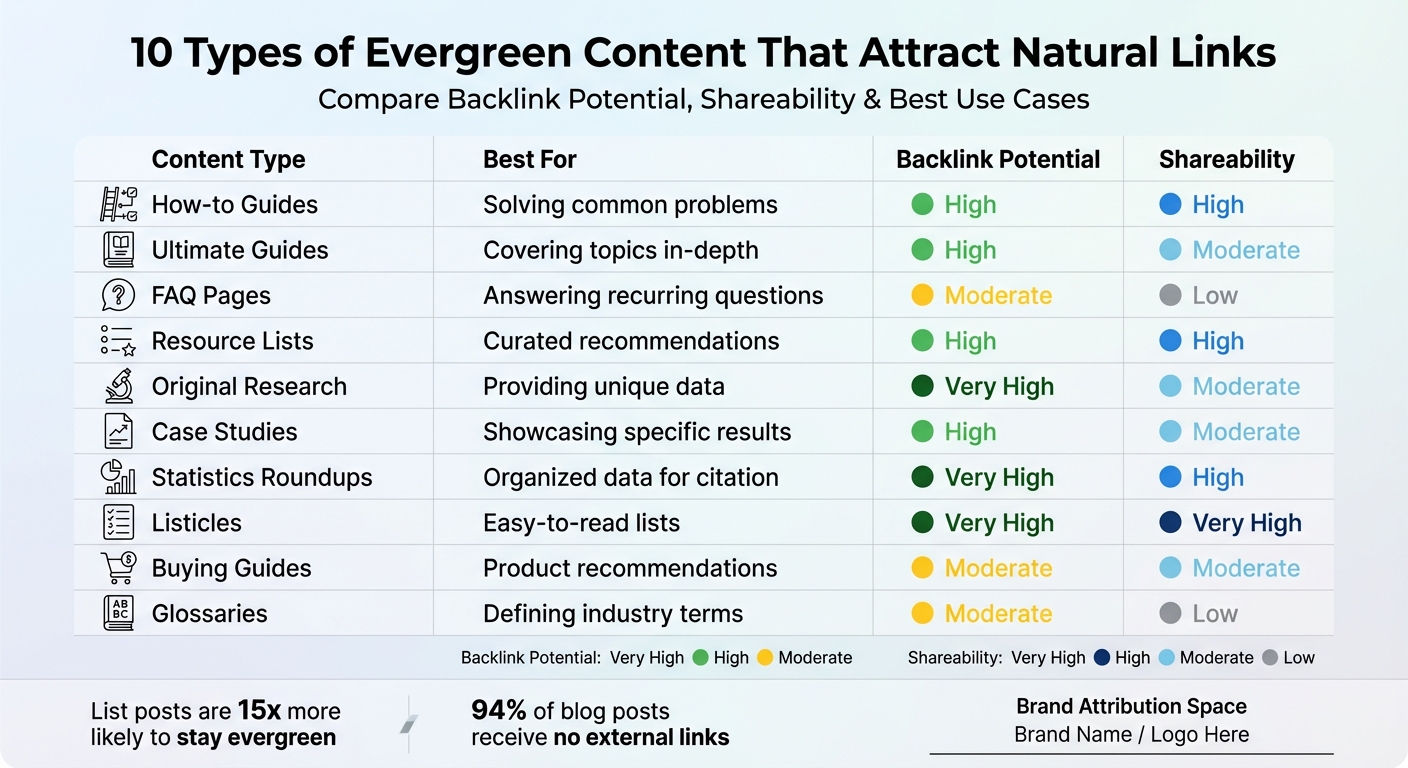
10 Types of Evergreen Content: Backlink Potential and Shareability Comparison
1. How-to Guides
Timeless Relevance
How-to guides are built around core strategies that remain useful over time, unlike content tied to temporary trends or updates. For example, a guide titled "How to Improve Your Writing" will still hold value years from now. In contrast, something like "How to Use Facebook's 2025 UI" becomes irrelevant as soon as the platform changes its layout [3]. The beauty of these guides is their ability to address ongoing interest - there’s always a steady stream of newcomers in every niche looking for answers to foundational questions [10]. This constant demand ensures these guides stay practical and useful for years to come.
Value to Readers
These guides shine by offering clear, step-by-step instructions to solve specific problems [3]. A well-written how-to consolidates all the necessary steps into one easy-to-follow resource [4]. This approach not only satisfies the reader’s need for actionable information but also aligns with Google’s Helpful Content System, which prioritizes detailed and high-quality tutorials in search rankings [8]. The impact is exponential: better visibility leads to increased traffic, which in turn attracts backlinks as more creators reference your well-researched guide.
Shareability
A study analyzing 3.6 billion articles found that how-to posts are among the most evergreen content types, making them 15 times more likely to generate lasting engagement compared to formats like slide decks or presentations [4]. Unlike fleeting social media posts, how-to guides continue to attract attention long after they’re published [2]. Platforms like Reddit are particularly effective for sharing these guides, as its niche communities actively seek out reliable and timeless resources [2][4]. You can also breathe new life into your guide by tying it to current events or seasonal topics, sparking renewed interest and driving long-term backlink growth [2][12].
Backlink Potential
How-to guides are also backlink magnets, thanks to their thorough and actionable content. Other creators often link to these guides to avoid explaining complex processes themselves [8][9]. Many top-performing websites generate a significant portion of their traffic from evergreen guides [10]. To maximize this potential, avoid tying your URLs to specific years (e.g., use /how-to-grow-bonsai/ instead of /2021-how-to-grow-bonsai/) and update your guides annually with fresh data or examples [2][8]. Brian Dean, the Founder of Backlinko, emphasizes the importance of keeping content current:
"One of the underrated keys to publishing evergreen content is keeping your existing content up-to-date. In fact, I tend to update every post on our site at least yearly" [2].
2. Ultimate Guides
Timeless Relevance
Ultimate guides stand the test of time by focusing on core principles that don’t change. These guides are structured to remain useful, regardless of trends, ensuring their value doesn’t fade [3]. A smart way to future-proof them is by using timeless URL structures - avoiding dates or version numbers in the slug. This allows updates without losing the backlinks that boost authority [1][2]. Brian Dean from Backlinko sets a great example with his "The Definitive Guide to SEO." Each year, he updates the guide entirely while keeping it on the same URL, preserving its link equity. This strategy has helped the guide consistently rank for competitive search terms [11]. By combining foundational knowledge with actionable insights, these guides become a lasting resource.
Value to Readers
Ultimate guides are packed with all the essential information readers need [1]. They cover a topic comprehensively, from beginner basics to advanced concepts, making them a go-to resource that people bookmark and revisit. These guides not only establish your authority but also rank for a wide range of keywords by addressing varying levels of expertise. For instance, Forbes’ "Beginner's Guide to Blockchain" simplifies a complex topic into an accessible format. Even four years after its release, it continues to attract social shares and backlinks, proving its long-term value [4].
Shareability
Unlike typical social media posts that lose momentum within days, ultimate guides often maintain or even grow their engagement over time [2]. The best evergreen guides, particularly in B2B spaces, average around 4,000 words. This depth positions them as comprehensive resources that outperform shorter content [2]. Take Brian Dean’s eCommerce SEO guide - it earned over 11,000 social shares because of its in-depth coverage. Additionally, niche communities, like those on Reddit, actively seek out these kinds of long-lasting, detailed resources [2]. Their ability to sustain engagement makes them a powerful tool for natural link building.
Backlink Potential
Ultimate guides are a magnet for backlinks. Other content creators link to them to enhance their own articles without needing to explain every detail themselves [9]. Their depth and original insights make them stand out, offering something competitors find hard to replicate [1]. This comprehensive approach not only signals expertise to readers but also boosts credibility with search engines, naturally attracting more backlinks [2]. Regular updates and thorough coverage elevate ultimate guides above shorter formats, helping them build long-term authority. Over time, they become a cornerstone for earning valuable, organic backlinks that strengthen your site’s reputation.
3. FAQ Pages
Timeless Relevance
FAQ pages are a go-to resource for answering recurring questions from your audience, making them useful year after year [11]. By addressing common challenges or concerns, they create content that search engines recognize as genuinely helpful. This lasting relevance positions FAQ pages as a key tool for both users and search engines.
Value to Readers
A well-structured FAQ page acts as a one-stop shop for your audience [13]. Instead of combing through multiple articles, readers can quickly find the answers they need. This approach is particularly effective for meeting informational search intent, especially for straightforward "what" and "why" queries [4]. A great example comes from Unity, which introduced a detailed FAQ and knowledge base in 2024. The result? Nearly 8,000 support tickets were deflected in just one year, saving the company around $1.3 million in operational costs. David Schroeder, Senior Manager of Services Support at Unity, shared:
"Last year we deflected almost 8,000 tickets due to self-service enabled by Zendesk. That amounts to about $1.3M saved due to the reduction in tickets" [13].
Backlink Potential
FAQ pages naturally attract backlinks by providing clear, authoritative answers [13]. To amplify this, adding FAQ schema markup can increase the chances of appearing as rich snippets in search results, which enhances backlink value [1]. These pages also perform well for long-tail queries - those detailed, multi-word searches often used by beginners exploring a topic [1][11].
Shareability
FAQ pages are highly shareable, especially as users frequently ask similar questions on platforms like Quora, Reddit, and social media [2][11]. Unlike the fleeting nature of most social media posts - where 96% of shares drop off within three days - FAQ pages have staying power. By engaging with Q&A platforms and linking back to your FAQ page, you can drive consistent traffic and build ongoing engagement [11].
4. Resource Lists
Timeless Relevance
Resource lists cater to ongoing needs that never go out of style [11]. Think about topics like "best marketing books" or "essential SEO tools" - these are subjects that both beginners and seasoned professionals continuously search for [3][4]. Unlike news articles that quickly become outdated, a well-crafted resource list can remain a traffic driver for years, requiring only occasional updates to stay current [3][4].
Value to Readers
The magic of resource lists lies in their ability to simplify the search process [3][4]. Instead of spending hours sifting through countless options, readers get a curated collection of the best tools, books, or resources - all in one place. This approach is especially helpful for beginners who need a clear starting point in a new field [11]. Daniel Ndukwu, Founder of Kyleads, explains:
"There's value in curation. Take the best research projects in your niche and create a statistics post. People love them and they tend to attract a lot of links and referral traffic" [3].
By doing the legwork, you’re not just saving readers time - you’re providing immediate, actionable value.
Backlink Potential
Resource lists naturally attract backlinks because they act as go-to references for other creators [9][3]. When someone writes about a topic and wants to point readers toward helpful tools or recommendations, they’re more likely to link to your comprehensive list than create one from scratch. These backlinks can keep coming months or even years after publication as new creators discover your content [9]. To stand out, go beyond the competition - if others list 10 tools, aim for 50 and include detailed insights like pros, cons, and screenshots [11]. This level of depth not only enhances your authority but also keeps your content shareable and relevant.
Shareability
Unlike typical posts that lose momentum quickly (with shares dropping by 96% within three days), resource lists have staying power [2]. They continue to generate traffic, shares, and links long after they’re published. Platforms like Reddit, where niche communities thrive on useful, evergreen content, are particularly receptive to these lists [4][2]. To boost shareability, use titles that include words like "best" or "top" - they signal curated value and resonate well over time [4][2]. Additionally, keep your URL slug simple (e.g., /best-seo-tools/) and update the title annually (e.g., "Best SEO Tools for 2026") to maintain freshness while preserving the backlinks you’ve already earned [2][4].
5. Original Research and Data Studies
Timeless Relevance
Original research has a unique staying power - it becomes a go-to reference for years to come [4][11]. Unlike fleeting news stories, it serves as a historical marker, often cited long after publication. This lasting importance makes it a standout example of evergreen content. Industry reports and data-driven studies frequently rank among the most enduring types of content [4]. Titles featuring words like "data", "study", or "research" tend to perform better in terms of evergreen value [4]. Even when new studies emerge, your original work remains relevant, either as a comparison point or as the first in-depth exploration of a given topic.
Value to Readers
One of the biggest strengths of data-driven content is its ability to provide readers with objective, reliable facts [3]. Unlike opinion pieces, original research offers clear, evidence-based answers to pressing industry questions, helping to establish trust and authority with your audience [16]. It also saves readers the time and effort of conducting their own research or analysis [4]. As Matt Janaway, CEO of MarketingLabs, puts it:
"Thorough research in evergreen content significantly boosts SEO performance. Delivering key insights and targeting niche areas makes your content valuable to readers, which sends the right signals to search engines." [3]
These well-supported insights not only educate readers but also encourage other creators to reference your work, amplifying its reach and impact.
Backlink Potential
When it comes to building links, original research is in a league of its own [17]. While the majority of blog posts - 94%, to be exact - receive no external links [15], a well-executed data study often becomes a widely cited source. Brian Dean highlights that data lends credibility to opinions, making it a magnet for backlinks [17].
Take his Voice Search SEO study from 2018, for example. Analyzing 10,000 search results, it became the first large-scale study of its kind and was featured by HubSpot, eventually racking up over 1,500 backlinks [14]. Similarly, his Google Ranking Factors study, which examined 1.3 million search results, earned backlinks from over 79,000 referring domains. By publishing the findings as an open blog post instead of a gated PDF, he made the content more accessible, further boosting its link-building potential [17]. These examples underline how original research can play a central role in long-term SEO success.
Shareability
Research studies are goldmines for journalists, often serving as the foundation for entire articles [17]. In fact, in-depth studies exceeding 3,000 words tend to earn 77.2% more backlinks [15]. To make your findings more shareable, break them down into bite-sized, easy-to-read statistics that bloggers and writers can quickly reference. Visual elements like charts, graphs, and infographics not only make complex data easier to understand but also encourage others to embed your visuals, earning you additional "image source" backlinks [17]. Targeting keywords such as "[Topic] statistics" or "[Topic] facts" can also attract traffic from writers actively searching for credible data. This combination of credibility and accessibility makes original research a cornerstone of evergreen content and backlink strategies.
How to Find & Create Evergreen Content That Brings Traffic for Years
6. Case Studies
Case studies stand out as a timeless content format, offering documented stories of success and lessons learned. They highlight specific, often landmark achievements - like a company hitting its first million in revenue, solving a unique problem, or achieving a major milestone at a pivotal moment [3]. As marketing expert Daniel Ndukwu puts it:
"Case studies are one of those rare pieces of content that never lose their potency. Why? Because they're about situations that can never be repeated." [3]
These stories act as enduring reference points, providing historical benchmarks and solid evidence of success [1][3]. Their longevity makes them a go-to resource for actionable insights, as outlined below.
Value to Readers
Case studies offer a balance of staying power and practical takeaways. They serve as real-world examples, helping readers see how they might replicate similar successes. By sharing both wins and setbacks, you add a personal touch to your brand, fostering trust and relatability. This format is especially effective for commercial searches, where readers are actively seeking proof of what works [1][3].
Backlink Potential
Few content types rival case studies when it comes to earning backlinks. They’re often cited by industry professionals as credible evidence of a strategy’s effectiveness [1][8]. To maximize their appeal, include original data, precise metrics, and expert commentary. Using date-free URLs ensures the content remains relevant for years to come [2].
Shareability
The authenticity of real-world results makes case studies naturally engaging. People are more likely to share content that showcases clear, measurable outcomes - especially when it includes specific figures, timelines, and candid reflections on challenges. Highlighting core strategies further increases shareability. Additionally, updating case studies with fresh data or follow-up results keeps them relevant and trustworthy over time [1][3].
sbb-itb-0f47b19
7. Statistics Roundups
Statistics roundups act as link magnets because they bring together data that journalists and content creators are constantly searching for to support their stories [15][18]. Unlike content that demands heavy original research, these roundups curate figures from sources like Statista or industry reports. It’s a straightforward approach that delivers big results [3][19]. By gathering key stats into one convenient resource, you save readers the hassle of digging through multiple sources. Plus, like other evergreen content types, this format stays valuable over time through regular updates.
Timeless Relevance
While specific stats may shift over time, the demand for reliable data never fades. Titles featuring words like "data", "research", or "study" consistently perform well, earning higher evergreen scores [4]. For statistics roundups, updating the content every 12–18 months and including the current year in the title (e.g., "2025 SEO Statistics") keeps it fresh and relevant [4][7]. A standout example is the roundup titled "74 Important SEO Statistics for 2025", which organizes data from various industry reports into categories like Voice Search and Local SEO. Its annual updates ensure it remains a trusted resource [20].
Value to Readers
Statistics provide hard facts that help readers draw clear conclusions [3]. Instead of sifting through endless sources, a well-crafted roundup delivers the most relevant numbers in one convenient spot. This is especially helpful for professionals who need credible data quickly for their projects, presentations, or reports.
Backlink Potential
When it comes to link-building, few content types outperform statistics roundups. Holly Lawton, Sales and Marketing Head at Pearl Scan, highlights the appeal:
"This strategy works incredibly well because journalists are likely to link back to data as a point of reference, and they always need fresh data" [19].
In 2022, Mike Brown, Director of Communications at Breeze, shared a remote work survey that cost $1,350 to create but earned 133 unique backlinks - breaking down to just $10 per backlink [19]. Considering that 94% of blog posts don’t get any external links [15], data-driven content has a clear advantage. Including visuals like infographics or charts can boost your chances of getting backlinks, as other sites are more likely to embed and credit your work [19]. This highlights the unmatched link-building power of statistics-focused content.
8. Listicles
Listicles have a knack for staying relevant. Research shows that list-based posts consistently outshine presentations and podcasts when it comes to earning long-term shares and backlinks [4]. Why? Because they give readers exactly what they’re looking for: a well-organized shortcut to the best information, without the headache of endless searching.
Timeless Relevance
What makes listicles stand the test of time? They tend to focus on evergreen topics rather than fleeting trends. Posts with titles like "Best" often perform better over the years because they address ongoing needs [4]. For instance, an article titled "Best SEO Tools" remains useful year after year, while an update about a specific software version quickly becomes outdated. To ensure your listicle stays relevant and retains its link value, avoid including date markers in the URL, especially if you plan to update it annually [2][4].
Value to Readers
Listicles are time-savers, offering readers a one-stop resource for the best options out there [4]. But to truly stand out, they need substance. A shallow "100 tips" post with one-sentence blurbs won’t cut it. Take Brian Dean’s list of 41 SEO tools as an example - it’s earned over 11,000 backlinks because it goes beyond the basics. Each tool comes with detailed reviews, personal insights, and real screenshots, turning a simple list into a trusted resource [21]. Adding this level of depth transforms a listicle from a quick read into a go-to guide.
Shareability
The numbered, structured format of listicles naturally grabs attention, while their skimmable layout - with clear headings - makes it easy for readers to find exactly what they need [1][4]. Expert roundups are especially effective for boosting shareability. They tap into the social reach of contributors, as Daniel Ndukwu from Kyleads explains:
"Expert roundups... [are] literally like built-in traffic to your content. You find experts, ask them a simple question, round up the answers, and promote it like crazy" [3].
When the featured experts share the post with their audiences, it generates instant visibility - no paid ads required. This format not only encourages engagement but also sets the stage for valuable backlinks.
Backlink Potential
Listicles are a favorite for creators looking to cite resources, whether they’re writing about productivity tools or marketing strategies. Comprehensive "best of" lists often attract links from other content as supporting references. For example, WordStream’s "75 Staggering Video Marketing Statistics" keeps its backlink authority intact by refreshing the content every year while maintaining the same URL. This approach preserves years of accumulated link equity [2]. The flexibility of listicles also helps - they can be crafted as informational guides ("10 Best Practices"), product comparisons ("Top 5 Software Options"), or actionable resources ("Best Pricing Plans"), each appealing to different types of content creators [1].
9. Buying Guides
Buying guides are like evergreen trees in the content world - they keep providing value long after they're published. These guides tackle basic but essential questions, like how to pick the right camera or which software is worth your money, making them relevant for years to come [11]. Headlines with the word "best" tend to perform particularly well, consistently driving traffic and earning backlinks over time [2].
Timeless Relevance
Buying guides stick around because they solve ongoing needs rather than focusing on fleeting trends. For example, someone searching for "best DSLR cameras" or "how to choose mountain bikes" is looking for advice that doesn’t expire [11]. To keep these guides feeling current, marketers often update the publication year in their titles (e.g., swapping "2024" for "2025") while leaving the core advice intact. A smart move for these guides is to use a date-free URL structure. This allows you to refresh the content annually without losing any SEO authority - a big plus when competing for high-value commercial keywords [2].
Value to Readers
Beyond their staying power, buying guides are incredibly helpful for readers. They act as a roadmap for shoppers, guiding them toward informed decisions [3]. By curating the best options in a single place, these guides save readers hours of research [4]. The most effective ones are beginner-friendly, often answering "how to choose" queries that new buyers frequently ask [11]. Matt Janaway, CEO of MarketingLabs, highlights the importance of creating this type of content:
"Taking the time to research and craft great evergreen content can make a huge difference to your SEO performance. Answering questions well, providing key insights and targeting niche areas with your content will ensure it's valuable to readers" [3].
This practical, easy-to-follow advice not only helps readers but also encourages others to share and reference the content.
Backlink Potential
Buying guides are backlink magnets. They serve as go-to resources for creators looking to recommend products [2]. By addressing commercial search intent - where users are actively comparing options before making a purchase - these guides establish themselves as trusted references [1]. Their impact grows when they include expert opinions, comparison tables, and actionable advice that’s tough to beat [1]. Regular updates keep them authoritative, ensuring they continue to drive traffic and conversions over time [1][2].
10. Glossaries and Definition Pages
Glossaries are a cornerstone of evergreen content, offering timeless resources that naturally attract links. By focusing on essential terminology and foundational concepts like "SEO" or "A/B Testing", these pages remain valuable over the long haul [3][11]. Beyond simplifying complex terms, they also help establish a website's authority within its niche.
Timeless Relevance
Glossaries stay relevant because they focus on the basics - concepts and definitions that rarely change. These pages often target popular informational searches like "what is [term]?" [22]. Since definitions don’t go out of style, they’re often considered "content without an expiry date" [23]. To make them more user-friendly, site owners often organize glossaries alphabetically or by theme, include a search bar for quick access, and link related terms internally. These small touches make the resource both practical and engaging [22].
Value to Readers
Glossaries make specialized fields more approachable by breaking down jargon into simple, easy-to-understand language. They act as a one-stop shop for definitions, saving readers the hassle of jumping between multiple sources. Nikolai Bain captures this perfectly:
"The purpose of a glossary page is to provide visitors with a convenient reference to understand and navigate specialized terminology." [22]
Backlink Potential
Glossary pages are natural link magnets. Their authoritative definitions are frequently cited by bloggers and journalists who want to explain terms without interrupting their own content [9]. This makes glossaries an excellent tool for earning backlinks. They also signal topical expertise to search engines, which can improve rankings and further increase their link-worthiness [24].
Comparison Table
Each of the ten evergreen content types offers unique strengths when it comes to drawing natural backlinks. For instance, listicles and how-to guides shine in shareability, while original research and statistics roundups become long-term references that writers continue to cite over the years. Knowing how these formats differ can help you make better choices based on your goals.
Some formats, like list posts and case studies, strike a balance between being highly shareable and serving as lasting reference material. The table below summarizes the timeless appeal, reader benefits, shareability, backlink potential, and key drivers for each evergreen content type.
| Content Type | Timeless Relevance | Reader Value | Shareability | Backlink Potential | Primary Link Driver |
|---|---|---|---|---|---|
| How-to Guides | Very High | Very High | High | High | Offers a clear "blueprint" or solution to common issues [4][5] |
| Ultimate Guides | Very High | Very High | Moderate | High | Acts as an all-encompassing resource, saving readers time [4][1] |
| FAQ Pages | High | Moderate | Low | Moderate | Answers recurring questions and targets long-tail queries [6][1] |
| Resource Lists | Moderate | High | High | High | Provides curated information, saving research time [4] |
| Original Research | High | Very High | Moderate | Very High | Serves as a primary data source that others frequently cite [4] |
| Case Studies | Very High | High | Moderate | High | Demonstrates unique results from specific scenarios [3] |
| Statistics Roundups | Moderate | High | High | Very High | Provides concise data for writers to reference [3] |
| Listicles | High | High | Very High | Very High | Combines easy readability with curated content [4] |
| Buying Guides | Moderate | High | Moderate | Moderate | Helps readers make informed purchasing decisions [1] |
| Glossaries | Very High | Moderate | Low | Moderate | Acts as a technical reference for industry-specific terms [1] |
The table highlights that formats like original research and statistics roundups stand out for their backlink potential. Articles with titles featuring terms like "data", "reports", "study", "science", or "research" tend to perform exceptionally well as evergreen content [4]. On the other hand, curated formats, such as resource lists, are highly valued because they save readers time [4].
How Linkzy Supports Natural Link Building
Publishing evergreen content is just the start - you also need a steady flow of backlinks to strengthen your authority and improve rankings. That’s where Linkzy steps in, streamlining the process by placing high-quality, contextual backlinks on real user websites within your niche. Instead of spending hours reaching out to site owners or worrying about inconsistent link velocity, Linkzy ensures a steady, search engine-friendly schedule for link placement.
What makes this even more effective is Linkzy's niche targeting feature. By selecting your industry during setup, the platform’s AI identifies related topics and clusters that align with your content. For instance, if you’ve created a detailed glossary of digital marketing terms, Linkzy will secure links from websites focused on SEO, content strategy, and analytics. This targeted method mimics the organic link-building process that successful evergreen content naturally attracts.
Maintaining proper link velocity is essential for sustained SEO results. As Kiana Mason, Associate Director of Content Marketing at Siege Media, explains:
"Evergreen content is the foundation of long-term growth... it can boost your individual post ranking and help elevate the domain authority for your site as a whole" [7].
Linkzy keeps this momentum going by automating link placement on a consistent timeline, ensuring your content gains authority over time. Formats like how-to guides, resource lists, and data studies often continue to build credibility months - or even years - after they’re published.
The platform integrates seamlessly with all ten evergreen formats mentioned earlier. Whether you’re promoting original research that benefits from citation links or a buying guide that needs product-related references, Linkzy adapts to your content type. Plus, its real-time analytics dashboard lets you track performance, helping you pinpoint which assets are gaining traction and when older content might need updates to complement ongoing link-building efforts.
Getting started is simple: install a tracking snippet, select your niche, and let the AI handle the rest. This automation is especially crucial for evergreen strategies because, as BuzzSumo notes:
"Gaining links over time is like someone consistently vouching for your content" [2].
With plans starting at just $19/month for five credits, Linkzy makes it easy for even small businesses to maintain competitive link velocity. Its tailored, automated approach ensures your evergreen content continues to thrive long-term.
Conclusion
Evergreen content builds value that grows over time. The ten formats we’ve discussed - from how-to guides to glossaries - all have one vital thing in common: they address timeless questions that people will continue searching for, year after year.
Here’s an eye-opening stat: list posts are 15 times more likely to stay evergreen, while non-evergreen posts lose 96% of their social shares within just three days [4][2]. This is why focusing on foundational topics - like the "what is" and "how-to" questions in your niche - can bring consistent traffic and natural backlinks without constantly churning out new content. These numbers highlight the importance of having a solid link-building strategy.
A strong backlink strategy doesn’t just increase visibility; it helps establish long-term authority. Tools like Linkzy make this process easier by automating contextual backlink placements on genuine user websites, ensuring your evergreen content retains its value. Plus, with plans starting at just $19/month for five credits, even small businesses can afford to support their evergreen strategy effectively.
To maximize the impact of your evergreen content, audit your existing material for timeless topics, update any outdated data, use date-free URLs, and focus on beginner-friendly queries. When you combine high-quality content with a smart link-building strategy, you’re not just aiming for better rankings - you’re building lasting authority that continues to deliver results for years to come.
FAQs
How does evergreen content improve my website's SEO over time?
Evergreen content - think guides, tutorials, or listicles - has staying power. Unlike posts tied to fleeting trends or news, this type of content remains relevant for years, making it a reliable asset for boosting your website's SEO. It consistently ranks for target keywords and draws in steady organic traffic long after it's published.
As other websites naturally link back to your evergreen pieces, their authority grows. This sends a strong signal to search engines, encouraging higher rankings. To keep your content competitive, it's smart to update it regularly with new examples or data. Tools like Linkzy can also help by enabling you to build high-quality backlinks from niche-relevant sources, further improving rankings and traffic. Over time, this creates a snowball effect, ensuring your site enjoys sustained visibility and growth.
How can I keep my evergreen content relevant over time?
Keeping evergreen content useful and engaging takes effort, but it’s worth it. Start by selecting topics that have long-term appeal and creating content that thoroughly addresses your audience’s questions or needs. Use clear headings, well-thought-out metadata, and internal links to make your content easier for search engines - and readers - to navigate.
Plan to review your content periodically, about every 6 to 12 months. During these reviews, update outdated statistics, swap in fresh examples, and double-check for accuracy. Avoid locking yourself into specific dates in URLs or titles unless absolutely necessary. Instead, include a “last updated” note within the content itself. Republishing updated articles and sharing them on social media can also breathe new life into your work.
Another key to keeping your evergreen content competitive is building strong backlinks. Tools like Linkzy can assist by consistently securing niche-relevant links from real websites, helping your content rank better in search results. By combining thoughtful topic choices, regular updates, and a solid backlink strategy, your evergreen content can remain relevant and effective for the long haul.
Why is original research so effective for earning backlinks?
Original research stands out as a powerful way to earn backlinks because it offers data, insights, or analysis that simply can’t be found elsewhere. When your content includes fresh statistics, case studies, or industry-specific findings, it becomes a go-to resource that other websites naturally reference and link to. Plus, this type of content often has long-lasting value, continuing to attract links and traffic well after it’s been published.
Beyond just earning citations, original research strengthens your site’s authority and drives steady organic traffic over time. To maximize its impact, tools like Linkzy can lend a hand by securing contextual, niche-specific backlinks on real websites - helping your research get the visibility it deserves.