How AI Improves Backlink Tracking
How AI Improves Backlink Tracking
AI has transformed backlink tracking, making it faster, more accurate, and easier to manage. Instead of manually auditing links, AI tools analyze backlink quality, monitor changes in real time, and flag harmful links before they affect rankings. Here's what you need to know:
- Real-Time Monitoring: AI tracks new, lost, or modified backlinks 24/7, sending instant alerts for critical changes.
- Link Quality Analysis: Advanced algorithms assess backlinks based on factors like semantic relevance, contextual placement, and user engagement.
- Toxic Link Detection: AI identifies spammy or harmful links and can generate disavow files to protect your site.
- Competitor Insights: AI uncovers competitor link-building strategies, helping you target high-value opportunities.
- Efficiency Gains: SEO professionals report saving time and improving accuracy by using AI-driven tools.
AI-powered tools like Linkzy simplify backlink management by automating tasks, analyzing link health, and providing actionable insights. This allows SEO professionals to focus on building meaningful connections and improving rankings.
AI Backlink Analysis: Spy on Your Competitors' Link Building Strategy
sbb-itb-0f47b19
Real-Time Backlink Monitoring with AI
AI-powered tools bring a game-changing approach to backlink monitoring. Using advanced scraper algorithms, these tools continuously scan the web, identifying inbound links faster and more precisely than manual checks ever could [8]. They operate around the clock, tracking your backlink profile and sending instant updates whenever there’s a change - whether it’s a new link, a lost one, or modifications to anchor text, target URLs, or link attributes like dofollow versus nofollow [6].
What makes these tools particularly effective is their use of machine learning. These algorithms sift through massive datasets, spotting patterns and anomalies in ways that would take humans weeks to accomplish. For example, AI can quickly flag sudden spikes in spammy links from questionable sites, like gambling or adult content platforms, which might indicate a negative SEO attack [9]. This kind of constant vigilance simply isn’t feasible with manual monitoring at scale.
Benefits of Real-Time Monitoring
Backlink profiles change constantly, and staying updated is critical. Studies reveal that websites lose 5–10% of their backlinks annually, and 15–20% of new backlinks disappear within the first month. Losing a high-authority link can cause rankings to plummet by 10–50 positions for key search terms [11]. Receiving real-time alerts - whether by email, Slack, or SMS - means you can act immediately when something changes.
Consider this: The New York Times saw a 20% boost in organic traffic in just three months by using automated backlink intelligence to identify and fix toxic links before they could harm rankings [3]. On the flip side, Expedia suffered a 25% drop in organic visibility after failing to catch an unnatural backlink penalty in real time [3]. With AI monitoring, recovery processes become far more effective, with success rates of 60–70%, compared to just 20–30% with manual efforts [11].
"SEORCE is an essential part of our SEO workflow. The accuracy and depth of backlink data are unmatched - we literally couldn't scale without it."
- Sarah Johnson, Head of SEO, Global Retail [6]
These benefits highlight how AI not only simplifies backlink tracking but also enhances its efficiency through automation.
How AI Automates Monitoring
AI doesn’t just track backlinks - it analyzes them in depth. Automated systems evaluate every detail of your backlink profile, from domain authority scores to topical relevance and trustworthiness, prioritizing the links that have the most impact [6].
With AI-based scoring, each link is assessed automatically, allowing you to focus on what truly matters. You can configure tools to alert you only when critical changes occur, such as losing a link from a high-authority domain or when toxic link scores surpass a set threshold. This minimizes unnecessary notifications and keeps your attention on the most pressing issues [9]. Additionally, integrating these tools with platforms like n8n lets you connect multiple SEO tools and create custom workflows [9], so your team can spend more time on strategy and less on data collection.
How AI Identifies High-Quality Links
AI takes backlink analysis to a whole new level by examining the semantic context and placement of links. Instead of relying solely on traditional metrics like domain authority, AI uses machine learning and natural language processing (NLP) to assess the contextual value of each link. This approach provides a deeper understanding of which backlinks can genuinely improve your rankings and which ones might be holding you back [2].
One of the most important factors is semantic relevance. AI evaluates the content surrounding a link to ensure there’s a strong "topical match" between the linking page and your target page. For instance, a plumbing supplier linking to a plumber’s website carries far more weight than a tech blog linking to the same plumber. Search engines reward these contextually aligned links because they demonstrate expertise and authority within a specific niche [2][3].
"The days of simply counting backlinks are long gone. Today's AI scoring systems consider factors like semantic relevance, user engagement metrics, and even the contextual placement of links within content." - SEO Director at a Fortune 500 company [2]
Link placement also plays a critical role. Links embedded within the main editorial content are valued more highly than those tucked away in sidebars or footers. These in-content links suggest genuine editorial approval and often drive more meaningful click-through traffic [2][12]. Advanced AI systems even monitor whether links generate actual user engagement, using this data as an additional quality signal [2].
Key Metrics for Link Quality
AI evaluates backlinks using a combination of metrics to determine their true value for SEO. While domain authority still matters, AI goes further by incorporating organic traffic data. This helps identify suspicious sites, such as "link farms", which may have high domain ratings but attract fewer than 500 visitors per month [12].
Topical alignment is another key metric. AI uses vector embeddings to calculate the "semantic distance" between topics, with shorter distances indicating higher relevance. If the alignment is weak, the link is flagged as potentially low-quality [14]. Additionally, AI monitors link velocity, or the rate at which you acquire backlinks. Unnatural spikes in link acquisition can raise red flags for manipulative behavior [13][10].
Other important factors include:
- C-block diversity: Ensures links come from a variety of IP address ranges, reducing the risk of private blog network (PBN) associations.
- Traffic integrity: Compares a domain’s metrics to its actual visitor data to verify its legitimacy.
- Security: Links from non-secure HTTP pages or those with a large "rank gap" (where page rank is significantly lower than domain rank) are flagged as concerns [12][10].
Avoiding Low-Quality or Toxic Links
AI is especially effective at spotting "bad neighborhoods." By analyzing a site’s outbound links, it can flag toxic associations, such as links to gambling sites, essay mills, or unregulated supplement vendors. Even if these sites have high domain authority, their questionable linking practices can harm your backlink profile [12].
Spam scores offer a quick way to gauge link health. AI tools typically categorize links into three risk levels:
- 0-30: Healthy
- 31-60: Moderate risk
- 61-100: High risk (requiring immediate disavowal) [12]
AI also identifies unnatural patterns, such as links that appear artificially inserted rather than naturally placed within editorial content. It flags links from "Made for SEO" sites - those lacking real authors or original insights - as low quality.
Another AI advantage is its ability to recover lost link equity. For example, it can identify high-quality backlinks pointing to 404 pages on your site. Redirecting these broken links to active, relevant content ensures you don’t lose valuable link authority [12][5].
Using AI Insights to Optimize Link-Building Strategies
AI turns raw data into actionable insights, helping you craft smarter outreach campaigns. Forget the guesswork - AI uses predictive analytics to estimate the ranking impact of a backlink before you even secure it. This allows you to focus on the opportunities most likely to improve your search rankings [2][13]. On top of that, AI excels at real-time backlink tracking, ensuring you stay ahead in the game.
AI also identifies which content formats - like infographics, data studies, or in-depth guides - are most likely to attract backlinks in your niche [15][2]. Considering off-page SEO (largely driven by backlinks) makes up about 50% of a website's ranking potential, these insights are critical [6].
The shift from reactive to proactive link building is already delivering measurable results. For example, enterprise SEO agencies have seen a 37% jump in response rates and a 28% increase in link placements after adopting AI-powered outreach systems [17]. Teams using AI-driven personalized outreach also report 30% higher email open rates than those relying on generic templates [7]. Below, we’ll dive into how AI personalizes outreach and monitors competitors to refine your link-building strategies.
AI Recommendations for Outreach
AI transforms outreach by identifying high-value opportunities. One standout feature is its ability to pinpoint "common linkers" - websites that link to multiple competitors but not to your site. These sites are prime targets because they’re already interested in your industry [2][13]. AI even ranks these common linkers based on their likelihood to respond and their potential SEO value [2][7].
Natural Language Processing (NLP) takes personalization to the next level. AI can scan target blog posts and craft customized outreach emails that reference specific details or data points from the content. This level of personalization can boost reply rates by up to 63% [3]. AI also identifies "niche edit" opportunities, such as outdated citations, broken links, or aging statistics in content, which you can replace with updated information [5].
Tracking Competitor Link-Building Strategies
AI doesn’t just help you build links - it also keeps a close eye on your competitors. By analyzing competitor backlink profiles, AI uncovers patterns you can act on. For example, link velocity tracking lets you spot successful campaigns as they unfold, giving you a chance to replicate or refine those strategies before the opportunity passes [15][17].
Here’s a real-world example: Over six months, an enterprise SaaS company used an AI-powered link-building system to generate 200 link sources weekly. The results? A 40% increase in DA 50+ backlinks, a 62% reduction in manual outreach time, and a 15% boost in organic traffic [17]. The key to their success was Link Intersect analysis, which identified influencer nodes - sites linking to two or more competitors - helping them prioritize outreach to high-impact targets [17][2].
AI also deciphers hidden patterns in competitor anchor text strategies, revealing the keywords they’re targeting to climb the rankings. By combining this with content gap analysis - spotting which content types attract the most links for your rivals - you can create a robust strategy. This approach not only strengthens your backlink profile but also ensures your content and outreach efforts are laser-focused [15][17].
Using AI Tools Like Linkzy for Better Backlink Tracking
Automating link placement and tracking can take the hassle out of backlink management. Tools like Linkzy combine intelligent automation with robust monitoring, making it easier to manage backlinks effectively. Here’s how Linkzy simplifies this process.
How Linkzy Simplifies Backlink Management
Linkzy uses AI-powered content analysis to streamline backlink placement. With Natural Language Processing (NLP), it scans your website in just 3–5 minutes, identifying spots where contextual backlinks fit naturally [18]. Instead of focusing solely on keywords, it examines entire phrases, offering more precise and niche-specific link suggestions [18].
The tool’s Quick Apply feature allows you to implement multiple link suggestions automatically, cutting down on manual work [18]. As James, the founder of Linkzy, explains:
"Quality backlinks are the foundation of successful SEO" [19].
This approach is central to Linkzy's design. It prioritizes natural link placement within high-quality content rather than relying on less effective methods like footer or sidebar links [18]. Plus, with a quick WordPress setup, straightforward pricing, and a free trial, getting started is easy [18].
Tracking and Reporting with Linkzy
Effective backlink management doesn’t stop at placement - it requires ongoing tracking. Linkzy’s real-time dashboard acts as a central hub, showing total link counts, website crawl status, and post-specific statistics all in one place [18]. This real-time data helps you stay on top of your backlink strategy.
To avoid over-linking, which could trigger spam signals, Linkzy lets you set link density limits for both inbound and outbound links per post [18]. Additionally, its Keyword Playground feature provides real-time keyword analysis, helping you make quick adjustments as needed [18].
Research shows that backlinks from relevant, high-quality sources can be up to 10 times more effective than those from irrelevant sites, even if they have high Domain Authority [19]. By combining automated placement with detailed tracking, Linkzy ensures you’re not just adding links - you’re building the right ones and monitoring their performance in real time.
Step-by-Step Guide to AI-Powered Backlink Audits
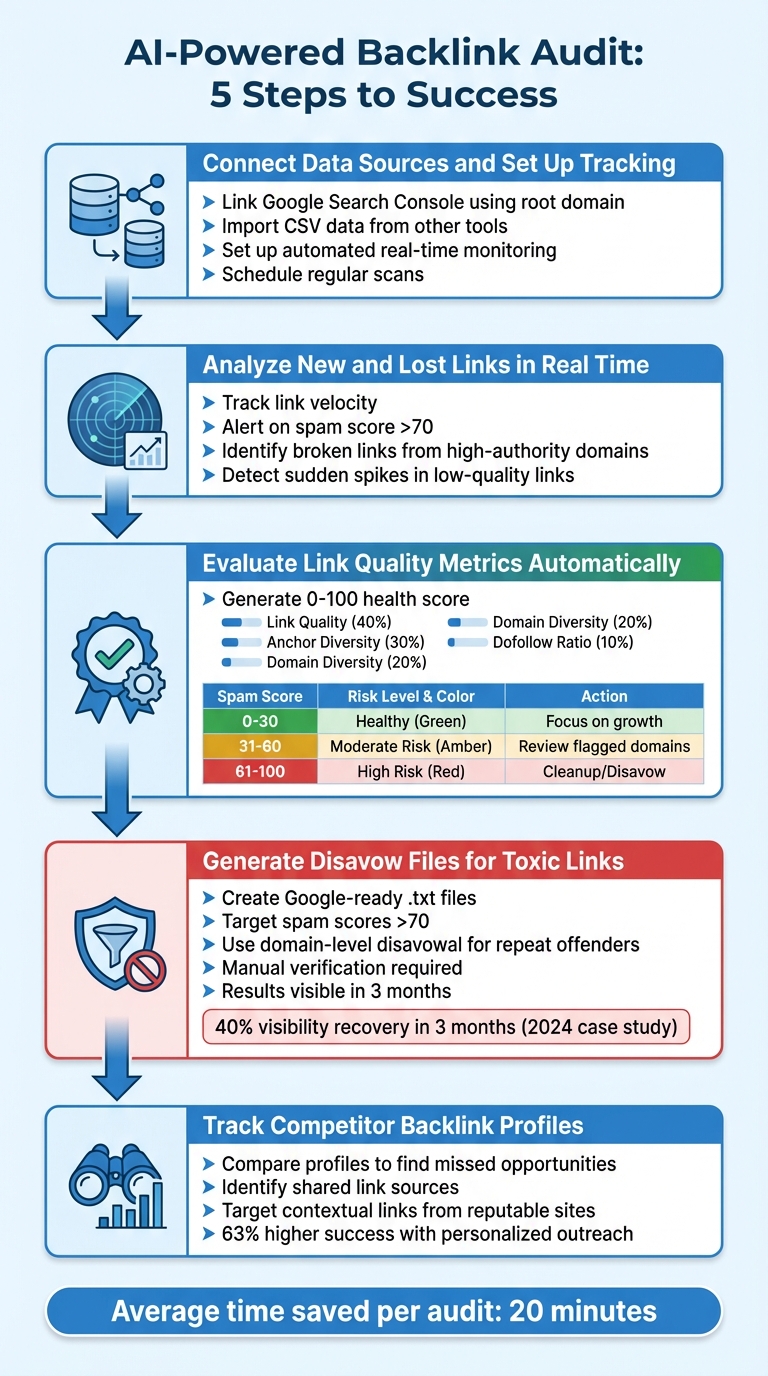
5-Step AI-Powered Backlink Audit Process
Using AI for backlink audits simplifies the process with automated insights, helping you spot opportunities and risks in your backlink profile. Here's how to conduct a thorough audit step by step.
Step 1: Connect Data Sources and Set Up Tracking
Start by linking your AI tool to Google Search Console (GSC) for official backlink data. Use your root domain (without "https://" or "www") to capture all subdomains. If you have backlink data from other tools, import it via CSV to create a more complete dataset.
Set up automated tracking to monitor backlinks in real time. This ensures you’re alerted immediately when links are gained, lost, or altered. Such tracking is key for addressing negative SEO threats or recovering lost link equity. Schedule regular scans to catch any spikes in toxic links.
Step 2: Analyze New and Lost Links in Real Time
AI tools monitor link velocity, which is the rate at which backlinks are gained or lost. A sudden influx of low-quality links can indicate a negative SEO attack requiring quick action [21]. You can set up alerts for new dofollow links from domains with high spam scores (e.g., Moz spam score >70) to respond swiftly.
Broken link filters are also helpful. They highlight high-authority links pointing to 404 pages, which you can redirect to active pages to recover lost link equity.
Step 3: Evaluate Link Quality Metrics Automatically
AI simplifies link quality analysis by generating a 0-100 health score for your backlink profile. This score is based on factors like Link Quality (40%), Anchor Diversity (30%), Domain Diversity (20%), and Dofollow Ratio (10%) [20]. These metrics help flag patterns such as toxic links (spam scores >50), over-optimized anchors (exact-match anchors >30%), and low authority (dofollow ratios <30%) [20].
A balanced profile includes at least 20% branded anchor text instead of keyword-heavy anchors. Focus on contextual links - those embedded in the main body of content - as these carry more weight with search engines than links in sidebars or footers [21].
| Metric | Healthy (Green) | Moderate Risk (Amber) | High Risk (Red) |
|---|---|---|---|
| Spam Score | 0–30 | 31–60 | 61–100 |
| Action Required | Focus on growth | Review flagged domains | Cleanup/Disavow |
Step 4: Generate Disavow Files for Toxic Links
If harmful links are identified, AI can generate Google-ready .txt files for the GSC Disavow Tool. Use filters to target links with spam scores over 70 or links from suspicious IP-based domains. For recurring spam from the same site, the "domain:" export feature allows you to disavow all links from that domain. AI can group multiple toxic links into a single entry, but always verify manually to avoid mistakenly disavowing legitimate links.
For example, a travel website penalized by Google in 2024 regained 40% of its lost visibility within three months after implementing a proper disavowal strategy guided by Marie Haynes Consulting [3].
As Google Search Central advises:
"The Disavow Tool should be used with caution and only after you've made a reasonable effort to remove the links yourself" [22].
Keep in mind that it can take up to three months for a disavow file to impact search rankings [22].
Once your backlink profile is cleaned up, you can shift focus to competitor analysis.
Step 5: Track Competitor Backlink Profiles
Analyzing competitor backlinks helps refine your link-building strategy. AI tools can compare your profile against competitors to highlight missed opportunities and shared link sources. This allows you to target high-value domains without merely copying your competitors.
Emphasize domains where competitors have contextual links from reputable sources. Personalized outreach to these sites can boost your chances of success by up to 63% [3]. The idea isn’t to mimic competitors but to uncover new link-building possibilities you might not have considered.
AI-Driven Analytics Dashboards and Reporting
AI-powered dashboards turn raw backlink data into clear, actionable insights, making decision-making faster and more efficient. Instead of sifting through endless CSV files from multiple sources, these tools bring everything together into dynamic, real-time visualizations. For example, you can integrate data from Google Search Console with backlink metrics to see how new links are influencing your organic traffic and keyword rankings - all in one place [23]. This streamlined approach also enables automated alerts and detailed visual analysis.
One of the standout features is real-time monitoring. These systems operate 24/7, sending alerts whenever you gain or lose high-value backlinks or experience spikes in toxic links [9][6]. This means you can respond quickly to negative SEO attacks before they harm your rankings.
Dashboards also use color-coded risk indicators (green/amber/red) to provide a quick view of your backlink health [12][3]. Spam scores, ranging from 0-100, help you identify which domains need immediate attention. Links with scores of 61-100 are flagged for action, while scores between 0-30 signal a healthy profile where you can focus on growth [12]. Some dashboards even include an "Analyze with AI" feature, which evaluates your entire backlink profile and offers data-backed suggestions for link removal, anchor text diversification, and authority-building [12]. These visual tools make it easier to act quickly and confidently.
Beyond insights, these dashboards save time. Automation reduces audit times by an average of 20 minutes [6]. Mark Rodriguez, SEO Director at Tech Enterprise, highlights the benefits:
"We've saved hundreds of hours and made faster strategic decisions across 15 global markets thanks to SEORCE" [6].
Automated weekly updates have also helped some SaaS providers cut client churn by 30% [3].
Advanced dashboards go a step further with one-click reporting and disavowal. They can generate Google-ready disavow files and schedule recurring PDF reports for clients [6][3]. You can set up custom notification thresholds - like flagging a referring domain with a spam score above 70 - and use heatmaps to compare authority and toxicity scores. This makes it easy to spot high-value links and identify candidates for disavowal [9][12][23]. These features contribute to a more effective backlink strategy, solidifying AI's role in improving backlink management.
Future of AI in Backlink Management
AI's role in backlink management is set to evolve dramatically in the coming years. While today’s AI tools focus on real-time monitoring and assessing link quality, the next five years will bring even deeper integration into backlink strategies. Search engines are shifting from simply counting links to recognizing brands as authoritative "entities." Links will act as signals that confirm a brand's expertise, influencing AI-generated answers and Knowledge Graphs [4][24]. As a result, maintaining consistent branding across platforms - social media, guest posts, and directories - will become increasingly important.
Predictive modeling will revolutionize decision-making in backlink strategies. AI will be able to forecast a backlink's impact on rankings before acquisition [2]. Imagine testing different link-building approaches and estimating ROI before spending a dime. An SEO Director at a Fortune 500 company explains:
"The days of simply counting backlinks are long gone. Today's AI scoring systems consider factors like semantic relevance, user engagement metrics, and even the contextual placement of links within content" [2].
Another development on the horizon is AI-to-AI negotiations. Brand bots will eventually communicate directly with editorial bots to secure content placements. Advanced Natural Language Understanding will go beyond simple keyword matching, analyzing semantic relationships and contextual tones. Click-through rates will also play a role in refining the value of these links [4][2][25].
The emergence of Generative Engine Optimization (GEO) marks a new chapter. This involves optimizing content to be cited in AI-generated summaries, ChatGPT responses, and voice search results [24]. This shift builds on earlier trends of contextual and real-time link evaluations. As Priya Kashyap puts it:
"Link building in 2026 is about earning the right to be cited. Do the work that deserves the link, and use AI link building to aim that work where it will be welcomed" [16].
In the near future, AI may prioritize brand mentions and co-citation patterns as much as traditional hyperlinks [16][4]. AI-driven tools for spam prevention are already devaluing outdated link schemes [4][7]. The focus is moving from sheer volume to relevance. Instead of creating large, low-quality lists, AI will pre-score prospects based on their likelihood to respond and their editorial compatibility [16]. As Stellar SEO notes:
"You can automate workflow. You cannot automate reputation" [24].
Conclusion
AI has reshaped the way backlink tracking and management are handled. Gone are the days of relying on manual spreadsheets - real-time monitoring now allows you to quickly identify lost links, problematic placements, and fresh opportunities. Modern AI tools go beyond traditional metrics like domain authority, evaluating links based on factors like semantic relevance, contextual placement, and user engagement. This makes it easier to spot truly valuable editorial links while avoiding those that could lead to penalties.
The benefits are clear and measurable: automation can cut audit times by 20 minutes and boost outreach email open rates by 30% [6][7]. These kinds of efficiency gains can make a huge difference, enabling you to scale your link-building efforts instead of getting bogged down in manual tasks.
That said, human oversight still plays a critical role. While AI excels at collecting, scoring, and monitoring data, strategic decisions - like building relationships and approving content - require a human touch [1][5].
Linkzy is a perfect example of how AI is advancing backlink tracking and quality assurance. By automating link placement and monitoring, tools like Linkzy let you focus on strategy while leaving the execution and maintenance to the technology. This seamless integration of AI-driven solutions allows SEO professionals to prioritize growth and innovation rather than getting stuck in repetitive, manual workflows.
FAQs
How do I set up AI backlink monitoring for my site?
To get started with AI backlink monitoring, pick a tool that offers real-time alerts, backlink analysis, and detailed insights. Once you've chosen your tool, integrate it with your website by either adding a tracking snippet or verifying your domain ownership. Set up alerts to track any changes to your backlinks, and take advantage of AI-powered features to evaluate links based on their relevance and trustworthiness. Make it a habit to review reports regularly so you can quickly deal with harmful links and refine your link-building strategies.
How can AI tell if a backlink is truly high-quality?
AI determines the quality of backlinks by analyzing several important factors, including domain authority, relevance to the topic, context within the content, and trustworthiness of the source. Through machine learning, it identifies patterns and evaluates the value of links with greater precision than traditional manual approaches. This results in a more dependable way to assess the effectiveness of backlinks.
When should I disavow backlinks, and how risky is it?
If backlinks are clearly jeopardizing your site's search visibility - like causing manual actions for unnatural links or involving a large number of spammy backlinks - consider using the disavow tool. However, proceed with caution. Overusing or misusing the tool can negatively impact your SEO. Google emphasizes being careful to avoid any unintended outcomes.