Top 7 Backlink APIs for SEO Automation
Top 7 Backlink APIs for SEO Automation
Backlink APIs simplify SEO by automating backlink data analysis and management. These tools provide real-time insights into backlinks, including their status, authority, and trends, directly from massive databases. They save time, reduce manual effort, and help scale SEO strategies effectively. Below are the top seven options:
- Ahrefs API: Access 35+ trillion backlinks with advanced filtering and historical data. Ideal for enterprise-level SEO teams. Starts at $999/month.
- SEMrush API: Offers toxic link detection and automated workflows. Best for agencies managing quality and outreach. Starts at $449.95/month.
- Moz API: Features Domain Authority (DA) and Spam Score metrics. Suited for small to mid-sized businesses. Pricing varies.
- Majestic API: Provides Trust Flow and Citation Flow metrics with historical data since 2006. Great for detailed credibility analysis. Starts at $399.99/month.
- DataForSEO API: Pay-as-you-go model with real-time updates. Perfect for developers and cost-conscious agencies. Starts at $100/month minimum.
- SE Ranking API: Affordable with AI integration and white-label reports. Ideal for freelancers and growing agencies. Starts at $149/month.
- Linkzy API: Automates backlink placement with DA-based tier matching. Tailored for small businesses and e-commerce. Starts at $19/month.
Quick Comparison:
| API Provider | Key Features | Starting Price | Best For |
|---|---|---|---|
| Ahrefs | Large database, historical trends | $999/month | Enterprise SEO teams |
| SEMrush | Toxic link detection, outreach workflows | $449.95/month | Agencies |
| Moz | Domain Authority (DA), Spam Score | Custom pricing | Small to mid-sized businesses |
| Majestic | Trust & Citation Flow, historical data | $399.99/month | Professional link builders |
| DataForSEO | Pay-as-you-go, real-time updates | $100/month min. | Developers, cost-efficient use |
| SE Ranking | AI integration, white-label reports | $149/month | Freelancers, small agencies |
| Linkzy | Automated link placement, DA matching | $19/month | Small businesses, e-commerce |
Choose based on your budget, data needs, and SEO goals. Whether you're analyzing backlinks or building them, these APIs streamline processes and provide actionable insights.
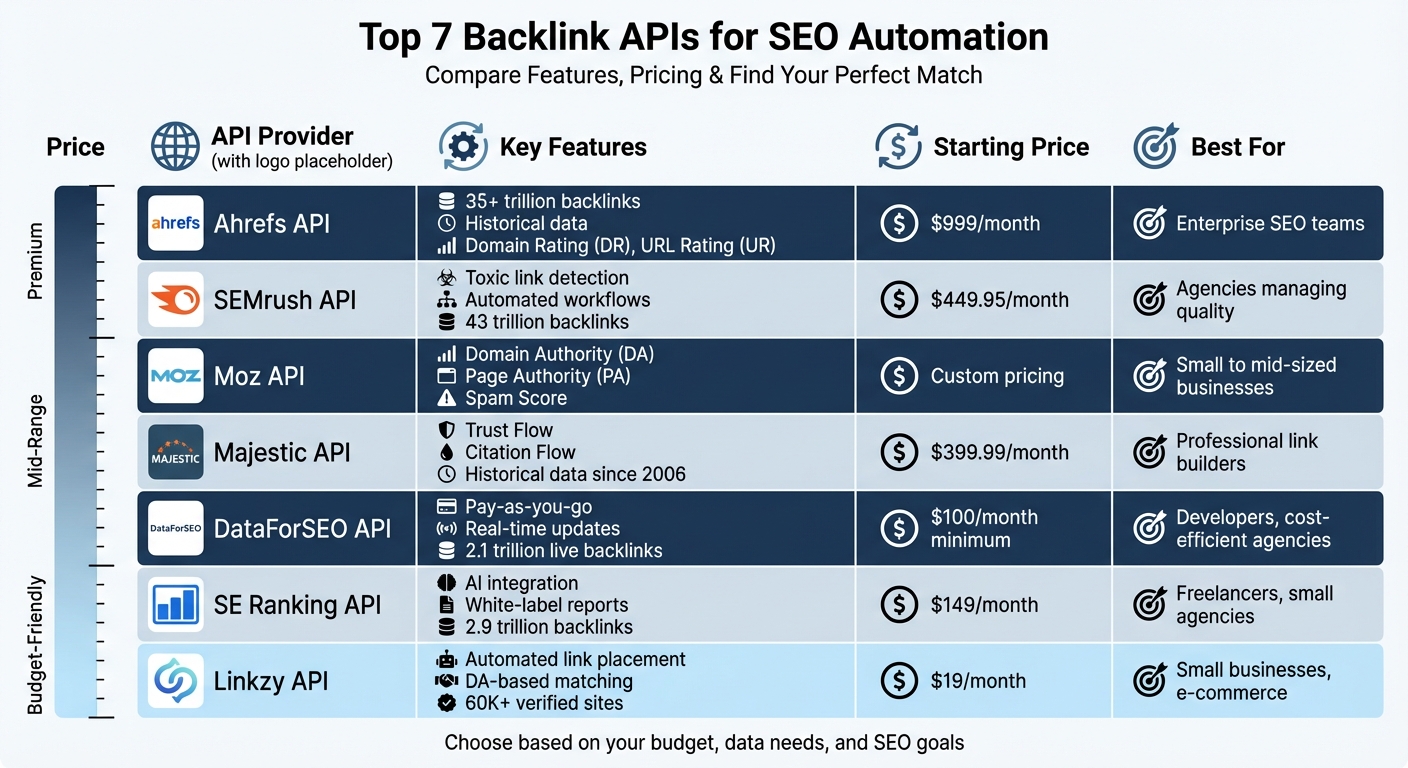
Top 7 Backlink APIs Comparison: Features, Pricing & Best Use Cases
1. Ahrefs API
Backlink Data Depth and Quality
The Ahrefs API v3 taps into one of the largest backlink databases available, boasting over 35 trillion historical external backlinks, covering 345.2 billion pages and 210 million domains [1][5]. This database is divided into three unique indices:
- Live Index: Tracks current links.
- Recent Index: Focuses on links that were active or lost in the last 3–4 months.
- Historical Index: Archives every backlink recorded since May 2016.
This structure allows users to monitor real-time changes while also studying long-term trends [5]. The API also categorizes links into eight types (text, image, redirect, frame, form, canonical, alternate, and RSS) and provides proprietary metrics like Domain Rating (DR) and URL Rating (UR) [1][5]. Updates occur partially every 15 minutes, with a full refresh approximately every two months, ensuring the data remains current [5].
Pricing Model and Affordability
Ahrefs positions itself as an enterprise-level tool with a pricing model to match. The Enterprise plan starts at $999 per month, providing 2 million API units. Pricing operates on a "units" system: each request begins at 50 units, with additional units charged per field per row (some metrics cost 5–10 units). For example, retrieving 1,000 rows of backlink data costs about $5.00 [5].
Standalone API subscriptions begin at $500 per month, offering access to 500,000 rows, with overage fees at $1.00 per 1,000 rows. For larger teams, the bundled Enterprise plan at $1,499 (which includes unlimited users and integrated API access) might be a more economical choice compared to purchasing multiple Advanced seats at $449 each [6].
Automation and Integration Capabilities
The API v3 supports OAuth 2.0 authentication, ensuring secure integrations for enterprise applications. Ahrefs also offers the "Ahrefs Connect" program, simplifying the process of integrating its data into third-party tools without requiring custom development [1]. For AI-powered workflows, the Ahrefs Model Context Protocol (MCP) connects directly with AI tools, enabling real-time SEO insights for tasks like automated link prospecting or competitive analysis.
Rate limits are capped at 60 requests per minute across all plans [6]. Advanced plan users and above can benefit from features like a native Looker Studio Connector, which automates reporting from tools like Site Explorer and Site Audit. Additionally, querying in "subdomains" mode provides a complete link profile for root domains, while the Historical Index supports detailed trend analysis [5].
These features make the API highly adaptable for a range of SEO tasks.
Best Use Cases for SEO Workflows
With its granular data and frequent updates, the Ahrefs API is especially suited for large-scale backlink audits and competitive research. Its ability to handle diverse link types - like frames, forms, and canonicals - makes it a valuable tool for technical SEO teams managing complex site structures [5].
However, successful use requires technical know-how and careful management of resources due to the strict rate limits [1]. Enterprise users enjoy priority support, including help with technical implementation and direct access to the API engineering team. Developers can also leverage the extensive historical archive, dating back to May 2016, for in-depth trend analysis [1][5].
sbb-itb-0f47b19
2. SEMrush API
Backlink Data Depth and Quality
SEMrush API boasts an extensive database, with 43 trillion backlinks and 1.6 billion referring domains [5]. Its bot crawls a staggering 25 billion links daily, with updates happening hourly and a full refresh every 2–3 days [1]. The tool uses a proprietary Authority Score (ranging from 0 to 100) that evaluates link strength, organic traffic, and spam risks [5]. For those tracking recent activity, the "Fresh Index" highlights backlinks spotted within the last six months. However, the API lacks an "active" filter, which can make isolating live links more challenging [5].
Pricing Model and Affordability
To access the SEMrush API, you’ll need a Business plan, which costs $449.95 per month [1]. The API employs a units-based pricing model, where costs vary depending on the type of report. Basic units are priced at around $20 per 1 million units, while advanced units cost $250 per 1 million units [1]. For example, pulling 1,000 backlinks will set you back roughly $2.00 [5]. While the pricing may seem steep, it supports seamless integration into advanced workflows.
Automation and Integration Capabilities
The SEMrush API is designed with integration in mind, offering two versions to suit different needs. Version 3 uses API keys and delivers data in CSV format, while the more advanced Version 4 employs OAuth 2.0 and returns JSON [1]. While Version 3 remains stable, Version 4 is continually updated with new features. The API can handle up to 200 simultaneous competitor comparisons, and its "Comparison by referring domains" endpoint is perfect for link gap analysis. Additionally, SEMrush’s MCP server enables backlink metrics to integrate directly into AI tools like ChatGPT, Claude, and Gemini, making it easier to automate SEO strategies.
Best Use Cases for SEO Workflows
SEMrush API shines in areas like competitor benchmarking and link gap analysis, helping teams pinpoint domains with similar backlink profiles and uncover new link-building opportunities. Its geographic and top-level domain analysis provides insights into region-specific link authority. Plus, features like real-time backlink discovery and toxicity monitoring ensure healthier link profiles across multiple websites. With these capabilities, SEMrush streamlines SEO workflows and supports automated strategies for better results.
3. Moz API
Backlink Data Depth and Quality
Moz API provides access to a well-established backlink database, with new links added daily to ensure up-to-date information [7]. It offers essential metrics like Domain Authority (DA) and Page Authority (PA), along with advanced tools such as Spam Score for identifying harmful backlinks and Brand Authority™ to gauge brand strength online. Built on a JSON-RPC 2.0 framework, the API delivers structured data, making it easier to integrate into custom workflows. This system is paired with a pricing model designed to accommodate businesses of all sizes.
Pricing Model and Affordability
Moz offers flexible pricing tiers to suit a range of users, from individuals to large enterprises. The Free plan includes 50 rows per month, while the Starter tier costs between $20 and $75 monthly, providing up to 15,000 rows. For growing businesses, the Growth plan (priced at $125 to $500 per month) offers up to 500,000 rows. Larger-scale operations can opt for the Advanced plan at $2,000 per month for 4 million rows or the Enterprise tier, which costs $10,000 monthly and supports up to 40 million rows.
Automation and Integration Capabilities
Moz API enhances efficiency by supporting bulk operations, making tasks like monitoring and planning much easier. The URL Metrics endpoint retrieves DA, PA, and Spam Score for multiple URLs simultaneously, while Link Status and Final Redirect methods help automate link health checks during site migrations and track campaign performance. Additionally, Moz's search intent algorithm categorizes keywords into groups - informational, navigational, commercial, or transactional - helping teams streamline content planning when integrated into automated systems.
Best Use Cases for SEO Workflows
Moz API is particularly effective for Domain Authority benchmarking, making it a great tool for evaluating large numbers of websites, such as premium-aged domains. Link intersect operations reveal shared backlink sources among competitors, creating new opportunities for outreach that would otherwise require manual effort. Content teams rely on metrics like Spam Score and keyword data to refine content strategies and perform detailed audits. Meanwhile, PR teams use Brand Authority™ tracking to assess campaign performance and compare their results with competitors.
4. Majestic API
Backlink Data Depth and Quality
Majestic API is a standout tool for backlink analysis, boasting a massive historical database that dates back to June 2006. It operates with two indexes: the Fresh Index, which covers recent data from November 2025 through March 2026 and includes over 250 billion unique URLs, and the Historic Index, which spans data from 2006 and contains about 4.5 trillion unique URLs. This dual-index system allows users to examine both current backlink profiles and long-term trends, offering a broad and detailed view of link activity.
The API provides over 20 metrics, including Majestic's signature Trust Flow and Citation Flow scores. These metrics are crucial for assessing link quality by measuring the trustworthiness of linking domains and the overall influence of backlink profiles. With real-time updates, users can rely on the most current data available, making Majestic a robust choice for in-depth backlink analysis.
Pricing Model and Affordability
Majestic’s pricing reflects the depth and precision of its data. The API tier is priced at $399.99 per month (or $3,999.90 annually), giving access to 100 million units. For users needing more, the API L tier costs $799.99 per month (or $7,999.90 annually) and offers 300 million units, while the API XL tier provides a hefty 1 billion units for $1,599.99 per month ($15,999.90 annually). Unit consumption varies depending on the command: basic domain stats use Index Item Units, while retrieving detailed backlink data can cost between 5,000 and 20,000 units, depending on the domain's size.
Automation and Integration Capabilities
The Majestic API supports a range of automation workflows with specialized commands. For detailed backlink data on large domains, the GetBackLinkData command is essential. The GetNewLostBackLinks command, costing 500 units per day, helps track link-building progress over time. For exporting large datasets - more than 50,000 links - the DownloadBackLinks command processes data asynchronously at 25,000 units. Additionally, the GetTopics endpoint identifies the topical influence of backlinks for 1,000 units, providing valuable insights into thematic relevance for content strategies.
Best Use Cases for SEO Workflows
Majestic is particularly effective for historical backlink analysis, making it a go-to tool for uncovering long-term link-building trends and recovering lost link data. Its Flow Metrics offer a fresh perspective on link quality, while commands like GetAnchorText (1,000 units) enable teams to analyze anchor text distribution across backlink profiles. For large-scale tasks, such as assessing portfolios of websites or identifying link prospects, the GetIndexItemInfo command streamlines bulk domain evaluations, making Majestic a powerful resource for SEO professionals managing extensive campaigns.
Build backlinks with AI: DataForSEO + CustomGPT [the cheapest setup]
5. DataForSEO API
DataForSEO offers a powerful backlink API designed for real-time data updates, enabling users to take immediate SEO actions with precision.
Backlink Data Depth and Quality
The DataForSEO API features a live index that updates every second, ensuring that newly discovered backlinks are accessible right away. The database boasts an impressive 2.1 trillion live backlinks and 234 billion live pages, with its crawler processing roughly 20 billion backlinks and over 1 billion pages daily. For context, in just 24 hours, over 16 billion backlinks were processed.
The API also provides proprietary quality metrics like Domain Rank, Page Rank, and Backlink Rank, inspired by Google's original PageRank algorithm. To detect spam, it includes a Spam Score (ranging from 0–100%), calculated using 18 different signals such as link ratios and domain name length. Additionally, users can access historical backlink data going back to 2019, making it easier to analyze long-term trends. The system also tracks various link attributes, including anchors, redirects, images, canonicals, and meta-refreshes, offering a comprehensive view of link diversity.
Pricing Model and Affordability
DataForSEO operates on a pay-as-you-go model with a $100 minimum monthly commitment, which applies across all their APIs. Each API call costs $0.02, plus $0.00003 per data row. For instance, retrieving 1,000 backlink rows would cost approximately $0.05 ($0.02 for the request plus $0.03 for the data). Filtering and sorting rules are included at no additional cost, making it easier to manage large datasets efficiently. For users integrating the API through platforms like Make.com or Google Sheets API Connector, the $100 monthly minimum is waived.
Automation and Integration Capabilities
With support for up to 2,000 API calls per minute and 30 simultaneous requests, this API is ideal for enterprise-level automation. Its "Live" retrieval method delivers results instantly in a single request, eliminating the need for separate POST and GET calls. Bulk endpoints allow users to retrieve metrics for up to 1,000 targets in one call, reducing costs and speeding up processing. The average response time for a Backlinks API request is just 2 seconds.
For no-code integrations, DataForSEO provides connectors for tools like Google Sheets, Make.com, n8n, Airtable, and Zapier. Additionally, its AI assistant, "Sofia," helps developers by offering API recommendations, development roadmaps, and tool analyses. Users can test these features in the DataForSEO Sandbox before moving to production, ensuring seamless integration into various workflows.
Best Use Cases for SEO Workflows
This API is a game-changer for automating traditionally manual SEO tasks. It excels in audits that analyze historical performance, anchor text distribution, and referring networks. The "Link Gap" analysis feature identifies domains linking to competitors but not to your site, while "Domain Intersection" and "Page Intersection" reports provide further insights into competitor strategies. For automated reporting, agencies can instantly generate detailed backlink audits using the Live retrieval mode.
Developers can leverage the API to create custom SEO tools, such as backlink checkers or proprietary "Keyword Difficulty" calculators. The "New & Lost Timeseries" endpoint is particularly useful for tracking the effects of link-building campaigns or identifying sudden drops in backlinks. With options to target whole domains, subdomains, specific URLs, or even directory paths, users can fine-tune their analyses to meet specific needs with precision.
6. SE Ranking API
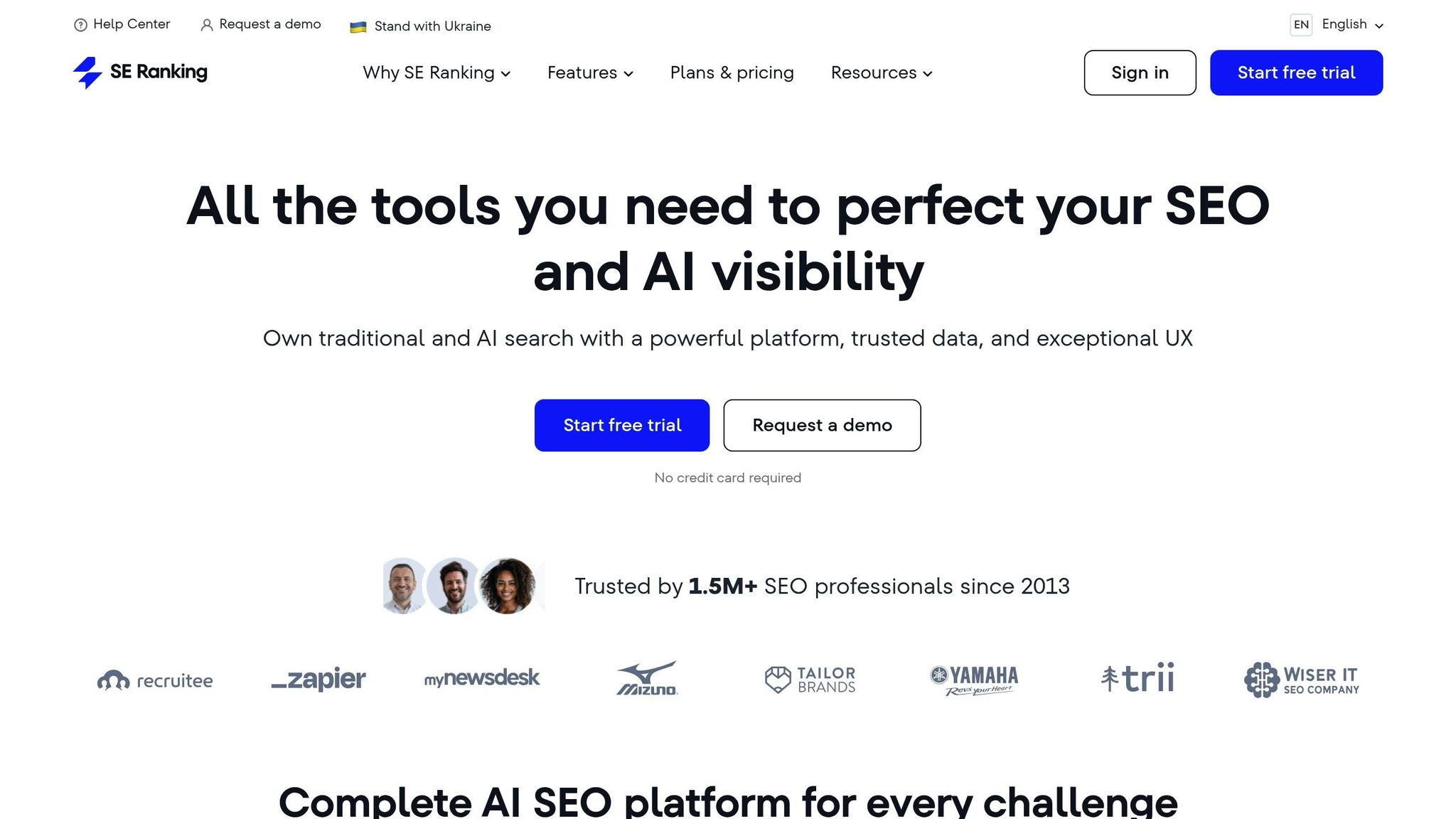
SE Ranking provides a backlink API tailored for agencies and mid-sized teams that need enterprise-level data. With a massive database of over 2.9 trillion backlinks and 420 million indexed domains, their crawler processes an impressive 6 billion pages daily to ensure the data remains up-to-date and actionable. Here's a closer look at its metrics, pricing, integration options, and how it fits into SEO workflows.
Backlink Data Depth and Quality
The API delivers backlink insights through 15+ key metrics, including two proprietary authority scores: InLink Rank (page-level authority) and Domain InLink Rank (domain-level authority). Both use a 0–100 scale, where higher scores (50–100) indicate strong authority, while lower scores (0–30) suggest newer or less authoritative domains. To maintain accuracy, 58% of the backlink index is refreshed every 90 days.
The data also includes granular details like anchor text, TLDs (e.g., .edu, .gov), link types (text or image), and attributes (dofollow or nofollow). These filtering options allow for precise analysis, making it easier to focus on the most relevant backlinks.
Pricing Model and Affordability
SE Ranking offers a straightforward credit-based pricing system. The Standard API plan costs $149 per month for 1 million credits, while the Professional API plan is $318 per month (billed annually).
The credit usage is simple:
- 100 credits per target for backlink summaries and metrics
- 10 credits per target for total backlink counts
- 1 credit per backlink for detailed backlink lists
A 14-day free trial includes 100,000 API credits, allowing users to explore the platform before committing. Adam Heitzman, Co-Founder and Managing Partner at HigherVisibility, shared his perspective:
We selected SE Ranking's API because it offered a full-featured suite of products... It has cost-effective pricing with flexible usage models and allows us to extract only the data we need without excess clutter.
Automation and Integration Capabilities
The API is designed for efficiency, supporting 10 requests per second per key and batch processing for up to 100 domains per summary request. For large-scale data pulls, cursor-based pagination streams up to 100,000 backlinks per call, while the asynchronous export endpoint generates compressed CSV files to handle millions of backlinks without hitting rate limits.
Integration options include no-code connections to tools like Looker Studio, Make, and n8n, as well as the Model Context Protocol (MCP), which links SEO data to AI assistants like ChatGPT, Claude, and Gemini. This enables real-time insights directly within conversational interfaces. Thomas Nething, Director of Business Innovation at hurra.com, highlighted the value:
SE Ranking's tools - and especially the API - are an integral part of our daily workflow. They not only provide us with accurate data for SEO analysis but also enable a deeper integration of SEO and SEA insights.
Best Use Cases for SEO Workflows
The API is particularly effective for several SEO tasks:
- Competitor backlink gap analysis: Compare clients' referring domains with competitors to identify opportunities for targeted outreach.
- Affiliate compliance monitoring: Automate daily checks to flag problematic IPs, low-authority domains, or suspicious anchor texts that might lead to penalties.
- PR and SEO ROI reporting: Match live backlink data with campaign tags to demonstrate which high-authority links resulted from specific outreach efforts.
- Link reclamation strategies: Use historical data to pinpoint why links were lost - whether due to page errors, link removals, or redirects - and take targeted action to recover them.
With its robust features and seamless integration options, SE Ranking's API is a powerful tool for streamlining SEO workflows and delivering actionable insights.
7. Linkzy API
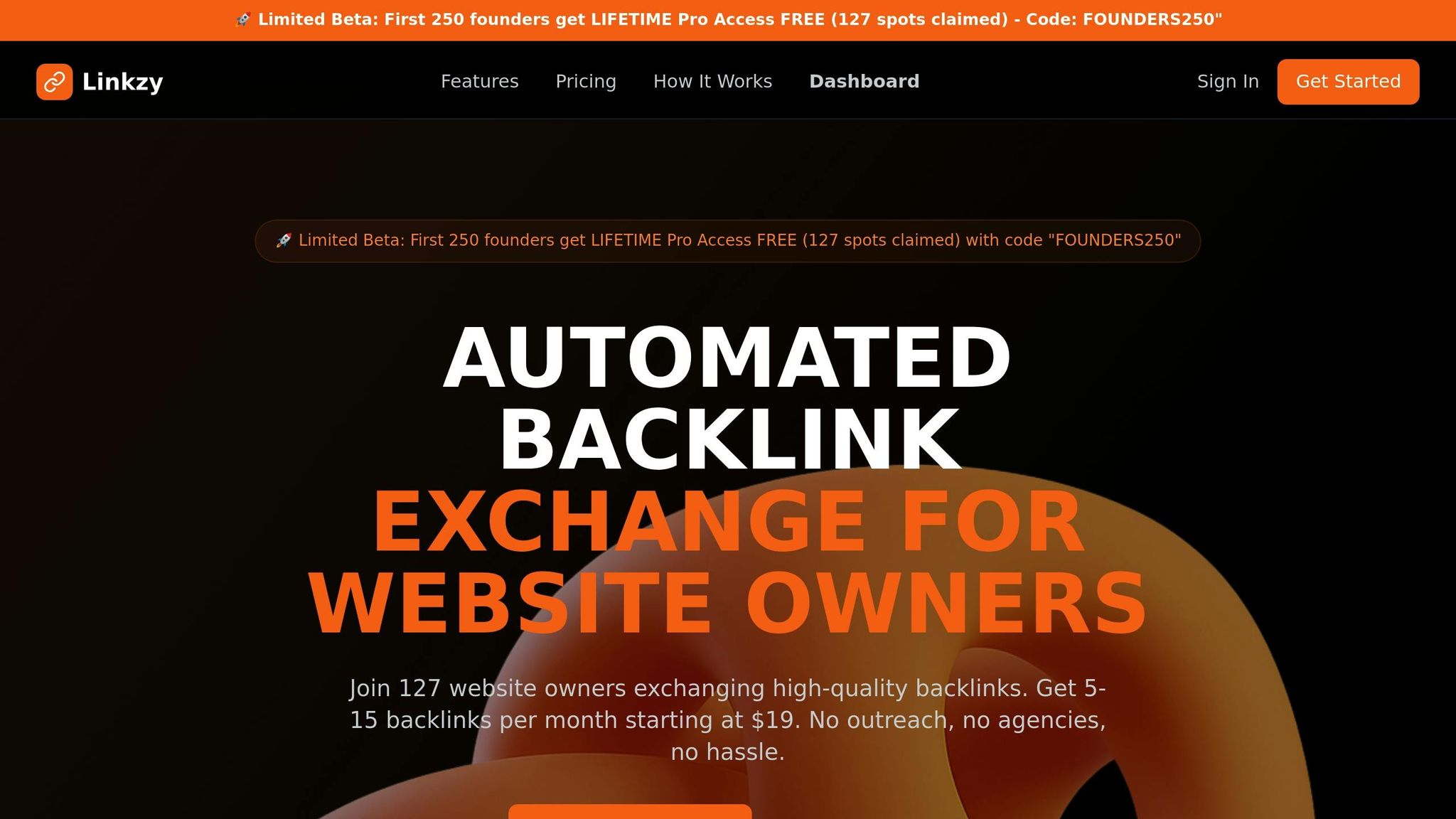
Linkzy streamlines backlink automation by focusing on exchange-based link building rather than manual outreach. With access to a network of over 60,000 verified sites, the platform automates the placement of contextual backlinks on blogs that match your niche. Forget the hassle of cold emailing or hiring expensive agencies - Linkzy makes setup quick and easy. You can get started in under 30 seconds using an API key, WordPress plugin, or sitemap connection.
What makes Linkzy stand out is its intelligent tier system. This system uses a Domain Authority (DA) matching algorithm to ensure link exchanges happen between sites of similar authority. Here's how it works:
- Starter Tier: For sites with DA 0–29.
- Standard Tier: For sites with DA 30–59.
- Premium Tier: For sites with DA 60+.
Every link placement is carefully vetted for factors like Domain Rating, organic traffic, and spam scores, ensuring quality remains high. So far, Linkzy has successfully placed 2,847 links with a 94% success rate. Users have reported an average traffic increase of 24% after implementing the platform's services [8].
One success story comes from an e-commerce fashion retailer that used Linkzy for eight months, ending in May 2024. They secured 45 high-quality backlinks, leading to a 200% boost in organic revenue and first-page rankings for 23 keywords. This effort generated an additional $1.2 million in revenue [9]. Kim, the Marketing Director at Simply, shared her experience:
"Linkzy delivered exceptional results. Our organic traffic increased by 180% in just six months, and we're now ranking on page one for our most competitive keywords."
Linkzy doesn’t just deliver results - it also keeps things simple. Pricing starts at $19 per month for 5 backlinks on the Starter plan, while the Pro plan offers 15 backlinks for $29 per month. There's even a free tier that provides 3 backlinks upon signup, no credit card required. The platform’s API ensures a natural link velocity of 5 to 15 backlinks per month, imitating organic growth to avoid penalties from search engines. This steady approach supports long-term SEO success.
Linkzy is compatible with all website platforms, including WordPress, Shopify, Wix, and custom builds. It also offers REST API responses in JSON format, making it easy to integrate into your current SEO workflows.
Comparison Table
Automated backlink management requires tools that combine extensive data access with pricing that fits the budget. Below is a summary of the key features, pricing, and ideal use cases for the APIs discussed earlier.
| API Provider | Main Strengths | Starting Price | Recommended Use Case |
|---|---|---|---|
| Ahrefs API | Largest link database with 30+ trillion backlinks; advanced filtering and historical data; Domain Rating (DR) and URL Rating (UR) metrics [3] | $999/month | Enterprise SEO teams needing comprehensive competitor research and historical analysis |
| SEMrush API | Toxic link identification; automated outreach workflows; integration with a full SEO suite [3] | $449.95/month + $20–$250 per 1M units | Agencies managing link quality and prospecting campaigns |
| Moz API | Proprietary Domain Authority (DA) and Page Authority (PA); Spam Score (0–100 scale) for link health assessment [3] | Custom quote | Small to mid-sized businesses focused on brand monitoring and link quality auditing |
| Majestic API | Trust Flow and Citation Flow metrics; "Fresh Index" for distinguishing live versus dead links [3] | $399.99/month | Professional link builders requiring deep credibility analysis and extensive historical data |
| DataForSEO API | Pay-as-you-go model; 2-second real-time data turnaround; Link Intersection analysis [4] | $100/month minimum | Developers building custom SEO tools or agencies needing cost-efficient, high-volume data |
| SE Ranking API | White-label reports; AI agent integration (ChatGPT); 1 million backlink credits [10] | $149/month | Freelancers and growing agencies seeking affordable, user-friendly automation |
| Linkzy API | Automated backlink placement; DA-based tier matching; natural link velocity (5–15 links/month) | $19/month | Small businesses and e-commerce sites wanting hands-off, automated link building |
DataForSEO stands out for its pay-as-you-go pricing and quick, real-time data access, making it a smart choice for developers or agencies needing flexible, high-volume integration. On the other hand, SE Ranking offers a budget-friendly solution for smaller agencies, priced at $149/month, which is far more accessible compared to Majestic’s $399.99/month.
For larger enterprises requiring in-depth data and analysis, APIs like Ahrefs or SEMrush are ideal. However, if your focus is on acquiring backlinks rather than just analyzing them, Linkzy provides a hands-off approach by automating link building through its network of real user websites. This makes it a practical option for small businesses or e-commerce sites aiming to grow their online presence without heavy involvement.
Conclusion
Backlink APIs take the hassle out of manual data collection and provide real-time, scalable SEO insights. The best API for you will depend on your specific goals. For example, enterprise teams diving deep into competitor analysis might benefit from Ahrefs' extensive link database, which boasts over 35 trillion live links [11]. On the other hand, smaller teams or operations might prefer budget-friendly options like SE Ranking, which align better with their needs and scale.
When choosing an API, consider key factors like data freshness, unique metrics (such as Majestic's Trust Flow or Moz's Spam Score), and any rate limits. It’s also a good idea to review the API documentation to ensure it’s compatible with your existing tools and workflows [2].
If your goal shifts from analyzing backlinks to building them, you might want to explore tools like Linkzy. This service automates backlink building by placing 5–15 contextual links each month on niche-relevant websites, starting at just $19/month. It’s a hands-off solution for businesses looking to expand their backlink profile without the hassle of managing outreach campaigns.
FAQs
Which backlink API fits my budget and goals?
When choosing the best backlink API, it all comes down to what you need. Are you after real-time data and detailed metrics? Then focus on APIs with flexible rate limits and up-to-date information. If your priority is historical insights and large-scale data, look for options that provide access to extensive backlink databases.
Also, keep your budget in mind. Features like data volume, freshness, and how easily the API integrates with your tools should align with your goals to ensure you're making the right choice.
How do I estimate API costs for my backlink reports?
To figure out API costs for backlink reports, start by looking at the pricing models offered. These could include pay-as-you-go rates (like $0.02 per request or $0.00003 per data row) or monthly plans (such as $75 for 7,500 credits). Once you know your expected usage, multiply it by the applicable rate to get a clear idea of your total expenses. Be sure to review the provider's pricing details carefully to ensure your calculations are accurate.
What rate limits should I plan for in automation?
Rate limits for backlink APIs can vary, typically ranging from 3,000 to 10,000 API requests per day, depending on the provider. For instance, some services cap usage at 3,000 requests daily, while others extend it to 10,000. It's crucial to review the documentation of the specific API you're using to understand its limits and tailor your automation processes to stay within those boundaries.